
Red-footed falcon
Falco vespertinus
Description
How to identify
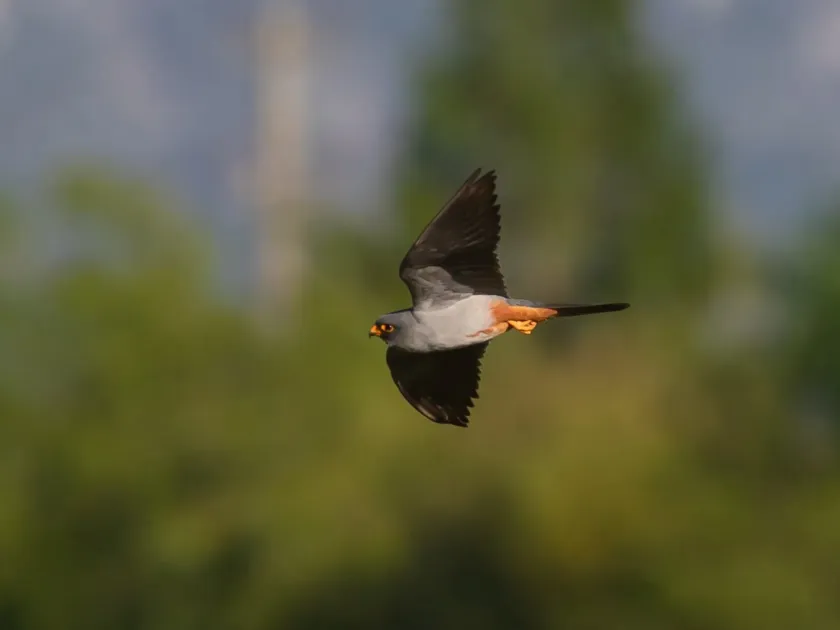
The Red-footed falcon is a small raptor known for its distinct appearance and behavior. Adult males are almost entirely slate-grey, while females and juveniles have a more variegated plumage with brownish tones and streaks on their underparts.
A signature characteristic of the species is the vivid red color of the eye ring, cere, and legs. These bright features are easily visible when the birds are perched on power lines or during their agile flight.
Systematically, this bird belongs to the order Falconiformes and the family Falconidae. It is a migratory species that thrives in open landscapes, forest-steppes, and agricultural mosaic habitats.
These falcons are often social, nesting in colonies within the abandoned nests of rooks or crows. Their communal nesting habits make them a prominent and beneficial feature of the rural landscape during the breeding season.
The species is well-adapted for catching prey in open fields, often hovering in the air with fast wingbeats before swooping down on large insects or small mammals.
What it damages
The Red-footed falcon is not a crop pest. On the contrary, it is highly valued by agronomists and farmers as an efficient biological control agent that consumes large quantities of harmful insects.
Its diet consists primarily of large insects such as grasshoppers, crickets, and beetles. By consuming these herbivores, the falcons help prevent outbreaks of pests that would otherwise damage crops and pasture lands.
The birds cause no physical damage to plants, seeds, or agricultural produce. There is no economic reason to view this species as a threat to yield; rather, it actively contributes to the health of the agro-ecosystem.
During massive locust or grasshopper outbreaks, these falcons can gather in large flocks, serving as a natural defense force that protects grain crops and meadows from devastation.
Categorizing the Red-footed falcon as a pest is factually incorrect. Promoting its presence in agricultural environments is an excellent strategy for reducing reliance on chemical pest management.
When it appears
The presence of the Red-footed falcon in its breeding range is seasonal, as it is a long-distance migrant. They typically arrive at their breeding grounds from late April to early May, depending on local climate conditions.
The birds are most active during the summer months, specifically June and July, when they are busy hunting for food to support their growing broods. This period overlaps with the peak activity of many agricultural insect pests.
By late August, the falcons gather in larger flocks, preparing for their migration. They remain active in the fields during this time, taking advantage of the abundance of insect life in post-harvest stubble.
The southward migration begins in September, and the species vacates the area entirely to spend the winter in more southern latitudes. Consequently, their benefits are restricted to the growing season.
Effective agricultural management should consider this seasonal cycle when evaluating the natural biological pressure exerted on local pest populations.
Control measures
There are no pest control measures required for the Red-footed falcon, as it is a beneficial and often legally protected species. Efforts should focus on protection rather than management.
To support these birds, farmers should preserve nesting sites, particularly trees used by rooks and crows, as the falcons rely on these existing structures for their own breeding success.
Avoiding the broad-spectrum use of insecticides is crucial. Pesticide misuse can lead to secondary poisoning of the falcons and drastically reduce their natural food supply, leading to long-term ecological imbalance.
Promoting integrated pest management (IPM) ensures that natural predators like the Red-footed falcon can play a key role in maintaining crop stability and reducing the need for toxic inputs.
- Preserve nesting trees and existing rookeries.
- Reduce reliance on synthetic chemical insecticides.
- Foster biodiversity within agricultural field margins.
- Educate agricultural workers on the value of predatory birds.
Taxonomy
- Latin name
- Falco vespertinus
- Family
- Falconidae
- EPPO code
- FALCVE
Discussion
No discussions yet — be the first.