
Peregrine Falcon
Falco peregrinus
Description
How to identify
The Peregrine Falcon (Falco peregrinus) is a powerful bird of prey belonging to the Falconidae family, known for its exceptional aerial speed.
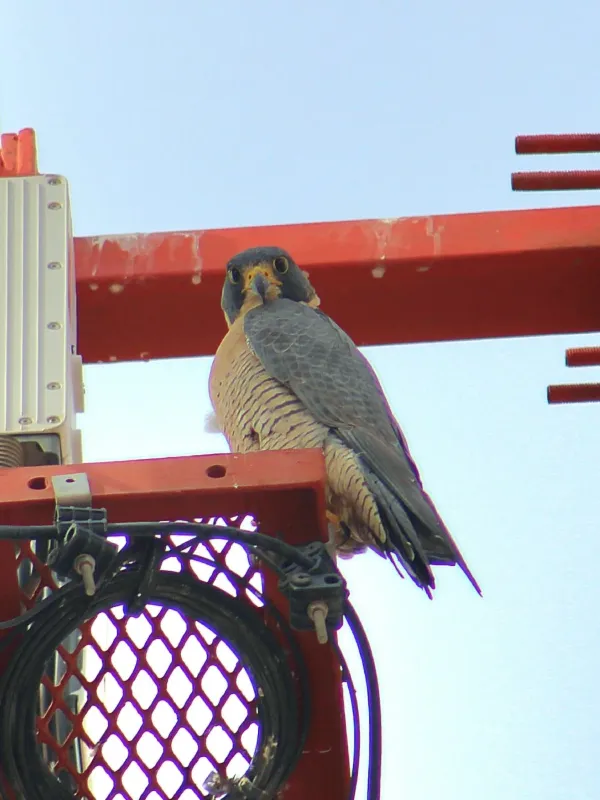
Physically, it is characterized by a dark grey back, barred white underparts, and a distinct black facial mark resembling a helmet.
These birds are master hunters, capable of reaching speeds exceeding 300 km/h during high-speed dives, known as stoops, to catch prey in mid-air.
Females are typically larger than males, a trait common among raptors, allowing them to hunt a wider variety of bird species.
In agricultural settings, they often utilize vantage points like tall trees, silos, or transmission towers to monitor fields for potential prey.
What it damages
The Peregrine Falcon is not a crop pest; it does not consume seeds, vegetables, or any parts of agricultural produce, leaving crops entirely untouched.
Its presence in agricultural landscapes is generally beneficial as it acts as a natural biological control agent against grain-eating birds.
In rare instances, they may target domestic poultry if proper protection measures, such as overhead netting, are not implemented by farmers.
Overall, they contribute to the ecosystem balance by keeping populations of small birds that might feed on grain crops under natural control.
Agricultural damage caused by the falcon is zero, as its behavioral biology is strictly centered on hunting other avian species for sustenance.
When it appears
Activity within agricultural zones typically peaks during the breeding and rearing season, spanning from early spring to late summer.
Springtime sees the birds focused on nesting sites, often resulting in localized hunting patterns near their chosen high-ground habitats.
During the summer, fledglings learn to hunt, which often leads to more frequent sightings of young falcons patrolling open field edges.
Autumn migration patterns might bring transients into the area, though these falcons do not typically settle long-term in specific fields.
Winter months generally show a decrease in activity in temperate regions as most populations follow migratory routes to warmer climates.
Signs of infestation
Pluck sites, where feathers and bones are found concentrated in one area, are the primary sign of recent Peregrine Falcon hunting activity.
A sudden, distinct change in the behavior of smaller birds in the vicinity, such as mass flushing or hiding, often indicates a falcon's presence.
White droppings (mutes) on high, exposed structures are a tell-tale sign that a specific location is being used as a regular perch or resting spot.
The high-pitched, piercing call of the falcon is frequently heard before it engages in a hunting stoop, signaling its movement across the field.
The absence of typical bird pest activity in a specific area is a subtle but positive indicator that a raptor is patrolling the territory.
Control measures
The Peregrine Falcon is a protected species under international law, and all direct control measures are prohibited to ensure population stability.
Farmers can prevent issues with domestic poultry by installing protective mesh or wire netting over outdoor pens to prevent aerial access.
Visual deterrents such as reflective tapes or kite decoys can be used sparingly around critical infrastructure if falcon presence becomes a disturbance.
Avoiding the use of chemical pesticides that could bioaccumulate in prey is essential, as these can lead to secondary poisoning of the falcon.
Promoting the falcon's presence serves as an eco-friendly way to manage pest bird populations naturally without relying solely on chemical treatments.
Taxonomy
- Latin name
- Falco peregrinus
- Family
- Falconidae
- EPPO code
- FALPCE
Discussion
No discussions yet — be the first.