
Pine needle miner
Exoteleia pinifoliella
Description
How to identify
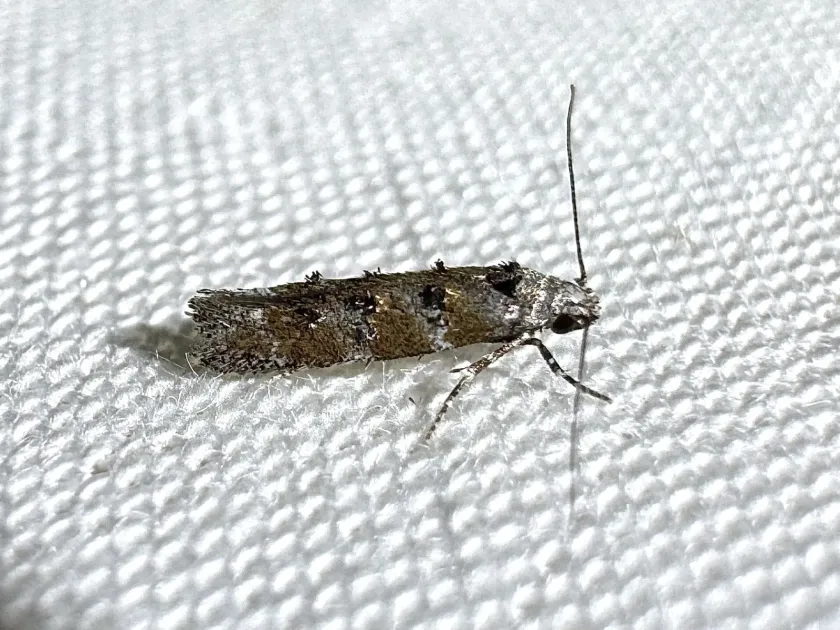
The Pine needle miner (Exoteleia pinifoliella) is a small moth belonging to the family Gelechiidae. Adult moths are quite inconspicuous, with a wingspan of only about 8–10 mm.
Their wings are typically brownish with lighter transversal bands, which provides excellent camouflage against the bark and needles of the host pine trees.
The larvae are yellowish-green in color with a dark head capsule, growing up to 5–6 mm in length. They are specialized feeders that reside entirely within the needles.
Eggs are minute and oval-shaped, laid individually by females on young pine needles during the late spring and early summer flight period.
The pupal stage occurs inside the mined needle or within a loose silk cocoon spun by the larva near the exit hole before it transitions into an adult moth.
What it damages
The primary hosts of this pest are various pine species, including Scots pine, Banks pine, and mountain pine. The larvae cause the damage by feeding on the internal tissues.
Young pine plantations, seedlings in nurseries, and saplings are most vulnerable, as even minor needle damage can impact their structural growth and development.
As the larvae mine the needles, they destroy the photosynthetic tissue, causing the needles to lose their functionality and eventually turn brown and wither.
Severe infestations can lead to significant defoliation, giving the tree an unhealthy, sparse appearance and potentially reducing the tree's overall vigor.
In forest management, high populations of this miner can cause stress to the trees, making them more susceptible to secondary pests and various fungal diseases.
When it appears
Adult moths typically emerge in late May and June, coinciding with the development of new needles which are preferred for egg-laying.
Larval emergence occurs throughout the summer. Upon hatching, the larvae quickly bore into the needle, sealing the entry point and beginning their internal development.
Throughout the summer and autumn, the larvae feed inside the needle, creating long tunnels (mines) as they consume the parenchyma from the tip towards the base.
The larvae overwinter inside these needles. They remain protected within the dead needle casing on the tree branches throughout the winter months.
With the return of warmer spring temperatures, the larvae resume feeding for a short period, pupate within the needle, and emerge as adults to restart the cycle.
Signs of infestation
The earliest symptom is the appearance of yellow or chlorotic spots on the needles, which eventually expand and turn reddish-brown as the mine progresses.
Upon closer inspection, a tiny entry hole can be found, often marked by a small drop of resin that the pine tree exudes as a defensive mechanism.
The needles eventually become completely brown and dry, looking hollowed out when inspected longitudinally or squeezed between the fingers.
Discolored needles may fall prematurely, leading to a thinner crown density that becomes particularly noticeable in the upper parts of the tree canopy.
- Browning of needle tips.
- Presence of visible mining tunnels when needles are split open.
- Increased needle drop during windy conditions.
Control measures
Effective chemical control requires applying contact insecticides just as the larvae are hatching and beginning to bore into the needles.
Systemic insecticides are often more effective, as they are translocated into the needle tissue, killing the larvae even after they have become sheltered within the mines.
Sanitation practices, such as removing and destroying heavily infested branches during the dormant season, can help reduce the population for the following year.
Maintaining optimal tree health through proper fertilization and irrigation helps the trees withstand the damage caused by the larvae during high-infestation years.
Monitoring adult populations with pheromone traps allows foresters to time chemical applications precisely, maximizing effectiveness while minimizing environmental impact.
Taxonomy
- Latin name
- Exoteleia pinifoliella
- Order
- Lepidoptera (butterflies)
- Family
- Gelechiidae
- EPPO code
- EXOTPI
Discussion
No discussions yet — be the first.