
Pine needle miner
Exoteleia nepheos
Description
How to identify
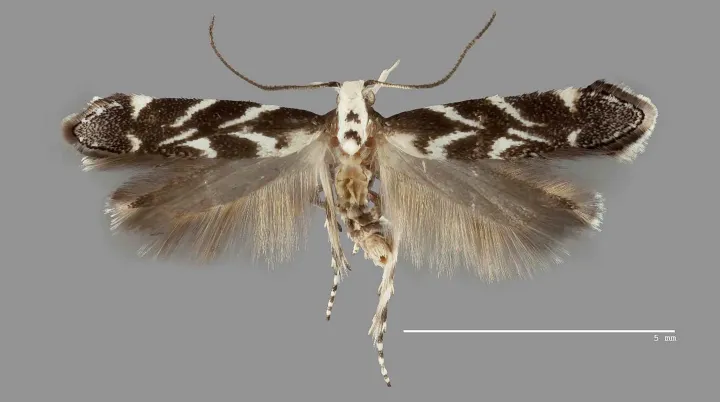
Exoteleia nepheos, commonly known as the pine needle miner, is a moth species within the family Gelechiidae. It is a specialized pest that specifically targets various species of pine trees during its larval stage.
The adult moth is relatively small and characterized by a brownish-grey wing pattern that provides excellent camouflage against pine bark, making it difficult to spot in nature.
The life cycle involves four distinct stages: egg, larva, pupa, and adult. The larval stage is the most critical for agricultural management, as the caterpillars spend most of their existence hidden within pine needles.
Taxonomically, the species is closely related to other gelechiid moths, requiring careful microscopic analysis of wing venation and genitalia for precise diagnostic identification in the field.
The species has developed significant biological adaptations to survive harsh winters, often overwintering as larvae inside the needles they have mined, protected by silk webs.
What it damages
The pine needle miner infests pine trees by boring into the needles, where the larvae consume the internal mesophyll tissue, leaving the epidermal layers intact.
This feeding behavior causes the needles to wither, turn yellow or reddish-brown, and eventually drop, which significantly impacts the aesthetic and biological health of the tree.
Young pine plantations and nurseries are particularly vulnerable to infestation, as severe needle loss leads to reduced growth rates and increased susceptibility to secondary infections.
In high-density populations, the accumulation of damaged needles can stress the tree, making it susceptible to secondary pests such as bark beetles and wood-boring insects.
The cumulative damage caused by repeated infestations can lead to crown dieback, significantly weakening the structural integrity and vitality of young pine saplings.
When it appears
Adult moths typically emerge in late spring or early summer, depending on local temperature conditions and the phenology of the host pine trees.
Female moths deposit their eggs on young needles, and larvae emerge shortly after to begin the mining process, which continues throughout the summer and autumn months.
During the winter, the larvae remain dormant within the mined needles, often tying needles together with silk to secure their overwintering site against wind and predators.
As spring approaches, the larvae complete their final feeding phase and transition into the pupal stage, usually within the tunnels they have excavated.
The emergence of a new generation of adults completes the cycle, with the timing being tightly synchronized with the growth of fresh pine needles.
Signs of infestation
The most prominent sign of infestation is the yellowing of individual needles, which look hollowed out when inspected closely under magnification.
Small, inconspicuous entry holes at the base of the needles indicate where the young larvae have bored into the needle to begin their feeding activities.
Fecal pellets (frass) may accumulate inside the hollowed-out parts of the needle, which is a definitive diagnostic sign of active larval mining.
In severe cases, entire branches may appear scorched or brownish due to the high density of mines, leading to premature needle shedding across the crown.
- Discolored, hollow needles.
- Small entry points at the needle base.
- Premature needle drop in summer.
- Visible larval tunnels within the needle structure.
Control measures
Biological control using Bacillus thuringiensis sprays is highly effective, as it targets the larvae during their early feeding stages before they are fully protected within the needles.
Systemic insecticides are frequently employed in commercial nurseries to ensure that the chemical is absorbed by the plant and reaches the larvae inside the needle tissues.
Cultural control, such as the removal and destruction of infested branches or heavily damaged trees, can significantly reduce the local population density.
Pheromone traps are used for monitoring adult activity and timing the application of control measures to align with the peak emergence of the moths.
Promoting a healthy environment for natural predators, such as parasitic wasps and predatory beetles, is a sustainable long-term strategy for managing the pine needle miner.
Taxonomy
- Latin name
- Exoteleia nepheos
- Order
- Lepidoptera (butterflies)
- Family
- Gelechiidae
- EPPO code
- EXOTNE
Discussion
No discussions yet — be the first.