
Exenterus walleyi
Exenterus walleyi
Description
How to identify
Exenterus walleyi is a parasitic wasp belonging to the family Ichneumonidae, within the order Hymenoptera. These insects are critical components of forest ecosystems, acting as specialized natural enemies of certain sawfly larvae.
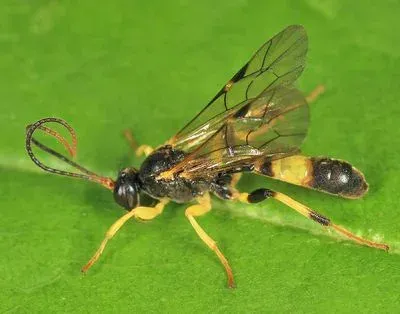
Adult wasps are characterized by slender bodies, long antennae, and transparent wings with distinct venation. They possess a mobile head and well-developed sensory organs used for tracking their hosts in dense pine canopies.
The females are equipped with a specialized ovipositor designed to penetrate the outer layer of host larvae, allowing them to place their eggs precisely for successful development.
Identifying this species in the field is challenging due to the high diversity within the Ichneumonidae family and the wasp's secretive behavior. Expert taxonomic knowledge is often required for accurate field identification.
Because these insects are not phytophagous, they do not feed on plant tissues. Their primary role in agriculture and forestry is the biological regulation of pine sawfly populations.
What it damages
Exenterus walleyi does not cause damage to plant tissues. Instead, it parasitizes larvae of specific pine sawflies, which are the organisms responsible for defoliating coniferous trees.
The impact of this wasp is generally considered beneficial. By suppressing sawfly populations, Exenterus walleyi helps maintain the health of pine forests and ornamental conifer plantations.
If chemical pesticides eliminate these wasps, the natural regulatory pressure on sawflies is lost, which can lead to rapid outbreaks of sawfly larvae that cause severe needle loss.
Thus, while they interact with coniferous hosts indirectly, their presence is an indicator of a healthy, balanced ecosystem where natural enemy pressure is present.
In managed landscapes, the goal is to protect these beneficial parasitoids rather than control them, as their contribution to pest management is significant and free of charge.
When it appears
The activity of adult Exenterus walleyi is highly synchronized with the larval development stages of its host, the pine sawfly. This typically occurs during the spring and summer months.
Adult wasps emerge and actively search for hosts during the warm season. Peak activity levels are reached when the target sawfly larvae are at the appropriate stage of development for effective parasitization.
Temperatures and daylight hours play a crucial role in regulating the wasp's life cycle. Shifts in climatic conditions can influence the timing of emergence each year.
As the season progresses toward autumn, the wasp completes its reproductive cycle, and the larvae enter a resting stage, often within the cocoons or remainders of their hosts.
Monitoring for these wasps is most effective during the early summer when they are actively flying and searching for sawfly larvae in the tree canopy.
Signs of infestation
Directly spotting Exenterus walleyi in a plantation is very difficult due to their small size and rapid movement. They usually remain in the higher levels of the tree canopy.
A primary indicator of their presence is a gradual reduction in sawfly larvae numbers in an area that has not been treated with harsh chemicals. This is a sign of natural control success.
Scientific confirmation of their activity involves analyzing sawfly cocoons for exit holes, which may indicate that a parasitoid has successfully emerged instead of the pest.
Entomologists often use specialized trapping techniques, such as malaise traps or pheromone-baited traps, to sample and identify the wasp populations within a given area.
The absence of typical sawfly damage in areas where they are historically present suggests that these parasitoids are effectively exerting population pressure on the pests.
Control measures
Management strategies for Exenterus walleyi focus on conservation. Since they are beneficial biological agents, no control measures should be applied to remove them.
To support these wasps, land managers should avoid the use of broad-spectrum insecticides, which harm natural enemies as much as the targeted pests.
Integrated Pest Management (IPM) practices recommend using selective biological agents, such as microbial sprays, to manage sawfly populations without impacting the parasitoid community.
Enhancing the surrounding habitat with nectar-rich flowering plants can help increase the longevity and fertility of adult wasps by providing essential sugar sources.
- Minimize the use of broad-spectrum synthetic pesticides.
- Promote integrated pest management practices.
- Preserve native plant diversity to support natural enemies.
- Regularly monitor pest populations to avoid unnecessary chemical intervention.
Taxonomy
- Latin name
- Exenterus walleyi
- Order
- Hymenoptera
- Family
- Ichneumonidae
- EPPO code
- EXENWA
Discussion
No discussions yet — be the first.