
Agriotypus
Agriotypus
Description
How to identify
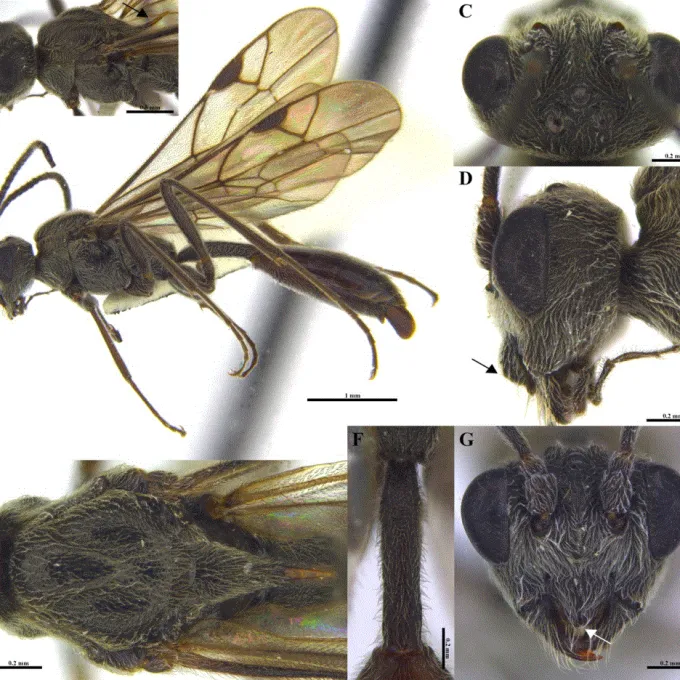
Agriotypus is a genus of parasitoid wasps belonging to the family Agriotypidae. They are distinguished by their semi-aquatic lifestyle, which is an evolutionary rarity among the Hymenoptera order.
The adult wasp has a dark body and is physically adapted to survive near water. Females are equipped with a specialized ovipositor designed to penetrate aquatic environments to locate their hosts.
The most fascinating aspect of their biology is the larval stage. They develop inside caddisfly larvae while partially submerged, utilizing a unique breathing tube connected to the cocoon for gas exchange.
Their anatomy, particularly the respiratory system, allows them to endure the transition between aquatic development and terrestrial adult life.
These insects are highly specific in their habitat requirements, preferring clean, fast-flowing streams where their caddisfly hosts reside.
What it damages
Agriotypus is not a pest to agricultural crops. It is a highly specialized parasitoid that targets larvae of the order Trichoptera (caddisflies) in aquatic habitats.
These wasps do not feed on plant tissues, nor do they infest farm crops, garden plants, or fruit trees. They cause zero damage to agricultural productivity.
Their ecological value lies in their role as natural regulators within aquatic ecosystems. They help manage the populations of caddisflies in riparian zones.
Classifying Agriotypus as a pest is a biological error. In an agronomic context, they are viewed as neutral or beneficial entities that do not interfere with farming practices.
Therefore, their presence in water bodies adjacent to farmland should be viewed as an indicator of a balanced and healthy local environment.
When it appears
The adult phase of Agriotypus typically occurs during the spring and summer months, coinciding with the peak activity of their host caddisfly larvae.
During this window, females are actively searching for suitable hosts in clean, oxygen-rich water. This timing ensures the larvae have sufficient resources for development.
The life cycle is extended by a long larval period, which can include overwintering in the aquatic stage to survive harsh temperature drops.
The emergence of adults from the water is generally synchronized with seasonal temperature changes, ensuring they can locate mates effectively.
Population density is heavily dependent on the stability of the aquatic environment and the availability of host species throughout the season.
Control measures
No control measures are necessary for Agriotypus, as it poses no threat to agriculture. Applying pesticides to manage this species would be counterproductive.
Conservation efforts should focus on protecting water quality in nearby streams and riparian zones, which benefits overall ecological health.
Agronomists are encouraged to maintain buffer zones near water bodies to prevent chemical drift from field applications, ensuring the survival of such beneficial parasitoids.
Natural biodiversity should be promoted, as species like Agriotypus are part of the natural control mechanisms that maintain environmental stability.
Integrated Pest Management (IPM) strategies typically prioritize the protection of such specialized parasitoids, even when they do not directly interact with target crop pests.
Taxonomy
- Latin name
- Agriotypus
- Order
- Hymenoptera
- Family
- Ichneumonidae
- EPPO code
- AGRTSP
Discussion
No discussions yet — be the first.