
Cabbage webworm
Evergestis rimosalis
Description
How to identify
The cabbage webworm (Evergestis rimosalis) is a moth belonging to the family Crambidae. It is a known pest that primarily affects plants in the Brassicaceae family.
Adult moths are relatively small, with a wingspan of approximately 25 to 30 mm. Their forewings are brownish-grey, marked with distinct dark wavy lines and spots.
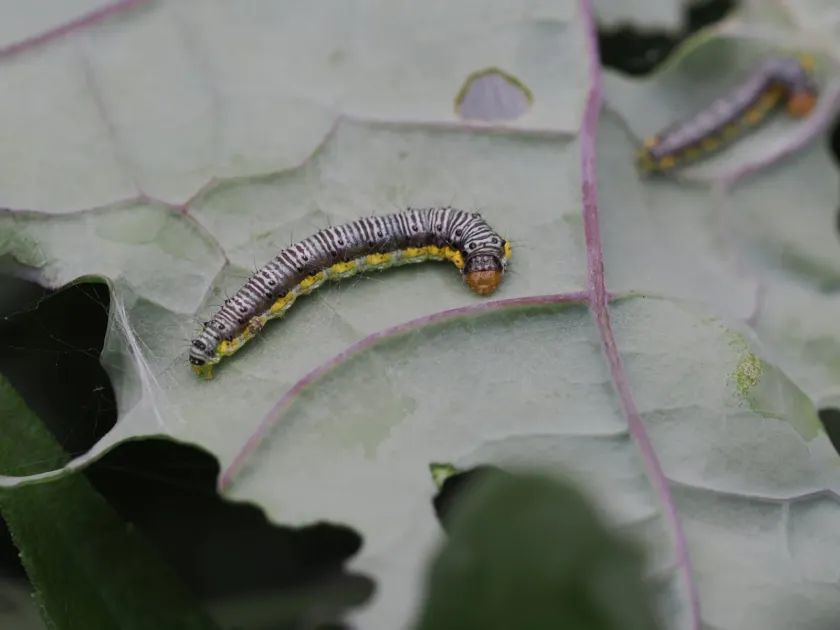
The larvae are the most destructive stage of the life cycle. They are pale yellow to greenish in color, often featuring distinct dark spots and longitudinal light stripes along their bodies.
Pupation typically occurs in the soil or within plant debris, where the larva spins a silk cocoon. The pupae are brown and are well-adapted to survive overwintering in temperate climates.
The species can complete one or more generations per year, depending on the local temperature and environmental conditions of the growing season.
What it damages
Cabbage webworms primarily feed on cultivated brassicas, including cabbage, cauliflower, broccoli, Brussels sprouts, and radishes in garden and farm settings.
Young larvae often start by feeding gregariously on the underside of leaves, creating skeletonized patches that are easily overlooked during initial field inspections.
As the larvae mature, they become increasingly destructive, consuming larger portions of the foliage and often boring into the heart of the cabbage or the florets of broccoli.
Feeding damage reduces the photosynthetic surface area, leading to stunted plant growth and a significant loss in crop yield and market value.
Damage to the growing point of the plant is particularly severe, as it can cause the plant to stop head formation or produce multiple, non-marketable secondary heads.
When it appears
Adult flight usually begins in late spring or early summer, as temperatures rise and host plants become available for oviposition.
Eggs are typically deposited in clusters on the underside of the leaves, which provides the newly hatched larvae with immediate access to food sources.
The peak activity of the larvae usually coincides with the mid-to-late summer months when the crops are entering their most active vegetative phase.
In regions with long growing seasons, overlapping generations can occur, meaning that the pest can be present on the crop from early summer until harvest time.
The species overwinters in the pupal stage, buried in the soil or beneath accumulated crop residues, remaining dormant until conditions become favorable in the spring.
Signs of infestation
One of the earliest indicators of an infestation is the presence of silk webbing, which the larvae use to tie leaf surfaces together for protection while feeding.
Frass (larval excrement) is often found in the leaf axils or on the surface of leaves, serving as a clear diagnostic sign of the presence of the webworm.
Significant leaf damage, characterized by ragged holes or skeletonized areas, is often visible once the larvae have progressed beyond the first few instars.
Wilting of the outer leaves and localized yellowing can occur when the larvae burrow into the central stalk or the head, disrupting the plant's vascular system.
- Silk webbing on foliage.
- Accumulation of larval frass.
- Irregular holes in leaf blades.
- Stunted or deformed plant growth.
Control measures
Cultural control practices, such as thorough soil cultivation after harvest, are essential for destroying overwintering pupae and reducing the next season's population.
Effective weed management, particularly the removal of wild mustard and other cruciferous weeds, helps eliminate alternative host plants and reduces pest pressure.
Biological control using Bacillus thuringiensis (Bt) sprays can be highly effective against early-instar larvae while remaining safe for beneficial insects.
Crop rotation remains a fundamental strategy, preventing the build-up of localized pest populations and breaking the cycle of development in infested fields.
Chemical control should be used as a last resort, applying registered insecticides when pest thresholds are reached, always respecting the pre-harvest interval.
Taxonomy
- Latin name
- Evergestis rimosalis
- Order
- Lepidoptera (butterflies)
- Family
- Crambidae
- EPPO code
- EVERRI
Discussion
No discussions yet — be the first.