
Lantana gall fly
Eutreta xanthochaeta
Description
How to identify
Eutreta xanthochaeta is a species of fruit fly belonging to the family Tephritidae. These insects are easily recognized by their patterned wings, which often display complex brownish markings.
Adult flies are relatively small, with bodies covered in stiff bristles. Their color palette, ranging from yellowish to dark brown, provides excellent camouflage when they rest on the stems or foliage of their host plants.
The life cycle of this species is intimately linked to the family Verbenaceae. In many ecological contexts, the fly is studied as a biological control agent for the invasive plant Lantana camara.
Females possess a sclerotized ovipositor, an essential tool for piercing the stems of host plants to deposit eggs. This adaptation is critical for their reproductive success within the woody tissues of the host.
The larval stage is internal, taking place within the plant tissue. Lacking distinct head capsules, these larvae develop inside the stems, where they remain protected from many environmental stressors and external predators.
What it damages
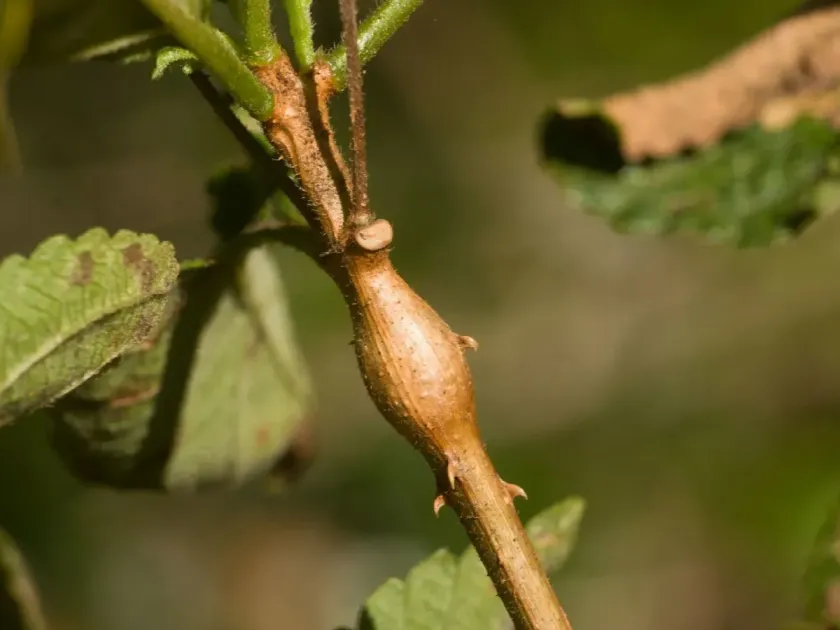
The primary host plant for Eutreta xanthochaeta is Lantana camara. The damage caused by the larvae is characterized by the formation of distinct galls, or abnormal cell proliferations, on the stems.
As the larvae feed, they disrupt the plant's vascular system, hindering the transport of water and nutrients. This physiological stress leads to stunted growth and reduced vigor of the affected plant branches.
The structural integrity of the stems is compromised by the presence of these galls, which can cause the branches to sag, twist, or break under wind stress or their own weight.
In addition to direct physiological damage, the galls create openings that allow secondary pathogens to enter. Fungal and bacterial infections often exacerbate the damage caused by the fly.
For ornamental growers, the presence of these galls reduces the commercial value of the plants, as the disfigured stems and weakened foliage render the plants unattractive for landscaping purposes.
Signs of infestation
The most visible sign of infestation is the presence of hard, woody swellings known as galls on the stems of the Lantana plant. These galls vary in size but are typically localized at nodes.
Growth abnormalities are common in infested plants. You may observe shorter internodes and a decrease in the overall size of the leaves, reflecting the systemic stress caused by the developing larvae inside the stem.
Examine the surface of the galls for small, circular exit holes. These indicate that the adult flies have successfully emerged, confirming that the infestation has reached a mature stage.
During the warmer months, adult flies can be observed on the plant surface. They are typically active in areas where the host plants are dense, resting on leaves or feeding on plant exudates.
A decline in plant health, characterized by yellowing foliage or branch dieback originating from the galled section, provides further evidence of a persistent and established infestation.
Control measures
Biological control is the most sustainable approach, relying on natural parasitoids, such as small wasps that target the larvae inside the galls. Promoting biodiversity in the landscape helps maintain these populations.
Sanitation is a critical management practice. Gardeners should prune and remove galled stems as soon as they are detected, ensuring that all infested material is destroyed by burning or deep burial.
Systemic insecticides may be used if targeting adult populations, though effectiveness is limited against larvae protected within galls. Timing applications to coincide with adult emergence is essential.
Monitoring using yellow sticky traps is an effective way to detect early activity. This data helps in making informed decisions about whether to initiate control measures on a property.
- Prompt removal and destruction of infested stems.
- Utilization of yellow sticky traps for population monitoring.
- Encouraging natural predators and parasitoids.
- Integrated pest management (IPM) to minimize chemical reliance.
Taxonomy
- Latin name
- Eutreta xanthochaeta
- Order
- Diptera (flies)
- Family
- Tephritidae
- EPPO code
- EUTTXA
Discussion
No discussions yet — be the first.