
West Indian sweet potato weevil
Euscepes postfasciatus
Description
How to identify
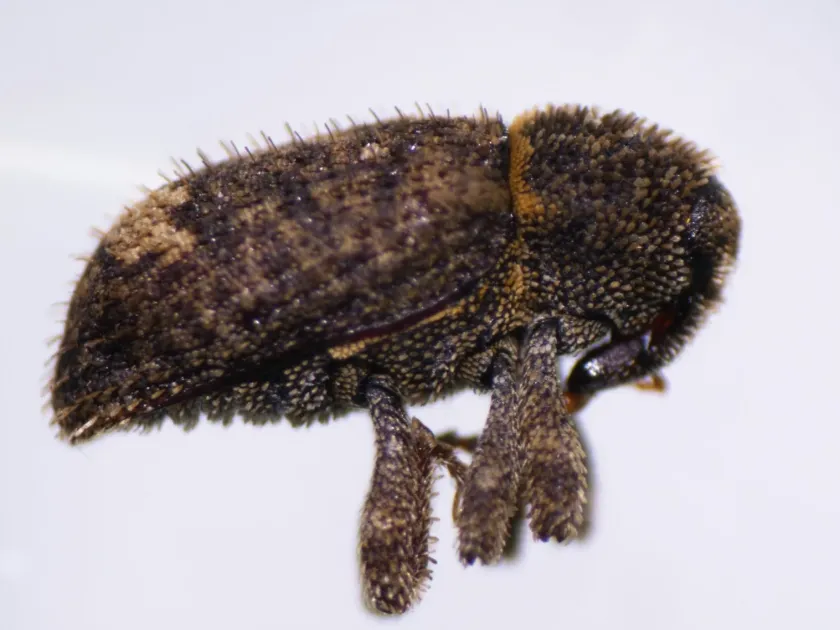
The West Indian sweet potato weevil, Euscepes postfasciatus, is a small but highly destructive beetle belonging to the Curculionidae family. Adult weevils are roughly 3–4 mm long with a dark brown to black body, often featuring faint lighter markings on the wing covers.
They possess a prominent snout (rostrum) used for feeding and boring into plant tissues. The larvae are legless, C-shaped, and creamy white with a distinct brown head capsule, characteristic of the weevil family.
The entire life cycle of this pest, from egg to pupa, occurs inside the plant host, making it extremely difficult to detect through visual inspection of the outer plant foliage alone.
This species is well-adapted to tropical and subtropical climates, where it can maintain high populations throughout the year if host plants are consistently available.
Adult weevils are capable of short-distance flight, but long-distance dispersal is primarily human-mediated through the movement of infested sweet potato tubers and vines.
What it damages
The primary host for this pest is the sweet potato (Ipomoea batatas). The larvae cause the most severe economic damage by boring tunnels through the fleshy root system of the plant.
Adult feeding activity creates small surface punctures on the vines and tubers, which can weaken the plant and serve as entry points for pathogens, though the internal damage by larvae is the most significant.
Extensive tunneling by larvae renders the roots unmarketable and inedible, as the flesh becomes riddled with galleries and contaminated with frass (insect excrement).
Secondary infections by soil-borne bacteria and fungi often follow the weevil damage, leading to rapid decay and complete loss of the storage root quality.
In high-infestation scenarios, losses can range significantly, sometimes leading to total crop failure if proactive control measures are not implemented during the growing season.
When it appears
The weevil is a year-round threat in tropical regions, where overlapping generations allow the pest to maintain a constant presence in cultivated fields.
Females deposit eggs in small cavities excavated in the stems or near the surface of the tubers, carefully covering the holes to protect the developing offspring.
The duration of the life cycle varies depending on the ambient temperature and humidity levels, with warmer conditions significantly accelerating the development of the population.
Pupation takes place inside the tunnels created by the larvae within the plant host, which provides a high degree of protection against environmental stressors and predators.
Post-harvest, any infested crop residue left in the field acts as a critical reservoir, allowing the population to survive and re-infest the next planting cycle.
Signs of infestation
Early detection is difficult because the insects feed inside the plant tissue. However, meticulous field scouting can reveal small pin-sized exit holes on the vines or root skin.
Plants showing signs of premature yellowing, wilting, or stunted growth despite adequate water and nutrient supply should be carefully inspected for weevil presence.
Upon cutting into a suspect tuber, the presence of dark, tunnel-like galleries filled with brownish waste is a definitive indicator of an infestation.
- Pin-sized entry or exit holes on stems and roots.
- Internal dark galleries within the tuber flesh.
- Bitter taste and foul odor of the damaged roots.
- Stunted plant growth and premature leaf senescence.
Finding live larvae or pupae within the root tissue confirms that the current field is actively being colonized by the pest, requiring immediate action.
Control measures
Strict quarantine protocols are the most effective way to prevent the introduction of this pest into non-infested regions by regulating the movement of vegetative planting materials.
Cultural practices, such as planting only certified weevil-free "slips" (vine cuttings) and ensuring deep cultivation after harvest to destroy crop residues, are essential.
Crop rotation is a fundamental strategy; avoiding sweet potatoes in the same field for several consecutive years helps break the pest's life cycle.
Monitoring populations using pheromone traps can provide early warning and assist in determining the optimal timing for localized control measures.
While chemical control with systemic insecticides can be used, it is often difficult due to the insect's internal feeding habits, making integrated pest management (IPM) the preferred long-term approach.
Taxonomy
- Latin name
- Euscepes postfasciatus
- Order
- Coleoptera (beetles)
- Family
- Dryophthoridae
- EPPO code
- EUSPPO
Discussion
No discussions yet — be the first.