
West Indian sweet potato weevil
Euscepes
Description
How to identify
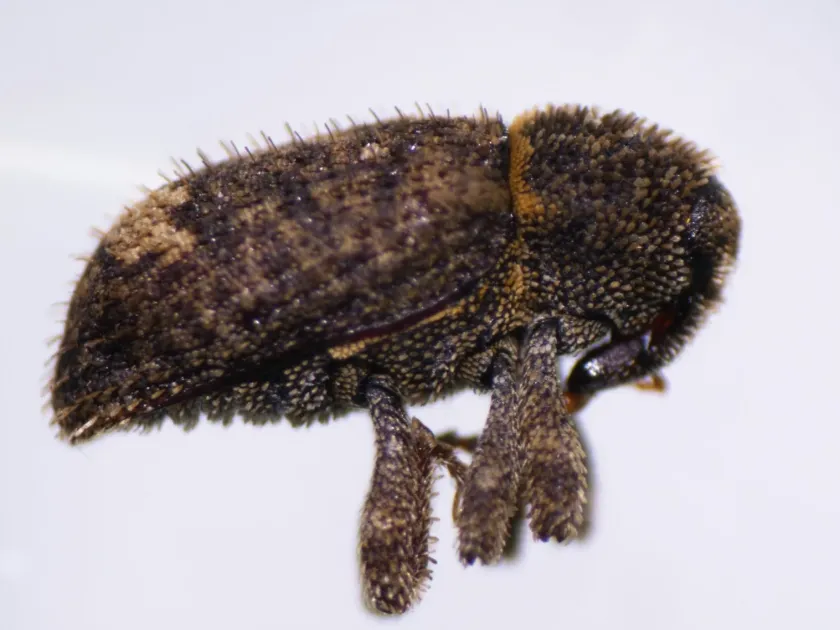
The West Indian sweet potato weevil (Euscepes postfasciatus) is a member of the Curculionidae family within the Coleoptera order. This small insect measures approximately 3-4 millimeters in length and is easily identified by its dark brown to black coloration.
The adult weevil's body is covered in dense hairs, giving it a somewhat matte appearance. A distinctive feature is the presence of irregular light-colored bands across the elytra, which helps in field identification compared to other weevil species.
The larvae are legless, white-bodied grubs with brown head capsules, specifically adapted for boring into plant tissues. They spend their entire larval development phase inside the roots or tubers of host plants, remaining completely hidden from the outside.
Pupation occurs within small, specially constructed chambers deep inside the tuber tissue. The pupae are pale yellow, transitioning into adults that eventually chew their way out to begin the reproductive cycle again.
Adults are primarily nocturnal, remaining active at night and seeking shelter in the soil or at the base of plants during the day. They exhibit thanatosis (playing dead) when disturbed, making them difficult to spot during routine field inspections.
What it damages
Sweet potato (Ipomoea batatas) is the primary host for this pest. The weevil causes significant agricultural losses, as both adults and larvae feed on the crop, with larvae causing the most severe and permanent structural damage to the tubers.
Larvae tunnel through the fleshy parts of the tubers, consuming them from within. This feeding activity leaves behind winding galleries filled with frass, which ruins the texture and quality of the sweet potato, rendering it unsalable.
The tunnels created by the larvae also serve as entry points for various pathogens, including bacteria and fungi, leading to rot and complete tissue decomposition. This often results in a foul odor and a bitter taste, making the produce unfit for human consumption.
In cases of heavy infestation, the yield loss can be extreme, often ranging from 50% to over 80%. This pest is a major limiting factor for sweet potato production in tropical and subtropical regions where the climate allows for continuous breeding.
Besides commercial sweet potatoes, this weevil can maintain populations on various wild species of the Convolvulaceae family, which serve as alternate hosts and bridges for the pest when primary crops are not available.
When it appears
The life cycle of Euscepes postfasciatus is highly dependent on environmental temperature. Optimal development occurs in warm, humid conditions with temperatures typically ranging between +25°C and +30°C.
Under these favorable tropical or greenhouse conditions, the weevil can complete multiple generations in a single year. Rapid population growth can occur if the pest is not managed proactively from the early stages of tuber formation.
Activity peaks generally coincide with the active growth phase of the sweet potato tubers. Migration to new fields is facilitated both by the natural movement of adults and, more commonly, by the transportation of infested slips or tubers.
While reproduction slows in cooler weather, the pest can overwinter in the adult stage within crop residues or the top layer of soil. Abandoned fields with remaining plant debris are the primary reservoirs for the pest between seasons.
Integrated pest management (IPM) programs must begin with rigorous field monitoring using pheromone traps before planting. Detecting the arrival of the first generation is critical to preventing the explosive population growth during the harvest season.
Signs of infestation
Early identification is often difficult due to the insect's cryptic behavior. The first signs are usually small, pin-prick feeding punctures on the stems, petioles, or leaf veins, indicating the presence of adults on the plant.
On the tubers themselves, look for tiny, round exit or entry holes. These are often the only visible signs that the tuber has been penetrated, though internal damage is usually much more extensive than the small surface hole suggests.
- Wilting and stunted growth of vines, sometimes with yellowing leaves
- Internal tunnels filled with brown, powdery excrement inside the tuber
- A distinct, unpleasant musty or sour smell emanates from damaged roots
- Presence of small dark beetles hiding in soil crevices near the plant base
- Significant reduction in tuber weight and marketability at harvest
If a tuber is cut open and reveals spongy, darkened tissue with cavities, it is a definitive sign of an advanced infestation. Such produce should be quarantined and destroyed to stop the cycle of re-infestation.
Regular field surveys, including digging up a few sample plants to inspect root health, are essential. Relying solely on visual observations of leaves will often lead to underestimating the severity of the problem.
Control measures
Cultural control is the cornerstone of management. Implementing a strict crop rotation cycle—avoiding sweet potatoes on the same plot for at least 2–3 years—is vital to breaking the pest's lifecycle and preventing the buildup of soil-borne populations.
Always use certified, weevil-free planting material. Since the pest is often spread through contaminated slips, sourcing from clean, inspected nurseries is the most effective way to keep fields free of Euscepes postfasciatus.
Field sanitation is equally critical. All crop residues should be removed and destroyed immediately after harvest. Deep plowing of the field can help bury and kill remaining insects, significantly reducing the survival rate for the next season.
Pheromone traps are highly effective tools for both monitoring and mass-trapping males. Deploying these traps early in the season can suppress the overall population density and provide data for informed decision-making regarding insecticide use.
Biological control methods, such as the application of entomopathogenic fungi like Beauveria bassiana or specific parasitic nematodes, can be used to target larvae and adults in the soil. These methods offer a sustainable alternative to broad-spectrum chemical treatments.
Taxonomy
- Latin name
- Euscepes
- Order
- Coleoptera (beetles)
- Family
- Dryophthoridae
- EPPO code
- EUSPSP
Discussion
No discussions yet — be the first.