
Small magpie
Eurrhypara hortulata
Description
How to identify
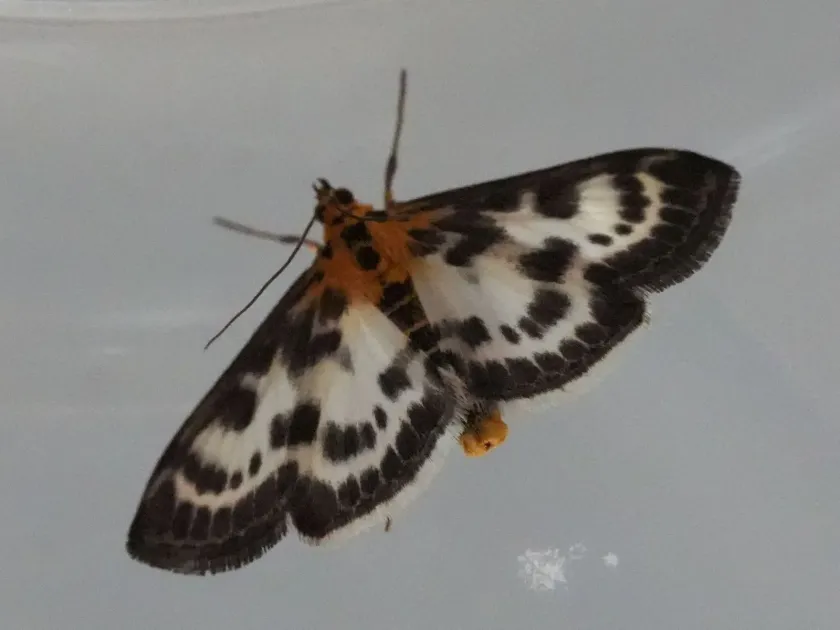
The Small magpie (Eurrhypara hortulata) is a moth belonging to the Crambidae family, order Lepidoptera. Adult moths are recognizable by their wingspan of 24–28 mm, featuring a distinct yellowish-white coloration with dark brown or black spots and bands.
The larvae (caterpillars) grow up to 25 mm long. Their body color ranges from greyish-green to dark, often marked with a light dorsal stripe and a glossy black head, which is a key identification feature for this species.
Pupae are brown in color and reside within robust cocoons. These cocoons are typically spun inside folded leaves or hidden among plant debris, providing an effective shield against predators and harsh environmental conditions.
The insect prefers humid habitats, which are conducive to the growth of its primary host plant, the stinging nettle. Moths are nocturnal and often fly under the cover of dusk, making them elusive during the day.
Distributed widely across the Palearctic region, this moth usually completes one generation per year in temperate zones, although favorable weather conditions may allow for a partial second generation in late summer.
What it damages
The larvae are the destructive stage of this pest. They feed aggressively on leaves, consuming the leaf tissue and leaving behind only a network of veins, which significantly reduces the plant's photosynthetic capacity.
While their primary host is nettle, they frequently infest various garden crops, including mint, lemon balm, horseradish, and berry bushes like currants and gooseberries, causing substantial economic losses.
Heavy infestations lead to stunted growth and reduced vigor. In herb crops, the damage ruins the aesthetic quality and marketability, often forcing growers to discard the affected portions of the harvest.
The destruction of foliage disrupts the plant's metabolic processes. This stress makes the plants more susceptible to secondary infections and winter damage, particularly in perennial shrubs.
Severely damaged shoots may exhibit deformities, which can alter the structural development of the plant and suppress further leaf production throughout the remainder of the growing season.
When it appears
Adult flight usually commences in early summer, typically in June. During this time, mating occurs, and females lay eggs on the undersides of host plant leaves, marking the start of the primary infestation period.
Egg development takes about 7 to 12 days depending on temperature. Larvae hatch mid-summer and immediately begin feeding; this late-summer generation is the most active as it prepares for winter diapause.
The Small magpie overwinters as a full-grown larva within its cocoon, hidden in soil debris or dead leaves. Pupation occurs in the spring, completing the cycle as they emerge as adults.
Larval activity peaks in August. Gardeners should conduct routine inspections during this period to catch potential outbreaks early before significant damage is inflicted on the plants.
Environmental factors, especially humidity, play a major role in population dynamics. Moist conditions generally support higher larval survival rates, whereas prolonged dry spells can suppress population growth.
Signs of infestation
The first indicator of an infestation is the presence of irregular "windowing" or holes in leaves. As the larvae grow, they consume more tissue, resulting in ragged edges and skeletonized foliage.
Larvae use silk to spin leaves together or roll them into protective tubes. The presence of this webbing is a definitive sign of Small magpie activity, distinguishing it from other leaf-feeding insects.
Small, dark granular frass (excrement) deposited beneath the leaves or caught in the webbing is a common indicator of a thriving larval population hidden within the canopy.
Leaves that yellow prematurely or curl unexpectedly without signs of fungal disease are often occupied by larvae, which feed sheltered from the surface of the leaf.
Inspecting the underside of leaves or gently unfolding rolled-up foliage during the early morning hours often reveals the larvae, as they are most active when temperatures are cooler.
Control measures
Effective control begins with good cultural practices. Removing wild nettle and other weeds from the perimeter of the garden is vital, as these provide the initial breeding grounds for the moth.
Manual removal of larvae and infested leaves is a simple yet highly effective strategy for small-scale gardens or when the infestation is caught in its early stages.
Biological control using Bacillus thuringiensis (Bt) sprays is highly effective against young larvae and is the preferred method for organic growers to avoid harming beneficial insects and pollinators.
For severe outbreaks, systemic insecticides may be used, though applications should be carefully timed. Always follow label instructions regarding pre-harvest intervals to ensure safety.
Autumn garden cleanup is essential. Removing plant debris destroys the pupation sites and overwintering larvae, significantly reducing the pest pressure for the following spring season.
Taxonomy
- Latin name
- Eurrhypara hortulata
- Order
- Lepidoptera (butterflies)
- Family
- Crambidae
- EPPO code
- EURRHO
Discussion
No discussions yet — be the first.