
Cushion scale
Eupulvinaria
Description
How to identify
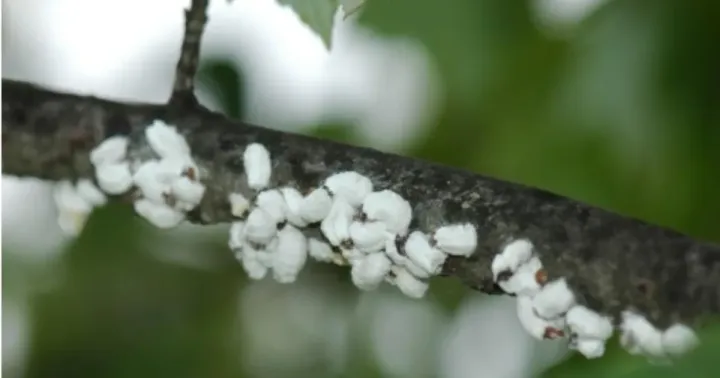
Cushion scale (genus Eupulvinaria, family Coccidae) is a destructive sap-sucking insect belonging to the order Hemiptera. Adult females are most identifiable during the egg-laying period, when they produce distinctive white, cottony egg sacs known as ovisacs.
The female's body becomes highly convex, ranging from yellowish-brown to dark brown, and adheres firmly to bark or the undersides of leaves. Unlike armored scale insects, cushion scales lack a separate chitinous shield; instead, their own body hardens to provide protection.
The nymphs, often called crawlers, are very small, mobile, and light-colored. During this stage, they actively disperse across the plant or are carried to neighboring plants by wind or other insects, facilitating the spread of the infestation.
Reproduction is often parthenogenetic, allowing the population to expand rapidly without the need for males. This reproductive strategy makes Eupulvinaria a highly efficient colonizer of both ornamental and fruit-bearing trees.
For accurate identification in the field, experts use a magnifying lens to examine the structure of the white, fluffy ovisac, which serves as a definitive diagnostic characteristic for this specific genus.
What it damages
These pests infest a wide range of woody plants and shrubs, including fruit crops such as citrus and grapes, as well as various ornamental trees like maples and viburnum, posing a threat to diverse agricultural landscapes.
The insects feed primarily on young shoots, leaf petioles, and veins. By extracting cell sap, they deprive the host plant of essential nutrients, leading to physiological stress and reduced overall plant vitality.
Mass infestations often lead to premature yellowing and dropping of leaves, stunted growth of new shoots, and a significant decrease in cold hardiness, which can prove fatal to young or weakened specimens during winter.
A major aspect of the damage is the secretion of honeydew, which serves as a substrate for sooty mold fungi. This fungal growth blocks sunlight and air exchange, severely hindering photosynthesis and reducing the plant's aesthetic and economic value.
If left unmanaged, persistent feeding can cause the dieback of individual branches or even the death of the entire plant due to systematic nutrient depletion and the secondary effects of fungal pathogens.
When it appears
The life cycle of the cushion scale is closely synchronized with climate conditions and host plant phenology. Typically, the insect overwinters as second-instar nymphs sheltered in bark crevices or along woody stems.
In spring, as sap begins to flow and temperatures rise, nymphs emerge from dormancy to resume feeding. This stage is marked by the maturation of females and the onset of egg production.
The emergence of crawlers generally coincides with the flowering stage or the early development of foliage. Depending on the local climate, the species may produce one or several generations within a single growing season.
Crawler activity peaks during the first half of the summer, as optimal temperatures facilitate rapid development and successful colonization of new feeding sites on the host plant.
As autumn approaches, late-season nymphs seek out protected areas on the bark to enter diapause, ensuring their survival through the harsh winter months until the following spring season.
Signs of infestation
The most visible indicator of infestation is the appearance of white, cotton-like masses on stems. These are often mistaken for fungal growth or wind-blown debris by inexperienced gardeners.
Sticky residue on leaves beneath scale colonies indicates the presence of honeydew. Over time, this residue turns black due to the growth of sooty mold, which is a clear diagnostic sign of a scale insect infestation.
Severe infestations cause distortion of new growth and stunted development. Leaves lose their turgor, become dull in appearance, and drop prematurely, even when the plant is receiving adequate hydration.
Increased ant activity is a strong secondary indicator, as ants forage on the honeydew secreted by the scales and protect the colonies from natural predators, effectively exacerbating the infestation.
Close inspection of the branches often reveals the hard, dome-shaped bodies of the adult females, which blend into the texture and color of the bark, requiring careful observation to detect in early stages.
Control measures
Effective management begins with cultural practices, such as the pruning and disposal of heavily infested branches, which significantly reduces the pest population and prevents further spread.
Applying systemic insecticides during the crawler stage is the most effective chemical intervention, as the nymphs are most vulnerable before they harden and settle permanently on the host tissue.
Dormant-season application of horticultural oils creates a protective barrier on the bark, effectively suffocating overwintering nymphs and preventing them from resuming activity in the spring.
- Utilizing beneficial insects, such as predatory beetles, for natural control.
- Monitoring plant health regularly using yellow sticky traps to detect crawler movement.
- Maintaining optimal irrigation and fertilization to boost the plant's natural immune response.
In cases of widespread infestation, multiple applications of insecticides with different modes of action may be necessary to overcome the pest population and prevent the development of pesticide resistance.
Taxonomy
- Latin name
- Eupulvinaria
- Order
- Hemiptera (bugs, aphids, leafhoppers)
- Family
- Coccidae
- EPPO code
- EPUVSP
Discussion
No discussions yet — be the first.