
Brown-tail moth
Euproctis
Description
How to identify
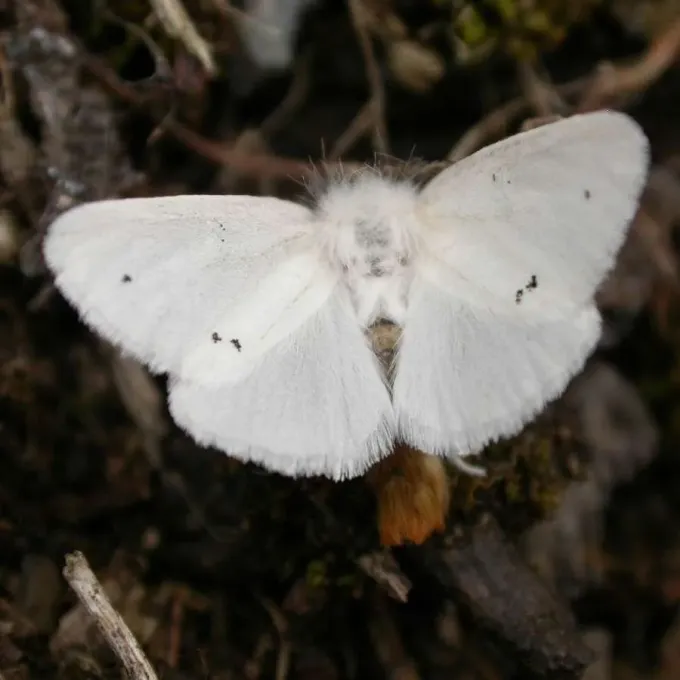
The Brown-tail moth (Euproctis chrysorrhoea) is a moth of the Erebidae family. The adult moth has a wingspan of 35–45 mm and is characterized by pure white wings and a distinctive golden-brown tuft of hair at the tip of the abdomen.
The larvae, commonly known as caterpillars, are dark brown or blackish with white patches and distinct bright red/orange tufts and dorsal spots. They are covered in long, irritating hairs.
These hairs, or setae, are equipped with microscopic barbs and contain toxins that cause severe skin rashes and respiratory irritation in humans, commonly referred to as "brown-tail moth rash."
The moth lays eggs on the underside of leaves, covering them with the golden-brown hair from its abdomen, which provides camouflage and protection for the developing eggs.
Proper identification is crucial because the larvae and their nests can be confused with other species, but their toxic nature requires specific handling precautions.
What it damages
The Brown-tail moth is a highly polyphagous species, capable of feeding on a wide range of deciduous trees and shrubs found in gardens and forests.
Key hosts include fruit trees such as apple, pear, cherry, and plum, as well as common ornamental trees like oak, hawthorn, and willow.
The caterpillars are gregarious, living in large groups. During spring, they emerge from hibernation and strip the buds and young foliage, severely hindering the tree's development.
Heavy infestations can lead to total defoliation of trees, which weakens the plant significantly, leading to reduced fruit yields and making the tree susceptible to diseases.
In addition to agricultural damage, the presence of these caterpillars in recreational areas poses a significant public health risk due to their toxic hairs.
When it appears
The life cycle consists of a single generation per year. Larvae overwinter in communal silken webs, known as "tents," which are tightly attached to the branches of the host trees.
Caterpillars emerge in early spring, precisely when tree buds start to burst, feeding actively until late May or early June, when they begin to pupate.
Pupation occurs inside loose, silken cocoons spun between leaves or in crevices on the tree bark, lasting for approximately two to three weeks.
Adult moths emerge during mid-summer, typically from July to August. They are nocturnal and are strongly attracted to artificial light sources.
Following mating and egg-laying, the next generation of larvae hatches in late summer, feeds briefly on leaves, and constructs the winter webs to begin the cycle again.
Signs of infestation
The most visible sign of infestation is the presence of tightly woven, greyish-white silk tents at the tips of branches during the dormant autumn and winter months.
Early spring activity is marked by damaged or missing buds and the presence of small, gregarious larvae feeding on the developing young leaves.
As the season progresses, the foliage appears skeletonized or completely consumed, leaving only the veins behind on the branches where the caterpillars have been feeding.
If you experience itching or skin irritation while pruning trees in infested areas, it is a strong indicator that you have disturbed caterpillar nests or their shed hairs.
Mass sightings of white moths around outdoor lights during summer evenings are a precursor to potential egg-laying activity in nearby garden trees.
Control measures
The most effective mechanical control is the removal and destruction of winter tents. This should be done before the larvae emerge in the spring.
When removing nests, it is mandatory to use full protective clothing, including gloves, goggles, and masks, to prevent contact with toxic hairs that can become airborne.
In cases where infestations are widespread, biological insecticides such as those based on Bacillus thuringiensis are highly effective and safer for beneficial insects.
Chemical control with systemic insecticides can be used if infestations are severe, but must be applied early in the caterpillar stage to be truly effective.
Gardeners are encouraged to monitor their trees and communicate with neighbors to coordinate pest management, as these moths can easily spread between adjacent properties.
Taxonomy
- Latin name
- Euproctis
- Order
- Lepidoptera (butterflies)
- Family
- Erebidae
- EPPO code
- EUPRSP
Discussion
No discussions yet — be the first.