
Japanese fruit fly
Euphranta japonica
Description
How to identify
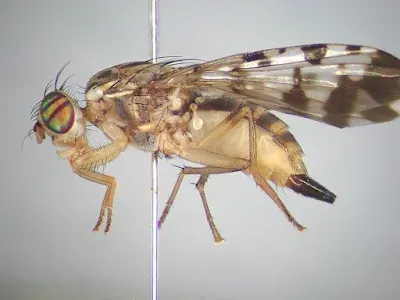
The Japanese fruit fly (Euphranta japonica) is a species of fruit fly belonging to the Tephritidae family. The adult fly is typically 6–8 mm long, possessing a yellowish-brown to dark-colored body that allows it to blend with its environment.
Its wings are transparent and marked with distinct dark cross-bands, a feature common to the Tephritidae family. Females are equipped with a prominent ovipositor, which they use to pierce the fruit's surface and deposit eggs directly into the tissue.
The larvae are legless, maggot-like creatures, often creamy-white in color, reaching up to 10 mm at their final growth stage. When they finish feeding, they drop to the soil to pupate, forming a barrel-shaped puparium that protects them during development.
The life cycle is closely synchronized with the development of their host plants. Adults emerge from the soil in spring as temperatures rise, beginning their search for suitable fruit for reproduction.
Accurate identification is vital for orchard managers to implement targeted monitoring programs, as the presence of this specific fly requires distinct control measures compared to other fruit pests.
What it damages
This pest is primarily known for damaging nut-bearing trees, such as the Manchurian walnut and heartnut. In regions where these trees are grown, the Japanese fruit fly can significantly decrease total yields if left unchecked.
Female flies penetrate the outer shell of the nut to lay eggs. Upon hatching, the larvae feed on the green husk, creating tunnels throughout the tissue. This feeding behavior destroys the structural integrity of the fruit husk.
As the larvae continue to feed, the husk turns black, begins to rot, and the nut often drops prematurely. These damaged fruits are largely worthless, as the kernel may also suffer from the secondary effects of the infestation.
Secondary infections are a major issue; the tunnels bored by the larvae allow fungi and bacteria to enter the fruit, leading to rapid decay and a souring of the nut’s exterior, rendering the entire fruit unusable.
High levels of infestation can lead to substantial economic losses, especially in high-density orchards where the fly population can propagate rapidly if preventive measures are ignored.
When it appears
Adult activity typically begins in mid-summer, matching the period when host fruits reach the milk-to-dough stage of development. This is when the trees are most susceptible to egg-laying by the female flies.
The oviposition period lasts for several weeks, meaning that different generations of larvae may be present within a single orchard. Once the larvae complete their development within the fruit, they exit and descend to the ground.
The pupation phase occurs in the top layers of the soil beneath the host tree. The insect remains in the pupal stage throughout the autumn and winter, surviving in a state of diapause until the following spring.
The severity of the season depends on weather conditions; warm, humid springs and summers generally favor fly emergence and survival, while cooler temperatures can delay the onset of the life cycle.
Orchard managers must observe the timing of the first flights closely, using monitoring tools to determine the precise window for implementing protective sprays or deploying traps.
Signs of infestation
The first outward sign of infestation is the appearance of small, dark, puncture marks on the green husks of the nuts. Occasionally, a small amount of clear or dark liquid may exude from these points of entry.
If an affected fruit is opened, one will find internal tunnels and cavities filled with larval frass. The tissue surrounding these tunnels will be soft, discolored, and exhibit a distinct, unpleasant putrid odor.
Premature fruit drop is a strong indicator of an active infestation. If nuts are falling to the ground before they are fully mature, they should be inspected immediately for the presence of maggots.
Adult flies can be detected using yellow sticky traps hung in the canopy of the trees. These traps are highly effective at attracting the flies and providing an early warning of population density.
Evidence of larval exit holes on the exterior of the husk, combined with a blackening of the surface, confirms that the larvae have finished their feeding cycle and entered the soil for pupation.
Control measures
Cultural control is the first line of defense; gathering and destroying all fallen fruit promptly is essential. By removing the fruit, you eliminate the larvae before they can exit into the soil to pupate.
Tilling the soil beneath the canopy during late autumn or early spring is highly recommended. This practice exposes the overwintering pupae to cold temperatures, predators, and desiccation, significantly reducing the next season's population.
Yellow sticky traps can be used not only for monitoring but also for mass trapping to reduce the adult population in smaller orchards. The traps should be placed high in the canopy where the flies are most active.
If chemical control is necessary, applications should target the adult stage before oviposition occurs. Always use insecticides labeled specifically for the crops being treated and follow local regulations strictly.
- Regular collection of infested fruit.
- Soil cultivation to disrupt the pupation cycle.
- Deployment of sticky traps for monitoring and mass trapping.
- Application of selective insecticides during adult flight.
- Proper disposal of all damaged nut material.
Taxonomy
- Latin name
- Euphranta japonica
- Order
- Diptera (flies)
- Family
- Tephritidae
- EPPO code
- RHACJA
Discussion
No discussions yet — be the first.