
Euphranta connexa fruit fly
Euphranta connexa
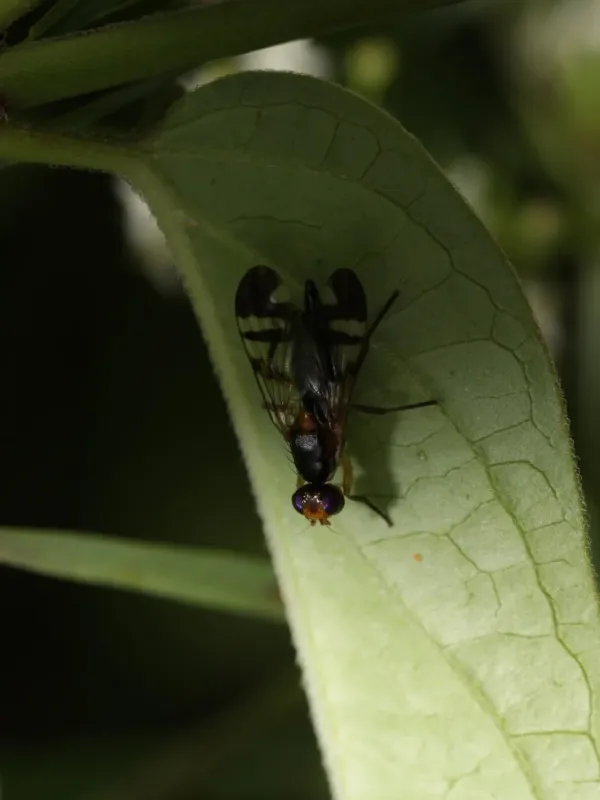
Description
How to identify
Euphranta connexa belongs to the Tephritidae family, order Diptera. This insect is characterized by its typical appearance: a small body with a distinct wing pattern consisting of dark spots and stripes.
Adults typically measure about 5–7 mm in length. Their body coloration ranges from yellowish-brown to nearly black, allowing them to effectively camouflage against the leaves and stems of host plants.
The pest's head features well-developed compound eyes that are highly sensitive to light and motion. Their mouthparts are designed for feeding on nectar and aphid honeydew.
The larvae have the legless, cylindrical shape typical of flies. They are generally whitish or yellowish, with a segmented body and a pointed anterior end for penetrating plant tissues.
Mature females possess a long ovipositor, enabling them to reach deep into plant tissues, including fruits or soft shoots, to lay eggs in protected spots.
What it damages
The primary hosts for Euphranta connexa larvae are members of the Asteraceae family. The pest is most frequently found on chicory and certain species of wild plants belonging to this family.
The damage is caused by the larvae, which develop inside flower heads or seeds. By feeding on the tissues of reproductive organs, they disrupt normal plant development and reduce crop quality.
During mass outbreaks, this pest can destroy a significant portion of the seed material, which is critical for seed-producing farms specializing in chicory cultivation.
Beyond direct damage to seeds, larvae can trigger secondary infections by fungi or bacteria that enter through the damaged plant tissues.
The economic impact depends on the pest population density per unit area. High numbers of adults during the flowering period directly correlate with losses in the final seed yield.
When it appears
The life cycle of Euphranta connexa is closely tied to the phenology of its host plants. Adult flies emerge during the flowering period, typically from late spring through mid-summer.
Mating and egg-laying occur over several weeks. Females are highly selective and search for suitable flower buds or young inflorescences to deposit their eggs.
The larvae go through several developmental stages (instars) inside the plant tissues, feeding actively for 3–5 weeks depending on temperature and nutrient availability.
Upon completing their development, the larvae typically leave the plant and pupate in the soil or plant debris, where they overwinter in the puparium stage.
In temperate climates, there is usually one generation per year, which limits the period of active impact on crops to the plant's vegetation cycle.
Signs of infestation
The first visual sign of the pest's presence is the occurrence of punctures on flower heads, left by the female during oviposition.
As the larvae develop inside the inflorescences, premature wilting or deformation of the flower heads occurs, which is often misidentified as physiological issues or diseases.
Opening damaged flower heads often reveals the presence of larvae or their excrement, as well as destroyed seed buds appearing as hollowed cavities.
On chicory fields, signs of infestation include uneven seed maturation and the presence of empty inflorescences that fail to produce viable seed material.
The presence of adult flies on the surface of plants during morning or evening hours also serves as a signal to begin population monitoring to prevent further spread.
Control measures
The most critical agronomic protection method is strict crop rotation. It is unacceptable to plant susceptible crops on fields where mass infestations were observed in previous seasons.
Deep autumn plowing of the soil helps destroy a significant portion of pupae overwintering in the upper soil layers, disrupting their life cycle and reducing the population for the next year.
Controlling Asteraceae weeds around field perimeters is crucial, as these serve as reservoirs for the pest when the main crop is not present.
Once the economic threshold of the pest population is reached, the application of systemic or contact insecticides registered for the specific crop is recommended.
The use of yellow sticky traps allows for efficient monitoring of adult populations, enabling treatments to be applied precisely when needed and significantly reducing pesticide usage.
Taxonomy
- Latin name
- Euphranta connexa
- Order
- Diptera (flies)
- Family
- Tephritidae
- EPPO code
- EPHNCO
Discussion
No discussions yet — be the first.