
Canadian gooseberry fruit fly
Euphranta canadensis
Description
How to identify
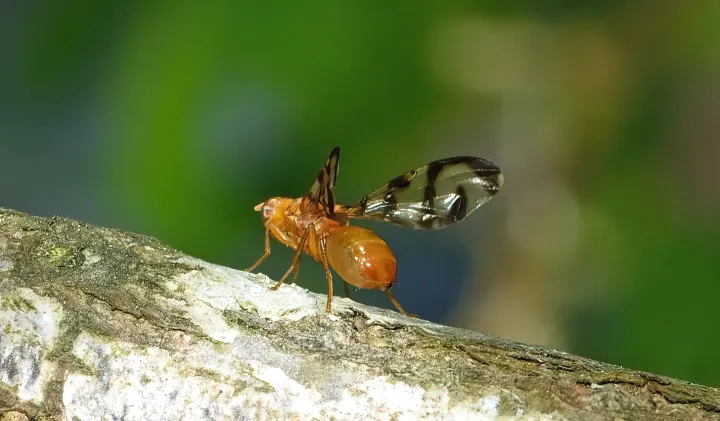
The Canadian gooseberry fruit fly (Euphranta canadensis) is a member of the Tephritidae family, also known as fruit flies. They are recognized by the characteristic dark bands on their wings.
Adult flies are relatively small, measuring approximately 5 to 6 millimeters in length. Their body color ranges from yellow-brown to dark brown, providing excellent camouflage on the foliage of host plants.
The larvae are typically creamy-white, legless maggots. They are found exclusively inside the developing berries, where they feed on the internal tissues, including seeds and pulp.
The lifecycle of the insect is synchronized with the phenology of the host plant. They overwinter as puparia in the top few centimeters of the soil beneath the bushes.
In spring, adults emerge from the soil. After mating, females lay eggs into the young, green berries, marking the beginning of the new generation's development.
What it damages
The primary hosts for this pest include plants of the genus Ribes, specifically red currants, white currants, and gooseberries, which are susceptible to fruit fly infestation.
The damage is caused by the larvae feeding inside the fruit. This infestation leads to premature coloring and softening of the berries, often making them unmarketable.
As the larvae continue to feed, the infested fruit frequently drops from the bush prematurely. This significantly reduces the harvestable yield and causes financial losses for growers.
Internal tissue destruction, combined with the presence of frass within the berry, renders the fruit unsuitable for fresh consumption or commercial processing.
In cases of severe infestation, a large percentage of the crop may be affected, requiring rigorous integrated pest management practices to protect the berries.
Signs of infestation
One of the earliest signs of infestation is the premature appearance of red or ripe color on berries that should still be green, often appearing in patches on the bush.
Close inspection of the berry surface may reveal tiny, subtle oviposition punctures where the female fly has inserted her eggs into the developing fruit.
Dissecting a discolored or suspiciously soft berry often reveals the presence of a maggot tunneling through the interior, destroying the fruit from within.
Significant fruit drop occurring mid-season, well before the normal harvest date, is a clear indicator that the larvae have completed their development and exited the fruit.
Adult flies can often be seen resting on the leaves of the bushes, particularly on warm, sunny days, which serves as a warning for potential future damage.
Control measures
Cultural control practices, such as cultivating the soil beneath bushes in early spring, can help disturb or destroy overwintering puparia, reducing the emergence of adults.
Promptly collecting and destroying all fallen fruit is a crucial sanitation step to prevent larvae from exiting the berries and entering the soil to pupate.
The application of landscape fabric or heavy mulch beneath the bushes can act as a physical barrier, preventing adult flies from emerging from the soil.
Yellow sticky traps are highly effective for monitoring adult fly activity, allowing growers to time their control interventions precisely for maximum impact.
- Application of selective insecticides during the adult emergence phase before egg-laying occurs.
- Use of biological control agents that target fruit fly larvae in the soil or within the fruit.
- Regular monitoring of berry development and fruit health to prevent rapid population growth.
Taxonomy
- Latin name
- Euphranta canadensis
- Order
- Diptera (flies)
- Family
- Tephritidae
- EPPO code
- EPOCCA
Discussion
No discussions yet — be the first.