
Celery fly
Euleia separata
Description
How to identify
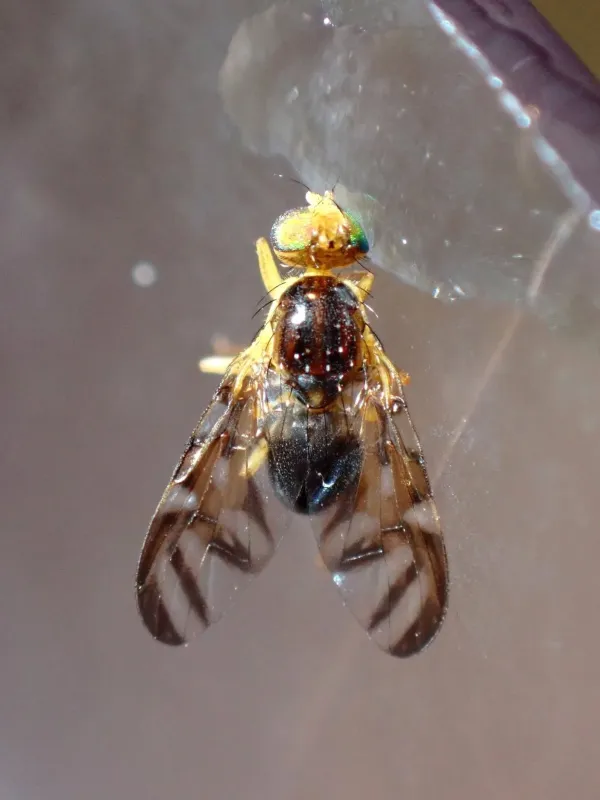
The celery fly (Euleia heraclei) is a notorious pest that specifically targets plants belonging to the Apiaceae family. The adult fly is easily recognizable by the distinct spotted, brownish patterns on its wings.
The adult insect is approximately 5–6 mm long. Its body is yellowish-brown, allowing it to blend in with foliage while searching for suitable sites to deposit its eggs.
Larvae are legless, maggot-like creatures, often white or pale yellow, reaching up to 7 mm in length. They spend their entire developmental period inside the host plant's leaf tissue.
Eggs are tiny and usually laid in small batches on the undersides of leaves. This hidden placement makes it difficult to detect early infestations without careful monitoring.
The life cycle involves multiple stages: egg, larva, puparium, and adult. Depending on local climatic conditions, there can be two to three generations per growing season.
##damage##The primary hosts for this pest include cultivated crops such as celery, celeriac, parsnips, and parsley. All these plants belong to the Apiaceae family, which is highly susceptible to the fly.
Beyond cultivated vegetables, the celery fly readily infests wild plants like hogweed and hemlock, which act as natural reservoirs for the pest population in rural and garden areas.
Damage is caused by larvae mining the leaves. They consume the photosynthetic tissue between the leaf surfaces, creating characteristic blisters or tunnels that destroy the plant's food-making ability.
Young plants are particularly vulnerable. A significant infestation can cause stunted growth, deformed leaves, and even the collapse of the plant if the mining is extensive enough.
In root crops like celeriac, the loss of foliage vitality directly affects root development, leading to smaller, lower-quality vegetables that are less suitable for long-term storage.
When it appears
The first generation of flies typically emerges in late spring, usually May, when temperatures rise significantly. These adults immediately begin searching for fresh host foliage.
Larval activity reaches its peak in early and mid-summer. This is when the characteristic "blistering" of the leaves becomes most apparent across the crop.
A second generation often emerges later in the summer, posing a serious threat to late-planted celery crops. Continuous monitoring is required throughout the summer months.
Generations frequently overlap, meaning that larvae at various stages of development can often be found on the same plant simultaneously throughout the season.
Overwintering occurs as a puparium, usually buried in the soil near the host plants. This allows the insect to survive harsh winter conditions and emerge the following spring.
Signs of infestation
The most diagnostic sign is the appearance of pale, blister-like spots on the leaves. These "mines" start small but eventually expand as the larva feeds and grows inside.
If you hold an infested leaf up to the light, you can often see the dark excrement of the larvae inside the mine, which looks like small black or brown specks.
As the infestation progresses, the mined areas turn brown, dry out, and become brittle. The foliage becomes unsightly, curled, and ultimately dies off.
In cases of heavy infestation, the entire leaf canopy may appear scorched and wilted. This significantly weakens the plant and reduces the overall harvest yield.
Early identification involves looking for tiny egg clusters on the undersides of the leaves. Removing these early can prevent the larvae from ever entering the leaf tissue.
Control measures
Effective management begins with strict crop rotation. Avoiding the planting of celery in the same area where Apiaceae were grown the previous year reduces the risk of larvae emerging from the soil.
Autumn soil cultivation is a highly recommended practice. Turning the soil helps bring buried pupae to the surface, where they are exposed to predators and freezing temperatures.
Removing wild Apiaceae weeds from the garden perimeter is essential. These weeds provide a bridge for the flies to move onto your valuable vegetable crops.
For small-scale gardeners, manual removal of infested leaves is an effective way to control the population. It is simple, chemical-free, and prevents the next generation from pupating.
Chemical control may be necessary for severe infestations. If using insecticides, choose products labeled for leaf miners and always pay close attention to the pre-harvest interval for edible greens.
Taxonomy
- Latin name
- Euleia separata
- Order
- Diptera (flies)
- Family
- Tephritidae
- EPPO code
- EULISE
Discussion
No discussions yet — be the first.