
Celery fly
Euleia heraclei
Description
How to identify
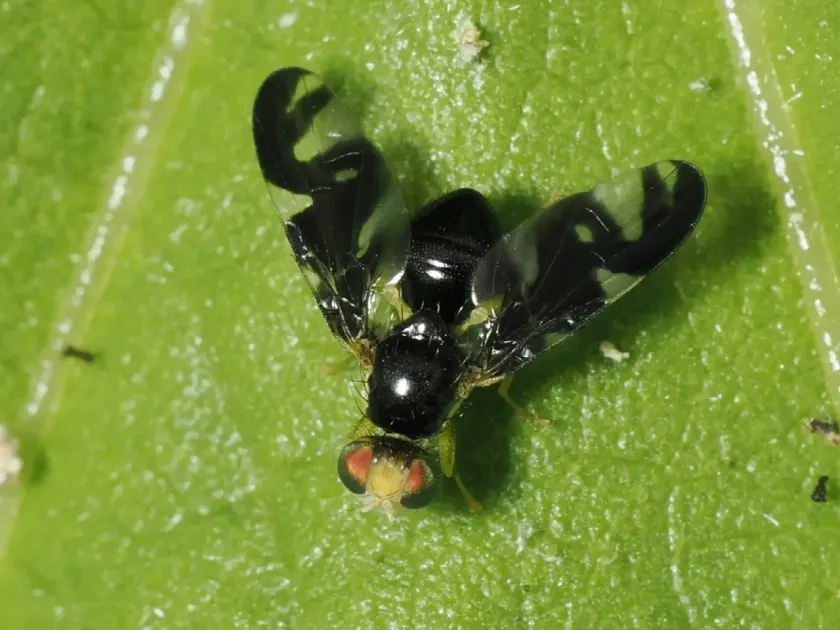
The celery fly (lat. Euleia heraclei) belongs to the order Diptera, family Tephritidae. The adult insect reaches 5–6 mm in length and features a brownish-yellow body with transparent wings showing a distinct dark net-like pattern.
The larvae are legless, maggot-like, dirty white or yellowish in color, and reach up to 7 mm in length. The larval stage is the most damaging for crops, as they lead a concealed life inside the leaf tissues.
The life cycle includes the egg stage, three larval instars, the pupal stage, and the adult phase. In temperate climates, the pest can produce one to two generations per season, significantly increasing the risks for plantations.
Pupae overwinter in the soil at a depth of a few centimeters, which provides them with reliable protection against winter frosts and makes it impossible to completely eradicate the pest by simple soil cultivation.
In spring, when the average daily temperature reaches approximately +15°C, adults emerge. They feed on the nectar of flowering plants, after which the females begin laying eggs on the underside of the leaves of host crops.
What it damages
The primary hosts of the celery fly are plants from the Apiaceae family. The most significant damage is inflicted on crops such as celery, parsnip, parsley, and lovage.
In the wild, the pest also infests native species like hogweed, angelica, and hemlock, which serve as infection reservoirs and ensure the survival of the population near cultivated fields.
Upon hatching, larvae burrow into the leaf epidermis and consume the parenchyma. This makes plants vulnerable to secondary bacterial infections that often develop at the damage sites.
Severe infestations lead to a sharp decline in photosynthetic activity, stunted growth, and a loss of marketability for the produce. In cases of intense infestation, the entire crop may be destroyed.
For root-type varieties of celery and parsnips, the quality and mass of the root are significantly reduced, as the plant must divert all resources to foliage recovery instead of root development.
Signs of infestation
The first visual sign of the pest's presence is the characteristic "mines" — light, winding paths inside the leaf tissue that eventually turn brown and wither.
When inspecting the foliage, one can notice irregular swellings; under close examination, translucent larvae or pest excrement can be found inside these blisters.
Affected leaves turn yellow, curl, and die off rapidly. If mass yellowing and drying of celery greenery are observed in the garden, it indicates a high level of infestation.
In the early stages, before mines become prominent, one can find small punctures from the female's ovipositor, which appear as tiny brown spots on the underside of the leaf.
- Appearance of winding leaf mines.
- Darkening and necrosis of leaf tissue areas.
- Presence of larvae inside tissue upon leaf tearing.
- Massive yellowing and suppression of plants.
- Growth retardation and leaf deformation.
Control measures
Agrotechnical methods include strict crop rotation and the removal of Apiaceae weeds around the garden. It is recommended to grow crops away from the previous year's planting sites.
Surface soil cultivation during the pupation and emergence periods helps destroy pupae located in the topsoil layer, which significantly reduces the population of the next generation.
To protect crops during the fly's active flight season, physical barriers such as floating row covers (agrofiber) are used, which effectively prevent egg-laying while preserving the quality of the greens.
Biological control methods include the use of entomophages or insecticides based on plant extracts, which target early-instar larvae before they burrow deep into the leaf tissue.
Chemical systemic insecticides are highly effective against leaf miners, but their application is strictly limited by pre-harvest intervals, especially for leafy celery varieties.
Taxonomy
- Latin name
- Euleia heraclei
- Order
- Diptera (flies)
- Family
- Tephritidae
- EPPO code
- ACIDHE
Discussion
No discussions yet — be the first.