
Celery fly
Euleia
Description
How to identify
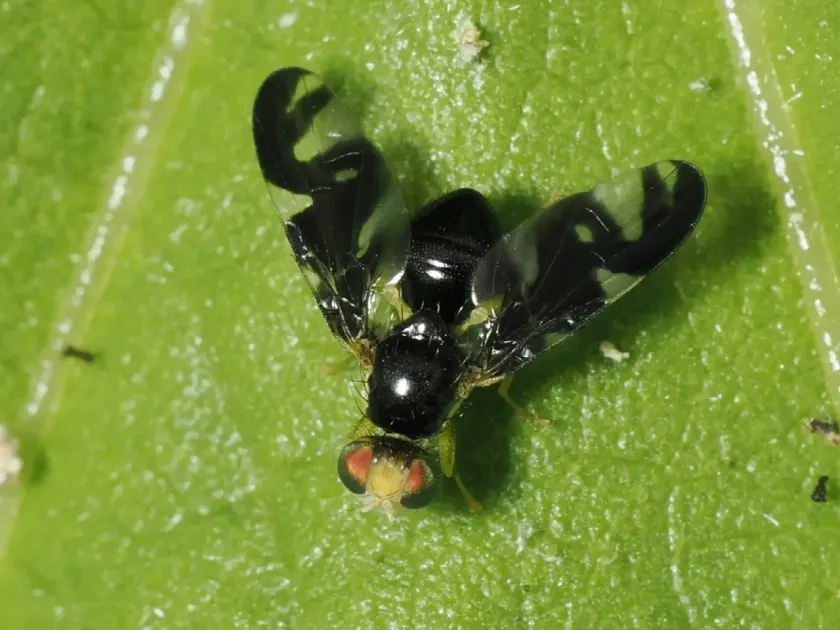
The celery fly (Euleia heraclei) belongs to the Tephritidae family, commonly known as fruit flies or picture-winged flies. The adult fly is approximately 5–6 mm long and possesses wings with distinct yellowish-brown patterns.
The body of the adult is reddish-brown or yellowish-brown. The larvae are legless, cylindrical, and reach a length of 7–8 mm, typically appearing creamy-white as they reside inside the plant leaves.
The life cycle involves an egg stage, three larval stages, a pupal stage, and the adult stage. The insect typically overwinters in the soil as a pupa, protected from frost.
Depending on regional climatic conditions, the celery fly can produce two generations per year, with the first emerging in late spring and the second during mid-summer.
Adults are most active during the day. They prefer warm, sunny conditions to locate host plants, where females insert eggs under the leaf epidermis using an ovipositor.
What it damages
Celery flies primarily target plants in the Apiaceae family. Key host crops include celery, celeriac, parsnip, parsley, and wild relatives like hogweed.
The larvae are specialized leaf miners. They feed on the internal parenchyma of the leaves while leaving the upper and lower leaf skins intact, creating characteristic tunnels.
Heavy infestations result in massive leaf chlorosis and necrosis. The leaves turn yellow, then brown, and eventually wither, which significantly impacts the plant's ability to photosynthesize.
In young plants, severe damage can stunt development or lead to total plant loss. For leafy celery, the aesthetic and nutritional damage to the foliage makes the product unmarketable.
Mining damage also exposes the plant tissue to secondary pathogens, increasing the likelihood of fungal and bacterial infections that can spread to the roots and stems.
When it appears
The first adult emergence typically occurs in late May or early June, coinciding with the beginning of the main growth phase for most Apiaceae crops.
Egg-laying activity peaks in June. During this time, the succulent, newly developed foliage is particularly vulnerable to the flies' attacks.
The second generation usually peaks in July and August, potentially damaging late-season crops and root varieties that are not yet harvested.
Environmental temperatures play a significant role in development speed; warmer summers lead to faster life cycles and, consequently, higher pest pressure on the garden.
By autumn, larvae of the final generation exit the leaves and burrow into the soil to pupate, entering a state of dormancy until the following spring.
Signs of infestation
The earliest symptom is the presence of small, pale dots on the surface of the leaves, which are the sites where the female fly has deposited her eggs.
As the larvae emerge and begin to feed, they create meandering, widening, pale-colored mines within the leaf tissue, which eventually turn dark and necrotic.
Upon close inspection, particularly when holding the leaf against light, the larvae themselves or their small, dark fecal deposits can be seen moving within the tunnels.
As the infestation progresses, the affected leaves become distorted, shriveled, and brittle. In severe cases, large portions of the plant canopy collapse.
The mining areas often become translucent or blistered, clearly indicating the presence of a pest consuming the internal leaf structure from within.
Control measures
Integrated Pest Management (IPM) is essential for controlling the celery fly. Cultural practices are the first line of defense to reduce the initial pest population.
- Practice crop rotation by moving celery beds away from previous sites annually.
- Deep autumn plowing to disturb the soil and expose overwintering pupae to predators and cold.
- Use fine-mesh insect netting (fleece) to cover young plants during the peak flight period in June.
- Remove and destroy any infested leaves immediately upon spotting the first mines.
Weed management is equally important; clearing nearby wild Apiaceae plants, such as giant hogweed, removes the alternate hosts that support the fly population.
Chemical control should be applied sparingly, targeting the early stages of infestation. Always follow local regulations regarding pesticide use on edible vegetables.
Taxonomy
- Latin name
- Euleia
- Order
- Diptera (flies)
- Family
- Tephritidae
- EPPO code
- EULISP
Discussion
No discussions yet — be the first.