
European fruit lecanium
Eulecanium tiliae
Description
How to identify
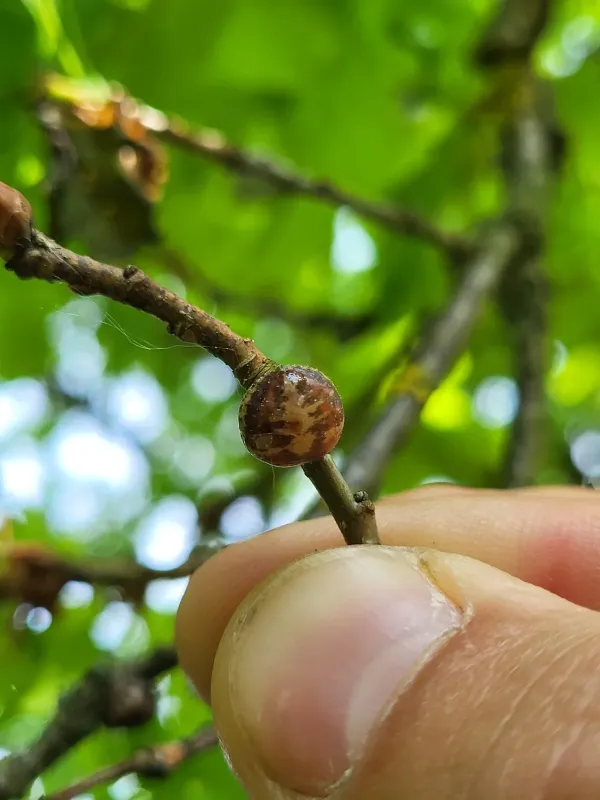
The European fruit lecanium Eulecanium tiliae is a scale insect belonging to the Coccidae family. The adult female is characterized by a convex, hemispherical, reddish-brown to dark brown body, reaching 5–8 mm in diameter.
Unlike armored scale insects, this species does not possess a separate wax cover; instead, the insect's own hardened cuticle functions as a protective shield.
This species is predominantly parthenogenetic, meaning reproduction occurs without fertilization, and males are rarely observed in natural populations.
First-instar nymphs, known as crawlers, are very small, flat, and equipped with legs, allowing them to actively move across the plant surfaces.
When the female lays eggs, she dries out, and her body creates a protective cover for the egg mass, ensuring survival against environmental fluctuations.
What it damages
Damage is caused by both nymphs and females, which feed on the plant's sap, leading to stunted growth, leaf yellowing, and general tree decline.
The insect infests a wide range of hosts, including lime trees, hawthorns, maples, as well as fruit trees like apple, pear, plum, and cherry.
The pest excretes honeydew, a sticky substance that promotes the growth of sooty mold, which blocks photosynthesis and reduces the tree's overall vigor.
Severe infestations result in premature leaf drop, dieback of young shoots, and increased susceptibility to other biotic and abiotic stress factors.
In ornamental settings, the presence of sooty mold and sticky excretions significantly impairs the aesthetic value of the trees and shrubs.
When it appears
The life cycle of the pest is univoltine, meaning there is only one generation per year. Second-instar nymphs overwinter in bark crevices.
In early spring, when the sap begins to flow, the nymphs migrate from their overwintering sites to the young branches to resume feeding.
Adult females mature by May, becoming stationary as they prepare for egg production, which typically occurs throughout the month of June.
The crawler stage emerges in mid-summer, moving to the undersides of leaves to feed and develop until the end of the summer season.
As autumn approaches, the nymphs migrate from the leaves back to the woody parts of the tree to find suitable locations for winter dormancy.
Signs of infestation
The most prominent sign is the presence of brown, raised, shell-like structures on the bark of twigs and branches during late spring and summer.
Sticky honeydew residues found on leaves and branches, often accompanied by foraging ants, are a clear indication of a sap-sucking pest infestation.
A black, sooty mold layer coating the foliage is a secondary sign that usually indicates a high population density of the scale insect.
Visible thinning of the canopy and yellowing of foliage in mid-summer are common symptoms observed in heavily infested trees.
Twigs may appear bumpy or roughened due to the accumulation of dead female remains that remain attached to the wood for a long time.
Control measures
Dormant oil applications in late winter or early spring are highly effective at suffocating overwintering nymphs before they become active.
Systemic insecticides applied during the crawler stage in mid-summer provide excellent control as the insects are most vulnerable during this period.
Cultural practices such as removing and burning heavily infested branches help to significantly reduce the pest population in the local environment.
Scrubbing the trunk and larger branches to remove old, loose bark can eliminate hiding spots for overwintering nymphs.
Encouraging natural predators like ladybird beetles and parasitic wasps is a sustainable way to keep scale populations below economic injury levels.
Taxonomy
- Latin name
- Eulecanium tiliae
- Order
- Hemiptera (bugs, aphids, leafhoppers)
- Family
- Coccidae
- EPPO code
- LECATI
Discussion
No discussions yet — be the first.