
Acacia scale
Eulecanium nocivum
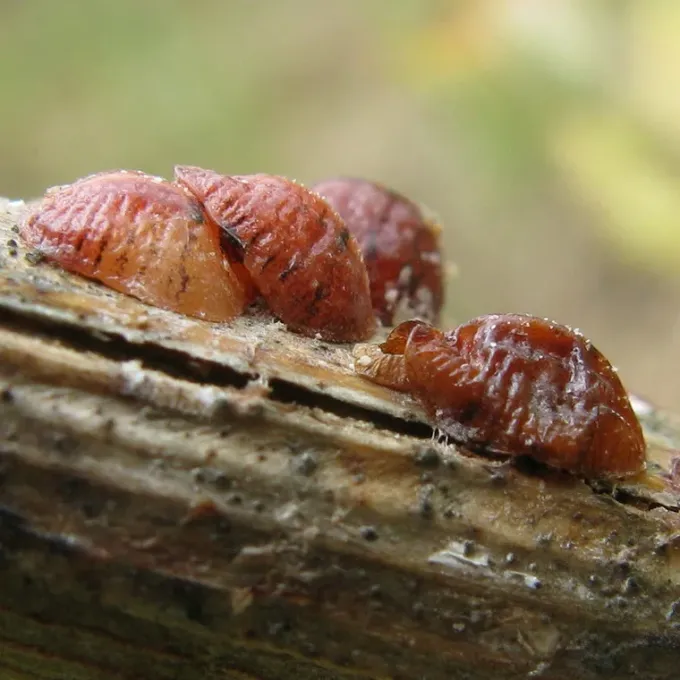
Description
How to identify
The acacia scale (Eulecanium nocivum) belongs to the Coccidae family (soft scales) within the order Hemiptera. The adult female has a characteristic convex, hemispherical shape, colored brown or reddish-brown, measuring 3–6 mm.
The insect's body is covered by a dense cuticle, which protects it from external influences and many contact insecticides. Females have almost entirely reduced limbs and lead a sedentary lifestyle on the bark of trees.
Males are extremely rare, short-lived, mobile, and winged. The coloration of females during the egg-laying period can vary from light brown to a dark chocolate shade with a characteristic sheen.
First-instar larvae, known as crawlers, are very small, flat, and pale yellow. They have well-developed legs, allowing them to actively disperse across the tree canopy in search of suitable attachment sites.
Second-instar larvae are less mobile; they begin to feed actively on plant sap, attaching themselves to the undersides of leaves or shoots. By autumn, they move back to the bark of branches for overwintering.
What it damages
This pest is a polyphage and affects a wide range of woody and shrubby plants. While it is named after the white acacia, it poses a threat to many fruit and ornamental species.
Host plants include apple, pear, plum, apricot, peach, hawthorn, and many other Rosaceae. The pest is also frequently found on maple, ash, and linden trees in shelterbelts and urban parks.
Mass reproduction of the insect poses a special danger in young orchards and nurseries, where saplings weakened by the scale may perish within one or two seasons.
Adults and larvae feed on plant sap, sucking nutrients from the phloem. This leads to significant weakening of the tree, slowed growth, and reduced immunity to infections.
Affected plants become more vulnerable to harsh winters and droughts, and in cases of heavy infestation, premature leaf drop and the drying of individual branches occur.
When it appears
Second-instar larvae overwinter on the bark of young twigs and shoots. As spring arrives, with average daily temperatures above 5-8 degrees Celsius, they wake up and begin to feed.
The process of transforming into an adult female takes about a month. In May-June, females lay a large number of eggs beneath their bodies, then perish, leaving the protective shield (the body) on the bark surface.
The emergence of crawlers from eggs usually coincides with the flowering phase of many fruit trees or shortly thereafter. June and July are the most active phases for their dispersal across the tree.
Larvae crawl to the underside of leaves, where they spend most of the summer, actively feeding and developing until the second stage.
In August-September, due to changes in daylight and temperature, second-instar larvae migrate from the leaves back to the bark of branches to prepare for the winter period.
Signs of infestation
The most visible sign of acacia scale presence is the appearance of a sticky substance—honeydew—on leaves and branches, which insects excrete while feeding.
Sooty mold fungi often colonize this sugary honeydew, causing leaves and shoots to be covered in an unpleasant black layer that interferes with the photosynthesis process.
When inspecting the bark of branches, one can notice characteristic hemispherical "bumps" of brown color. If pried open, a mass of small eggs or the dry shell of a female is found beneath.
Infected trees look depressed; their leaves may turn yellow and curl, and the canopy becomes sparse due to the death of young shoots.
During the summer, the presence of the pest is signaled by ants actively visiting the trees to feed on the sweet secretions of the scales and protecting them from predatory insects.
Control measures
A combination of agricultural and chemical control methods is used to manage the acacia scale. Regular sanitary pruning of damaged and dried branches, where the bulk of overwintering larvae are concentrated, is crucial.
An effective technique is to clean trunks and large branches of old, dead bark, where pests often hide, followed by whitening the trunks.
Chemical treatment is most effective during the crawler emergence period (June-July), when they are not yet covered by a dense protective shell and are most vulnerable to insecticides.
- Application of systemic neonicotinoid insecticides.
- Use of organophosphate preparations during the growing season.
- Application of mineral oils in early spring to eliminate overwintering larvae.
The biological control method involves attracting natural enemies to the garden, such as parasitic wasps and predatory lady beetles, which can significantly reduce the population density.
Taxonomy
- Latin name
- Eulecanium nocivum
- Order
- Hemiptera (bugs, aphids, leafhoppers)
- Family
- Coccidae
- EPPO code
- EULCNO
Discussion
No discussions yet — be the first.