
Eucalyptus scale
Eucalymnatus
Description
How to identify
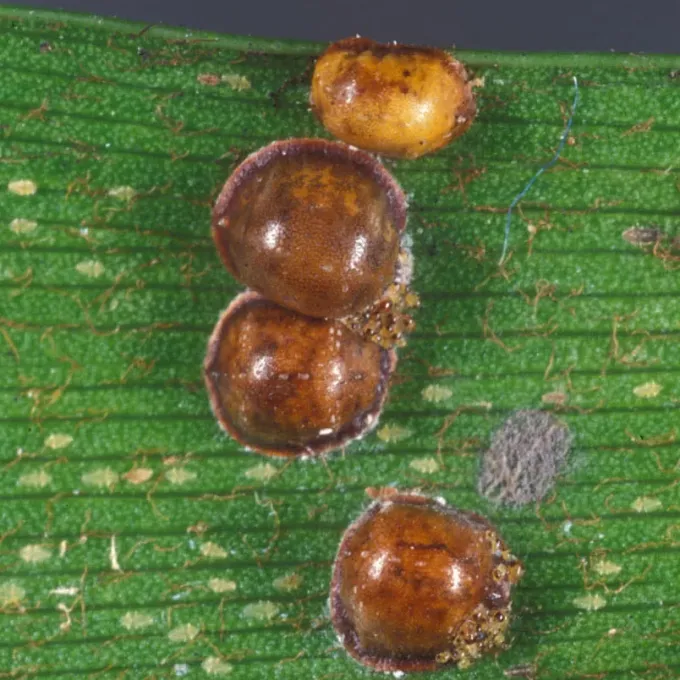
The Eucalyptus scale (Eucalymnatus tessellatus) is a member of the Coccidae family. Adult females are characterized by a flat, oval, brown or greenish-brown body that features a distinct tessellated or mosaic-like pattern on the dorsal surface.
Unlike armored scale insects, this species does not have a separate waxy shield that can be easily lifted off. Instead, the entire body of the insect hardens and functions as a protective covering for its eggs and developing nymphs, making it blend in with plant stems and leaves.
The nymphs, known as crawlers, are microscopic and highly mobile. They move across the host plant seeking suitable sites to settle and insert their mouthparts into the plant tissue to begin feeding on sap.
Reproduction is typically parthenogenetic, meaning the population can expand rapidly without the need for males. This biological trait allows a single individual to successfully infest an entire plant in a relatively short period under favorable conditions.
These insects prefer settling along the veins on the underside of leaves, as well as on petioles and young, succulent stems where the plant’s vascular system is most accessible for nutrient extraction.
What it damages
This pest attacks a wide range of ornamental and greenhouse plants, including eucalyptus, ficus, palms, bay laurel, and various orchids. Greenhouse environments provide a year-round habitat for these insects, leading to persistent infestations.
The primary damage is caused by the insect sucking cell sap, which leads to significant nutrient depletion. Infested plants exhibit stunted growth, leaf wilting, and sometimes total decline due to the physiological stress imposed by the pest.
As they feed, the scales excrete a sticky substance known as honeydew. This sweet, sugary residue serves as a perfect medium for the growth of sooty mold, which coats the foliage in a black film, hindering gas exchange and photosynthesis.
Heavy infestations can lead to leaf drop and, in severe cases, the death of individual branches or the entire plant. The damage is often cumulative, meaning the plant loses vigor gradually over time, making it prone to other secondary infections.
Because the insects are masters of camouflage, owners often notice the infestation only after significant damage has occurred or when the sticky honeydew becomes visible on surfaces beneath the plant.
When it appears
In indoor and greenhouse environments, the lifecycle of the Eucalyptus scale is continuous. There is no natural winter diapause, meaning that reproduction and feeding occur throughout the year as long as the host plant is kept alive.
While environmental conditions like temperature are relatively stable, seasonal changes in plant health—often caused by lower light levels in winter—can make the host plant more susceptible to severe damage and rapid insect colonization.
Crawlers can spread between plants at any time of the year, particularly in collections where plants are grouped closely together. Introducing new, infested plants without a proper quarantine period is the most common way this pest enters a clean environment.
Ambient room temperatures are ideal for the rapid development of successive generations. The length of the lifecycle can vary depending on the specific temperature, but it is generally fast enough to create overlapping generations of the pest.
When plants are moved outdoors during warmer months, there is a risk of additional stressors, but the primary threat remains the high-density colonies formed within the stable, protected environment of a home or conservatory.
Signs of infestation
The most immediate sign of an infestation is the appearance of sticky spots on leaves, stems, or nearby furniture. This honeydew is a clear indication that sap-sucking insects are active on the plant.
Another telltale sign is the presence of small, immobile brown or greenish bumps on the leaves and stems. These are the adult females, which remain fixed in place and can be mistaken for natural plant bumps or bark structures.
The development of sooty mold, appearing as a patchy black powdery film on the leaves, is a secondary symptom. If you see this mold, it is a definitive sign that a colony of scale insects or other sap-suckers is feeding on the plant.
Visual decline, including yellowing leaves, curling, and abnormal growth patterns, indicates that the plant is struggling to maintain its physiological balance under the pressure of the pest.
Upon closer inspection with a magnifying glass, one might spot the tiny, translucent crawlers moving across the surface of the leaves, preparing to establish new feeding sites across the plant.
Control measures
Control should start with the physical removal of the pests. Using a soft cloth or cotton swab dipped in rubbing alcohol, manually wipe down the leaves and stems to remove as many adult scales as possible.
Systemic insecticides are the most effective solution, as they are absorbed by the plant and ensure that the sap becomes toxic to the scale insects. This is particularly useful for hidden individuals that may be missed during manual cleaning.
A consistent treatment schedule is crucial; apply insecticides at 10 to 14-day intervals to catch the next generation of crawlers as they emerge from beneath the protective shells of the dead females.
- Isolate new plants for a 3-week quarantine period.
- Inspect the undersides of leaves and leaf axils regularly.
- Use systemic pesticides with imidacloprid or similar active ingredients.
- Maintain plant health with optimal light and humidity to improve natural resistance.
Do not ignore the soil and pot surfaces, where crawlers can hide. Keeping the plant clean and monitoring for early signs of honeydew will prevent major outbreaks and ensure the long-term health of your collection.
Taxonomy
- Latin name
- Eucalymnatus
- Order
- Hemiptera (bugs, aphids, leafhoppers)
- Family
- Coccidae
- EPPO code
- EUCYSP
Discussion
No discussions yet — be the first.