
Cocklebur gall fly
Euaresta aequalis
Description
How to identify
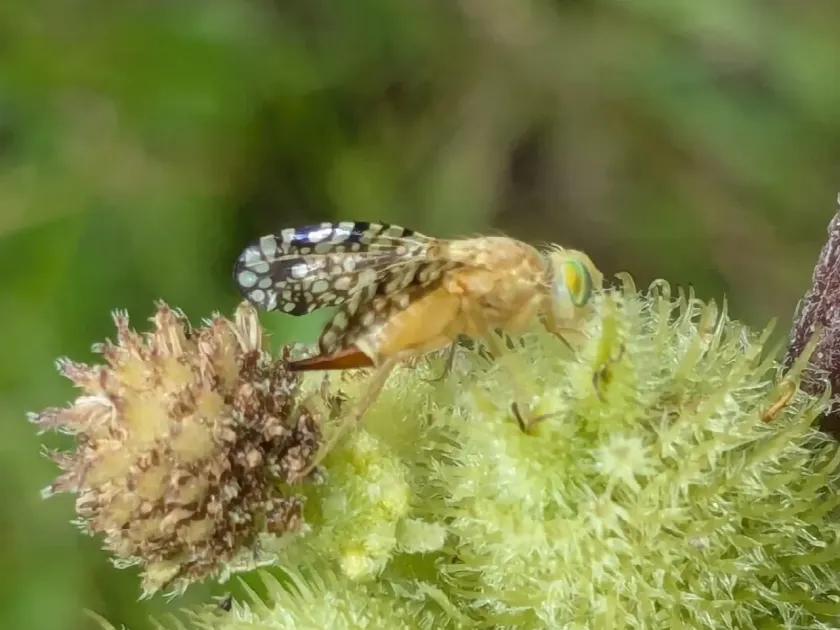
The cocklebur gall fly Euaresta aequalis belongs to the order Diptera and the family Tephritidae. This small insect is distinguished in the adult stage by a characteristic net-like pattern on its wings, which serves as a key diagnostic feature.
The body of an adult typically reaches 4–6 mm in length. The coloration ranges from yellowish-brown to darker shades, providing effective camouflage against the background of flower heads.
The larvae of the pest have a typical tephritid appearance: they are legless, headless, and creamy-white in color, specifically adapted to feed inside plant tissues.
The species is a specialized pest closely associated with plants of the Asteraceae family. Its life cycle is strictly synchronized with the flowering period of its host plants.
Identifying this pest in the field requires close inspection of flower heads during the budding and early flowering stages, when adults are most active and ovipositing.
What it damages
The primary food sources for this species are plants from the Asteraceae family, particularly those within the genus Xanthium (cockleburs).
The pest targets seed heads, where larvae develop by feeding on developing seeds and ovaries, leading to significant yield losses in seed production.
Damaged flower heads fail to form viable seeds, rendering them unsuitable for plant propagation or the collection of raw botanical materials.
In regions where cocklebur is considered an invasive weed, Euaresta aequalis may be viewed as a biological control agent as it naturally limits the spread of this plant.
However, when it affects cultivated Asteraceae crops, the pest can significantly reduce the germination rates and quality of seed batches on an industrial scale.
When it appears
The pest overwinters primarily in the pupal or adult stage, residing in plant debris or the upper layer of soil beneath affected host plants.
Adult emergence begins in the spring once stable positive temperatures are reached, coinciding with the onset of bud formation in host plants.
Peak activity occurs during the summer months, characterized by mass flight and mating, followed by egg deposition into the flower heads.
The development of one generation takes approximately 4–6 weeks, depending heavily on the regional climate and humidity levels.
Towards the end of the summer, the final generation appears, which enters diapause to prepare for successful overwintering.
Signs of infestation
The first visual indication of infestation is the presence of tiny punctures on the bracts of flower heads, created by females during the egg-laying process.
Inside the flower head, premature wilting of individual florets and discoloration of tissues occur as a direct result of larval feeding activity.
Opening a seed head reveals larvae feeding among developing seeds, usually accompanied by frass (larval excrement) left behind in the chambers.
- Deformation of flower heads and premature shedding.
- Lack of full-sized, healthy seeds inside the heads after the flowering cycle.
- Presence of small exit holes in dried flower heads during the autumn.
In areas of high larval density, flower heads may undergo secondary decay caused by pathogenic fungi entering through the larval feeding wounds.
Control measures
The primary management strategy is cultural control, which involves deep plowing after harvest to bury and destroy overwintering plant debris.
Timely removal and destruction of wild Asteraceae weeds surrounding the fields help prevent the buildup of pest populations near crops.
The use of biological control agents, such as specialized parasitoids that limit larval numbers, represents an environmentally friendly approach to management.
Chemical control using systemic insecticides can be effective during the mass emergence of adults, applied before larvae penetrate deep into the flower heads.
Implementing a proper crop rotation schedule that excludes host plants for this specific fly helps break the development cycle and reduces the overall pest pressure.
Taxonomy
- Latin name
- Euaresta aequalis
- Order
- Diptera (flies)
- Family
- Tephritidae
- EPPO code
- EUARAE
Discussion
No discussions yet — be the first.