
Walnut felt mite
Eriophyes tristriatus
Description
How to identify
The walnut felt mite (Eriophyes tristriatus) belongs to the Eriophyidae family, known as gall mites or four-legged mites. These are microscopic pests that are invisible to the naked eye.
The mite has a worm-like, elongated body that is typically pale or yellowish. Because they are only about 0.2 mm long, identification is based primarily on the specific symptoms they cause on the leaves.
The life cycle is closely linked to the host plant. Adult females overwinter under the bud scales, remaining dormant until the tree begins its growth phase in early spring.
As soon as the buds begin to open, the mites emerge and move onto the developing leaves. They feed on plant sap, causing the leaf tissue to react by forming abnormal growths.
Several generations can occur throughout the growing season, allowing the colony to spread rapidly across the canopy under favorable temperature conditions.
What it damages
The walnut felt mite primarily affects the common walnut (Juglans regia). It can also occur on other species within the Juglandaceae family, causing similar symptoms.
While the mite rarely kills a mature tree, it weakens the host by disrupting photosynthesis in the affected leaf areas, which is particularly detrimental to young saplings.
Extensive infestation leads to premature leaf drop, which stresses the tree, reduces its vigor, and may compromise its ability to withstand harsh winter conditions.
The quality and yield of nuts may be indirectly affected due to the reduced photosynthetic area and general physiological stress imposed on the walnut tree.
In ornamental walnut plantings, the primary damage is the significant decline in aesthetic value due to the deformed and discolored leaves caused by the mite colonies.
Signs of infestation
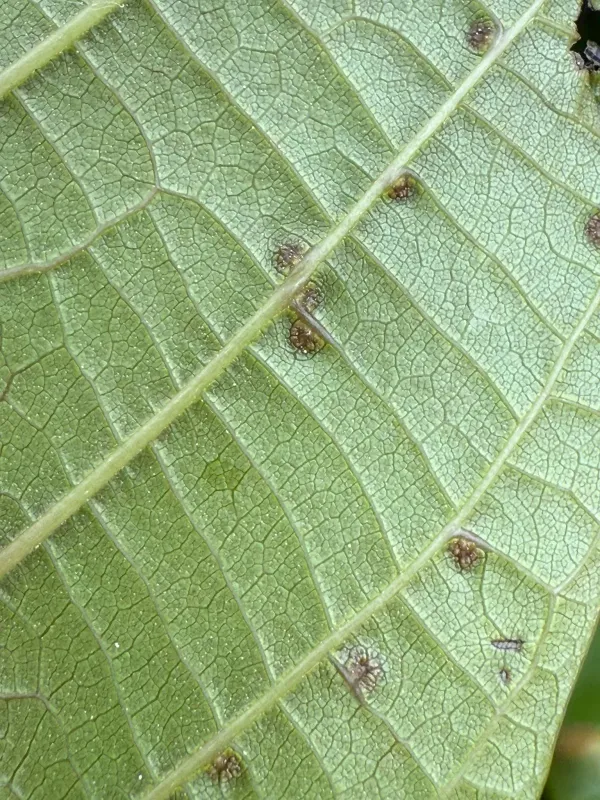
The most distinctive sign is the development of felt-like patches (erinea) on the underside of the leaflets. These patches begin as white or pale but turn brown as they age.
On the upper side of the leaf, corresponding to the patches below, one will notice small, raised bumps or blisters, causing the leaf to appear deformed or bubbled.
The "felt" is composed of abnormally developed leaf hair cells stimulated by the mites. This structure provides a secure shelter for the mites, protecting them from predators.
In cases of heavy infestation, the leaves may curl, turn yellow prematurely, and drop off, leading to a thin canopy during the peak of the growing season.
- White or brown velvet-like patches on the underside of leaves.
- Raised, distorted bumps on the upper surface of leaves.
- Premature yellowing and leaf shedding throughout the season.
Control measures
Control is primarily achieved through the application of acaricides. Because the mites are protected within the galls, systemic products are significantly more effective than contact sprays.
The most critical window for treatment is early spring when the mites are migrating from their overwintering sites to the new buds before they can establish protective galls.
Sanitation is a vital cultural practice. Collecting and destroying fallen leaves during the autumn helps reduce the overwintering population for the following year.
Maintaining the overall health of the walnut tree through proper irrigation and balanced fertilization helps the tree recover more quickly from mite-related stress.
Encouraging beneficial predator mites in the orchard can provide biological control, as these predators can significantly reduce the population of gall mites over time.
Taxonomy
- Latin name
- Eriophyes tristriatus
- Order
- Mites
- Family
- Eriophyidae
- EPPO code
- ACEITR
Discussion
No discussions yet — be the first.