
Lime nail gall mite
Eriophyes tiliae
Description
How to identify
The lime nail gall mite (Eriophyes tiliae) is a member of the Eriophyidae family of mites. These are microscopic organisms, typically measuring about 0.2 millimeters in length, making them invisible to the naked eye.
They possess a worm-like, elongated body that is typically pale or whitish. Unlike many other arachnids, these mites have only two pairs of legs, which are positioned near the front of the body for movement.
The life cycle is closely synchronized with the growth of the Tilia tree. Overwintering females emerge from crevices in the bark or bud scales just as the new leaves begin to unfurl in the spring.
These mites are highly specialized and rely on the host plant to provide both nutrition and a physical environment for their development, which they achieve by inducing gall formation.
Dispersal is primarily passive, relying on wind currents to carry individuals to new host trees, though they can also be transported by insects or larger animals moving through the foliage.
What it damages
The primary host for this mite is the linden or lime tree (Tilia). It is most frequently found on Tilia cordata and Tilia platyphyllos, where it targets the developing young leaves.
The mite feeds by sucking sap from the leaf tissue. As it feeds, it releases chemicals that cause the plant to produce a gall, which serves as a protective enclosure and feeding site for the mite colony.
While an established linden tree can usually tolerate a moderate infestation without significant long-term mortality, severe outbreaks can cause substantial stress to the tree's physiological health.
In nursery settings, high mite density is a significant problem as it ruins the aesthetic value of the trees, making them less desirable for landscaping and commercial sales.
Persistent and heavy infestations can lead to premature leaf drop, reduced photosynthesis, and potentially a decline in the tree's overall growth rate over several successive seasons.
Signs of infestation
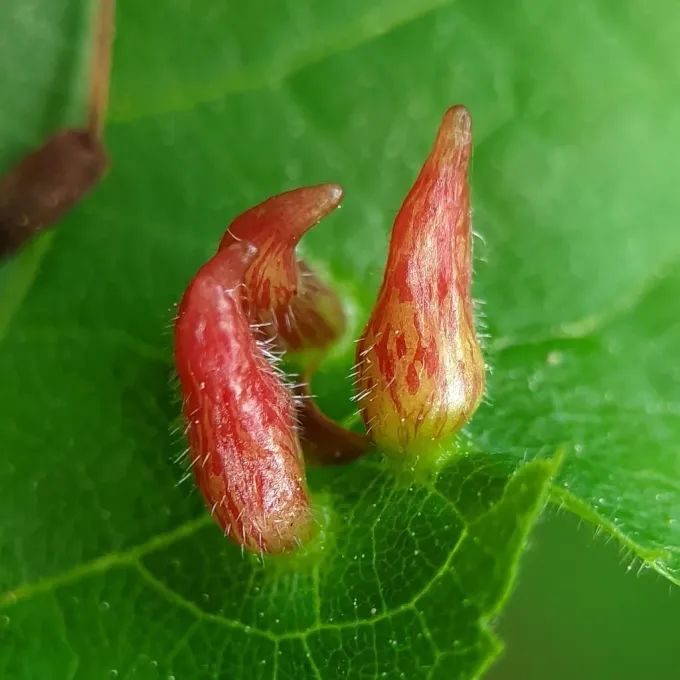
The most distinctive symptom is the presence of galls, which appear as narrow, spike-like or nail-shaped protrusions. These typically develop on the upper surface of the leaf.
These galls are often vividly colored, ranging from light green to various shades of red or purple. This coloration is a typical physiological response of the leaf tissue to the mite's feeding activity.
When observing the underside of the leaf, one can usually find a small opening corresponding to the base of the gall, which allows the mites to enter and exit their protective structure.
As the season progresses, the galls may become woody, brown, or shriveled. If the infestation is widespread, the entire leaf may become curled, deformed, or yellowish, signaling a decline in leaf function.
The overall effect on the tree is a noticeable change in the texture and health of the canopy, which is particularly evident in urban environments where tree appearance is carefully monitored.
Control measures
Managing the lime nail gall mite is challenging because the mites spend most of their life cycle protected within the galls, where contact pesticides are largely ineffective.
Control efforts must be timed precisely to the spring period when the overwintering adults are moving onto the fresh, emerging leaves before they initiate new gall formation.
- Apply acaricides specifically during the bud-burst stage to eliminate the emerging population.
- Utilize sulfur-based sprays, which are known to be effective against eriophyid mites.
- Promote tree vigor through proper watering and fertilization to help the tree withstand stress.
- Remove and dispose of heavily infested leaves during the autumn to reduce the overwintering mite population.
Biological control can also play a role; encouraging populations of predatory mites (such as phytoseiid mites) can naturally suppress the numbers of Eriophyes tiliae in the landscape.
Always ensure that any chemical application is performed according to local regulations, prioritizing the safety of the surrounding environment and the health of other beneficial insects.
Taxonomy
- Latin name
- Eriophyes tiliae
- Order
- Mites
- Family
- Eriophyidae
- EPPO code
- ERPHTI
Discussion
No discussions yet — be the first.