
Plum gall mite
Eriophyes similis
Description
How to identify
The plum gall mite, scientifically known as Eriophyes similis, is a microscopic pest belonging to the family Eriophyidae. Adults are typically 0.2–0.3 mm long, with a worm-like body and a pale, yellowish or white coloration.
These mites possess only two pairs of legs located at the front of their bodies, which is a key morphological characteristic distinguishing them from other arachnids. Due to their minute size, they are impossible to see without professional magnification.
Their primary biological feature is the ability to manipulate plant growth hormones. By feeding on leaf tissue, they cause the formation of specific structures known as galls, which serve as their primary habitat and nursery.
The population consists almost entirely of females, which are the only stage capable of overwintering in the buds of the host plant. Males are rarely observed, as reproduction can occur through various complex life strategies.
Being highly host-specific, Eriophyes similis mainly affects trees within the Prunus genus. They are cryptic pests that remain hidden for most of their lives, making monitoring and control quite challenging.
What it damages
The primary host for this pest is the domestic plum (Prunus domestica), although wild plum and sloe bushes are also frequently infested. Severe infestations can occur if adjacent trees are left untreated.
Mites primarily target the leaf blades. By piercing plant cells to feed on sap, they cause localized irritation that results in abnormal cell proliferation, forming the characteristic pouch galls.
These galls act as a sink for plant nutrients, diverting resources that would otherwise be used for shoot growth and fruit development. This leads to a decline in the overall vigor of the host tree.
Heavy infestations reduce the photosynthetic capacity of the tree. As leaves become covered in galls, they lose their efficiency, leading to premature leaf drop and reduced sugar storage in the wood.
Reduced carbohydrate storage directly affects the tree's winter hardiness. Trees severely affected by mites are significantly more prone to winter injury and show lower fruit yields in the following seasons.
When it appears
The life cycle is closely synchronized with the phenology of the plum tree. Overwintering females emerge from their shelters under bud scales as soon as the buds begin to swell in early spring.
The mites migrate to the newly unfolding leaves and begin feeding, which initiates the formation of galls. These galls provide protection and a food source for the developing generations throughout the summer.
Multiple generations occur throughout the growing season. The development speed is strictly dependent on temperature, with warmer summers leading to faster population growth and more significant damage.
Toward the end of the season, typically in late summer or early autumn, the mites leave the galls and migrate back to the buds. They settle in the bud axils and under the scales to survive the winter dormancy period.
Spread between trees occurs passively, primarily through wind dispersal. Even in well-managed orchards, mites can easily migrate from nearby untreated wild or neglected plum trees.
Signs of infestation
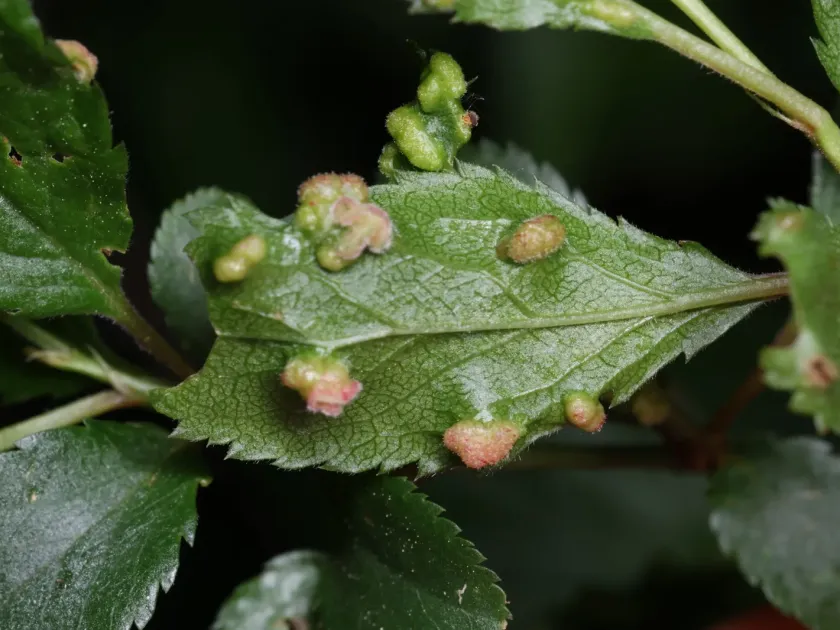
The most prominent sign of infestation is the appearance of pouch galls. These are small, elongated, or pocket-like protrusions found mostly on the upper surface of the leaves.
Initially, these galls are small and light-colored, often blending with the leaf. As the season progresses, they may turn reddish, brown, or black, becoming very conspicuous against the green leaf tissue.
- Distorted, curled, or stunted leaf blades.
- Visible bumpy texture on the leaf surface.
- Yellowing or premature browning of leaves in high-pressure areas.
- Reduced shoot elongation and general canopy thinning in chronic infestations.
Close inspection reveals small openings on the underside of the leaves, which serve as entry points for the mites into the gall chambers. In severe cases, the galls merge, covering significant portions of the foliage.
Control measures
Integrated management is essential for controlling the plum gall mite. The first step involves physical removal: pruning and destroying infested branches can significantly reduce the overwintering population.
Orchard hygiene is equally important; collecting and burning fallen leaves in the autumn prevents mites from seeking nearby shelters or surviving in plant debris under the canopy.
Chemical control must be timed precisely. The most vulnerable period is during the early spring migration from the buds to the leaves. Once the mites are inside the galls, they are shielded from most surface-applied insecticides.
Systemic acaricides are preferred over contact ones, as they can be translocated into the leaf tissue, reaching the mites protected within the galls.
Always implement a rotational spraying program to avoid the development of chemical resistance. Monitoring local economic thresholds is advised to avoid unnecessary pesticide applications that could harm beneficial predatory mites.
Taxonomy
- Latin name
- Eriophyes similis
- Order
- Mites
- Family
- Eriophyidae
- EPPO code
- ERPHSI
Discussion
No discussions yet — be the first.