
Grape erineum mite
Eriophyes reyesi
Description
How to identify
The grape erineum mite, Eriophyes reyesi, is a microscopic pest belonging to the family Eriophyidae. Unlike common spider mites, these pests have only two pairs of legs and are invisible to the naked eye.
Their bodies are elongated, worm-like, and pale in color. They reside in protected environments, specifically within the leaf galls they induce on the host plant.
The mite overwinters as fertilized females sheltered deep within the bud scales or in the bark crevices of the grapevine.
With the onset of spring, they emerge and migrate to the developing leaves to begin their feeding cycle and colonization of new tissue.
Due to their sheltered lifestyle inside the erinea (the felt-like patches), traditional chemical control can be challenging, requiring systemic or specifically timed contact treatments.
What it damages
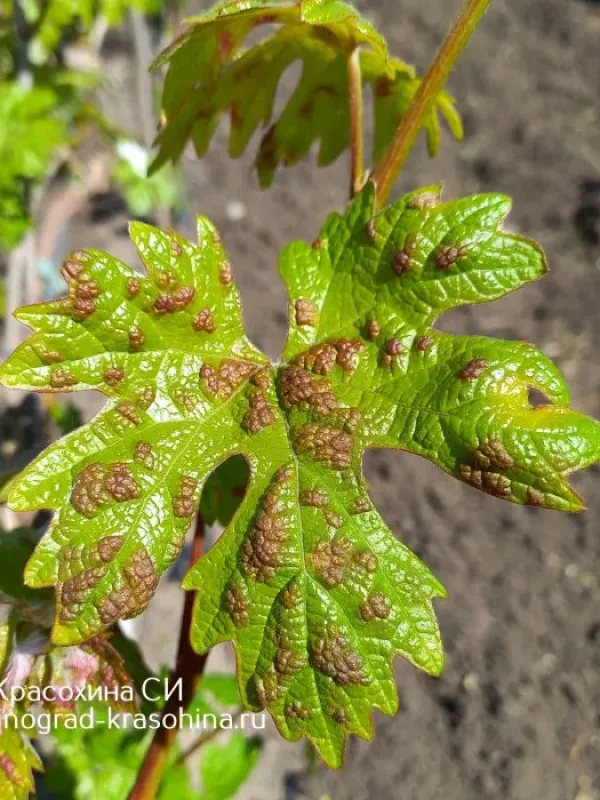
This mite is a plant-parasitic species that feeds on the epidermal cells of grape leaves. This feeding triggers the plant to form dense, felt-like hairs on the undersides of the leaves.
These patches, known as erineum, can vary in color from white to yellow, pink, or reddish-brown as the season progresses and the tissue ages.
Excessive feeding inhibits the leaf's ability to undergo photosynthesis, causing the leaves to become distorted, blistered, and curled.
When the mite population is high, the damage can spread to floral clusters, causing flower abortion and potentially leading to significant yield loss.
Long-term heavy infestation results in reduced vine vigor, stunted growth, and poor wood maturation, which negatively impacts the vine's cold hardiness.
When it appears
The mites resume activity as soon as the sap begins to flow and the buds break in the spring, typically when temperatures reach about 10°C.
The pest progresses through multiple generations throughout the spring and summer, with the population density peaking during warm and dry periods.
Migration from older leaves to the younger, more succulent leaves at the shoot tips continues until late in the growing season.
As the weather cools and leaves begin to senesce in autumn, the mites abandon the foliage to seek out overwintering sites in the buds.
The total duration of a single generation can be as short as two weeks in optimal high-temperature conditions, allowing for rapid outbreaks.
Signs of infestation
The most diagnostic sign is the presence of felt-like patches (erinea) on the underside of leaves, corresponding to convex bumps on the upper surface.
Initially, these patches are bright and white, but they often turn brownish and resemble necrosis or rust as the season proceeds.
Infected leaves may show severe deformation or curling, which can sometimes be confused with herbicide drift or viral symptoms.
Stunted shoot development and poor berry set in the current season are key indicators that the infestation level has become detrimental.
A closer inspection with a hand lens (at least 10x magnification) is required to distinguish the mite activity from fungal diseases like downy mildew.
Control measures
Effective management requires a combination of cultural practices and targeted chemical interventions to suppress mite populations.
- Apply sulfur-based fungicides during bud break, as they are highly effective against early-season mite populations.
- Use selective acaricides if infestations reach thresholds that threaten leaf area or cluster health.
- Ensure thorough spray coverage, especially on the undersides of leaves where the mites are protected by the felt.
- Remove and destroy heavily infested leaves early in the season to reduce the local pest reservoir.
- Promote vine health through balanced fertilization and irrigation to help the plant tolerate mite-induced stress.
Taxonomy
- Latin name
- Eriophyes reyesi
- Order
- Mites
- Family
- Eriophyidae
- EPPO code
- ERPHRE
Discussion
No discussions yet — be the first.