
Oak gall mite
Eriophyes quecerinus
Description
How to identify
The oak gall mite (Eriophyes quercinus) is a microscopic member of the Eriophyidae family, order Trombidiformes. These mites are too small to be seen with the naked eye, measuring only a fraction of a millimeter in length.
The body of the mite is elongated, worm-like, and typically light-colored. They possess only two pairs of legs, which is a distinctive characteristic of the eriophyid mite family, distinguishing them from other arachnid pests.
These mites are highly host-specific, primarily infesting oak trees (Quercus spp.). They spend most of their life cycle inside plant tissue deformations known as galls, which provide both food and protection from environmental stress and predators.
Dispersal is mainly passive. Mites are carried by wind currents, raindrops, or through the movement of insects that travel between host trees. Human activities, such as transporting infested nursery stock, also play a significant role in their spread.
Adult females overwinter in the crevices of oak buds or under bud scales. As soon as temperatures rise in spring, they migrate to the newly unfolding leaves to begin feeding and initiating the formation of new galls.
What it damages
The oak gall mite specifically targets oak species. While it is rarely lethal to mature trees, it can cause significant damage to young saplings in nurseries, ornamental trees in landscapes, and stressed specimens in forests.
Damage occurs when mites feed on the surface of young leaves, causing the plant to react by growing abnormal tissue, known as galls. This tissue proliferation disrupts the leaf's ability to photosynthesize and regulate water usage efficiently.
Heavy infestations can lead to premature leaf yellowing and dropping, which weakens the tree. This reduced vigor can make the oak more susceptible to other stressors, such as drought, secondary pests, or fungal infections.
For young trees, extensive gall formation can lead to stunted growth and structural deformations of the foliage. This often ruins the aesthetic appearance of the tree, which is a major concern in urban parks and residential gardens.
In forest stands, while the direct impact on timber quality is minimal, the cumulative stress caused by repeated annual infestations can contribute to the overall decline of oak populations, especially in already challenged ecosystems.
Signs of infestation
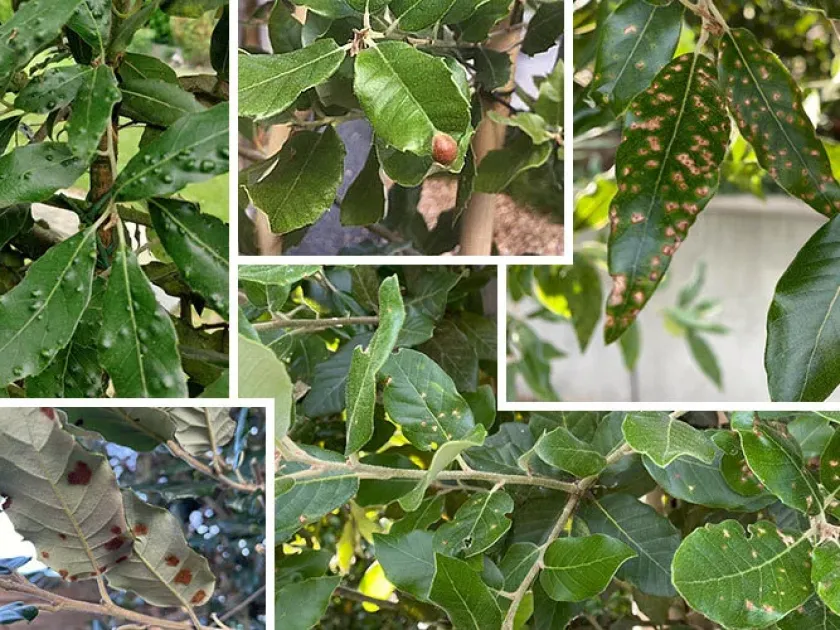
The most diagnostic sign of an infestation is the presence of small, fuzzy, velvet-like patches on the underside of leaves. These are the galls, and they can vary in color from light green to yellow or brownish.
On the upper surface of the leaf, corresponding to the galls below, one can observe localized depressions or bumps. The foliage may appear crinkled, curled, or distorted in areas where mite colonies are established.
During the growing season, the galls may become more pronounced. In some cases, the tissue around the mite colony becomes necrotic, leading to brown spots that might be mistaken for leaf spot diseases caused by fungi.
Unlike fungal spots, which are usually flat, the galls caused by Eriophyes quercinus have a distinct texture. Magnification reveals the felt-like structure, which is a hallmark of the damage caused by this mite species.
Towards the end of the summer, heavily infested leaves may begin to wither and dry out prematurely. This early defoliation is a clear indicator that the trees are struggling to maintain normal metabolic functions due to the mite pressure.
Control measures
Managing the oak gall mite is challenging because the mites are protected inside the leaf tissues once the galls are fully formed. Therefore, timing is critical for any intervention, focusing on the early season migration phase.
Sanitation is a vital component of control. Removing and destroying infested leaf litter and pruning heavily infested branches during the dormant season helps to reduce the number of overwintering females, thus limiting next year's population.
Chemical control is most effective when applied at the very beginning of the spring, just as the buds begin to burst and the overwintering females emerge to colonize new leaves. Systemic acaricides can be effective if applied correctly.
Promoting general tree health is a proactive measure. Well-watered and properly fertilized trees are better able to tolerate mite damage. Improving soil quality and reducing competition with other plants can enhance the tree's resilience.
- Apply systemic acaricides when buds begin to open in spring.
- Remove and incinerate fallen leaves to eliminate overwintering sites.
- Regular monitoring of tree foliage for early signs of gall formation.
Taxonomy
- Latin name
- Eriophyes quecerinus
- Order
- Mites
- Family
- Eriophyidae
- EPPO code
- ERPHQU
Discussion
No discussions yet — be the first.