
Plum gall mite
Eriophyes pruni
Description
How to identify
The plum gall mite (Eriophyes pruni) is a microscopic pest belonging to the order Acariformes and family Eriophyidae. These mites are worm-like and extremely small, measuring approximately 0.2 mm in length.
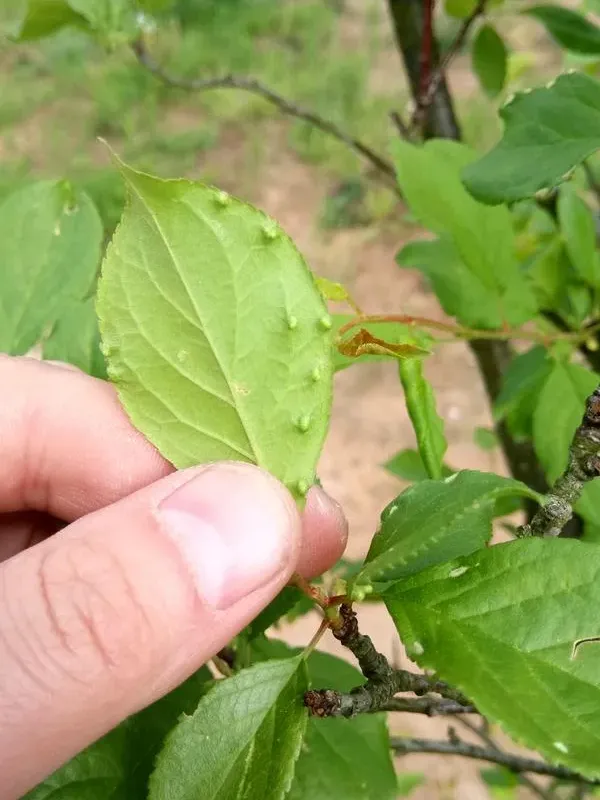
Because they are invisible to the naked eye, their presence is identified by their characteristic damage. They live in colonies and induce the host plant to produce abnormal structures known as galls, which protect the mites.
What it damages
The primary host for this pest is the plum tree (Prunus domestica). In some cases, it can also attack related species such as bullace, sloe, and occasionally cherry trees.
As the mites feed on the plant tissues, they inject salivary substances that cause localized hyperplasia of the leaf cells. This results in the formation of numerous small protrusions on the leaf surface, which serve as shelter and food source for the mite population.
When it appears
The life cycle begins with overwintered females hiding under the scales of dormant buds. As the buds start to swell in the spring, the mites move onto the newly emerging leaves to feed and lay eggs.
Throughout the growing season, the mites produce several overlapping generations. The cycle of infestation often continues until autumn, when the adult females move back into the buds to undergo diapause during the winter months.
Signs of infestation
The hallmark symptom is the appearance of small, narrow, spike-like or nipple-shaped galls on the leaves. These galls are typically concentrated on the upper surface of the leaf blade.
- Widespread development of clusters of small galls on the foliage.
- Discoloration, curling, and distortion of affected leaves.
- In severe cases, premature leaf drop and reduction in tree vigor.
- A decline in photosynthetic efficiency, potentially impacting fruit size and quality.
Control measures
Chemical control is most effective when conducted during the early stages of bud burst, before the mites have fully protected themselves inside the galls.
Use registered acaricides during the pre-blossom and post-blossom periods. Cultural control measures, such as pruning and burning heavily infested branches during the growing season, can help manage the mite population and prevent its spread to neighboring trees.
Taxonomy
- Latin name
- Eriophyes pruni
- Order
- Mites
- Family
- Eriophyidae
- EPPO code
- ERPHPR
Discussion
No discussions yet — be the first.