
Grape erineum mite
Eriophyes paderinus
Description
How to identify
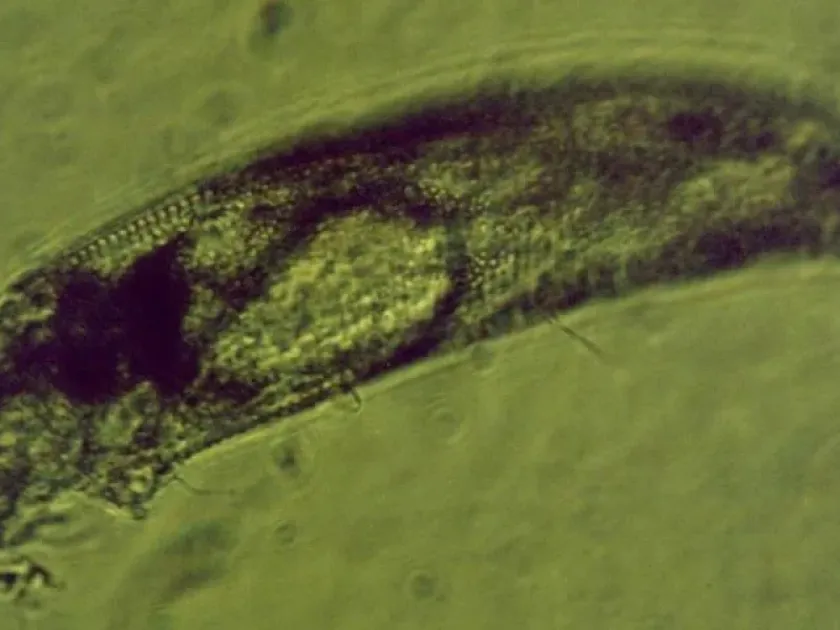
The Grape erineum mite (Colomerus vitis, formerly Eriophyes vitis) belongs to the Eriophyidae family. It is a microscopic mite, measuring only about 0.15 to 0.2 mm in length, which makes it invisible to the naked eye.
These mites have an elongated, worm-like body and are typically creamy white or yellowish. Unlike other mites, they possess only two pairs of legs located near the front of the body.
They are specialized parasites of the grapevine, living in colonies on the underside of leaves or within the protective scales of dormant buds during the winter months.
The mite overwintering population consists of adult females that hide in bark crevices or under the outer scales of the vine buds to survive cold weather.
As spring temperatures rise, these mites emerge to migrate onto the developing leaves, where they establish new feeding sites and begin their reproductive cycles.
What it damages
The primary damage is caused by the mite feeding on the plant's sap, which induces the growth of abnormal, hair-like cells on the leaf surface, forming what is known as an erineum.
This feeding activity reduces the leaf's photosynthetic capacity, which can weaken the overall vine vigor and negatively impact fruit sugar accumulation and wood maturation.
Severe infestations can lead to stunted shoot growth, shortened internodes, and, in some cases, the total failure of buds to develop properly in the spring.
While the mite does not feed directly on the fruit, the loss of leaf area and physiological stress on the vine can reduce yields and overall crop quality significantly.
The presence of the mite also makes the plant more susceptible to other environmental stressors, potentially reducing the lifespan of the grapevine if left unmanaged.
When it appears
The life cycle begins in early spring when temperatures reach approximately 10–12 °C, prompting the overwintering mites to move onto the young leaves.
Throughout the growing season, the mite produces multiple generations. In warm, dry weather conditions, the development from egg to adult is very rapid, often taking less than two weeks.
Peak mite activity and the most visible symptoms typically appear in mid-to-late summer when colonies reach their maximum density on the vine canopy.
As autumn approaches, signaled by shorter days and cooler nights, the mites begin their migration away from the leaves to find suitable overwintering sites.
The process of entering hibernation is completed by the time of leaf fall, ensuring the next generation is safely tucked away in the buds for the upcoming winter.
Signs of infestation
The most distinctive sign is the development of raised, blister-like galls on the upper leaf surface, corresponding to dense, felt-like patches on the underside.
Initially, these felt-like patches are white, but they often darken to a rusty-brown or deep red color as the season progresses and the leaf tissue begins to age.
In cases of bud infestation, signs include deformed, zig-zagging shoots, small and malformed leaves, and a general lack of vigor in the early spring growth.
- Raised bumps (galls) on the upper leaf surface.
- Dense, felt-like patches on the lower leaf surface.
- Leaf curling and deformation in young tissue.
- Reduced shoot elongation and stunted plant growth.
Under a hand lens, the mite colonies and their small, clear eggs can sometimes be observed within the dense hair-like structures of the erineum.
Control measures
Effective management requires the application of acaricides at the early leaf stage (bud break) before the mites are protected by the formation of the galls.
Sulfur-based sprays are widely used as they provide good control of the mite while simultaneously acting as a fungicide against powdery mildew in the vineyard.
For more severe infestations, specialized acaricides targeting eriophyid mites should be rotated to ensure that the mite population does not develop resistance.
Cultural practices, such as the removal and destruction of heavily infested vine shoots during pruning, are essential for reducing the initial pest pressure.
Maintaining strong vine health through balanced fertilization and adequate irrigation can help the plant recover from mite damage and maintain better overall productivity.
Taxonomy
- Latin name
- Eriophyes paderinus
- Order
- Mites
- Family
- Eriophyidae
- EPPO code
- ERPHPA
Discussion
No discussions yet — be the first.