
Apple leaf mite
Eriophyes malimarginemtorquens
Description
How to identify
The apple leaf mite (Eriophyes malimarginemtorquens) is a microscopic member of the Eriophyidae family. Unlike spider mites, these pests are worm-like and have only two pairs of legs, making them invisible to the naked eye.
Their life cycle begins with overwintering females hiding under bud scales. As soon as temperatures rise and buds begin to swell, the mites move to the developing green tissue to start their feeding cycle.
The reproductive rate is rapid, with multiple generations emerging throughout the summer. Each female lays eggs directly on the leaf surface, which hatch into larvae that immediately start feeding, causing characteristic symptoms.
Environmental conditions such as high humidity and stable spring temperatures significantly promote the growth of mite populations. They prefer the micro-environment of succulent young foliage found on actively growing shoots.
Dispersal between trees occurs primarily through wind currents, though insects, birds, and contaminated horticultural equipment can also act as vectors for spreading the infestation across the orchard.
What it damages
The primary host for this pest is the domestic apple tree. Mites specifically target young, succulent foliage, which interferes with normal leaf expansion and long-term development of the tree canopy.
Signs of infestation
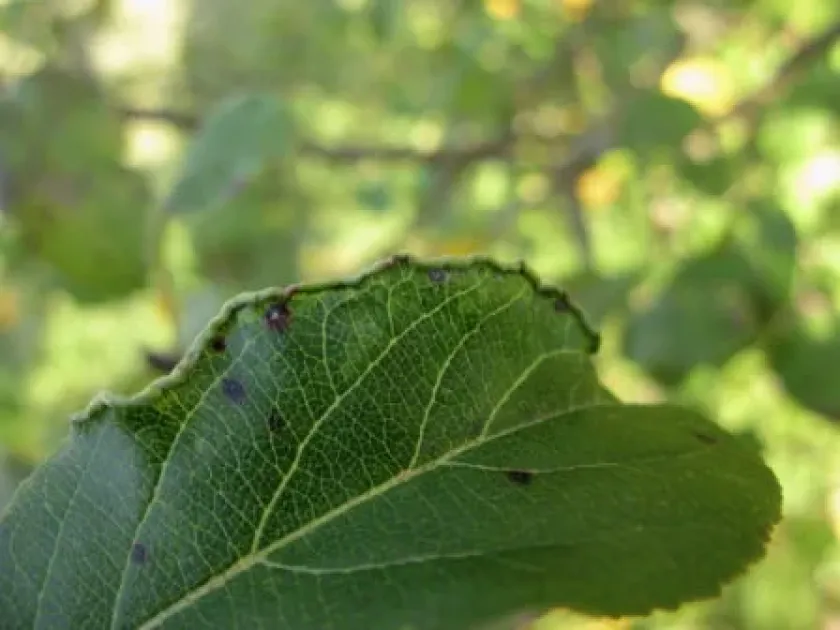
The most distinctive sign of infestation is the marginal curling of the leaves. The edges roll inward or outward, creating a distorted shape that disrupts the leaf's ability to undergo standard photosynthesis.
Infested areas often exhibit chlorotic or necrotic spots. These patches result from the mite's saliva, which is injected into the plant tissue, triggering a chemical reaction that creates the characteristic leaf deformity.
In cases of severe infestation, affected leaves may turn yellow and drop prematurely. This premature defoliation significantly reduces the tree's vigor and its ability to store energy for the subsequent growing season.
Growth of terminal shoots can become stunted, leading to a loss of symmetry and overall productivity in young trees. The mite can also impact fruit set if the infestation reaches the blossoms or pedicels.
- Curling or rolling of leaf margins.
- Visible chlorosis on leaf surfaces.
- Premature leaf drop in late summer.
- Stunted growth of new terminal shoots.
- Overall decrease in tree vitality.
Control measures
Effective control requires an integrated approach. Pruning and removing infested branches is a primary method for reducing local populations, especially in small-scale orchard settings where chemical usage is minimized.
Chemical control focuses on the use of specialized acaricides. Timing is critical; applications must be made during the green tip stage to effectively reach the mites as they emerge from their overwintering sites.
Biological control involves maintaining a healthy population of predatory mites, such as Phytoseiidae, which feed on eriophyid mites. Protecting these beneficial predators is essential for maintaining natural balance in the orchard.
Horticultural oils can be applied early in the season to smother overwintering mites. This preventative measure is often safer for the environment and highly effective if applied with thorough coverage.
Ongoing monitoring is vital for early detection. Orchard managers should inspect new growth regularly during the spring months to determine if threshold levels have been reached before applying any corrective measures.
Taxonomy
- Latin name
- Eriophyes malimarginemtorquens
- Order
- Mites
- Family
- Eriophyidae
- EPPO code
- ERPHMM
Discussion
No discussions yet — be the first.