
Lime gall mite
Eriophyes leiosoma
Description
How to identify
The lime gall mite, Eriophyes leiosoma, is a microscopic member of the Eriophyidae family, commonly known as gall mites. Due to their minute size, they are invisible to the naked eye and require professional magnification for identification.
Their bodies are elongated, worm-like, and semi-transparent, typically pale yellow in color. A defining characteristic is the presence of only two pairs of legs situated at the anterior end of the body.
These mites overwinter as adults within bark crevices, under bud scales, or in other protected refuges on the tree's bark. As temperatures rise in spring, they emerge to infest the developing foliage.
The life cycle involves multiple generations per season, with each generation living inside specialized leaf structures called galls, which the mites induce during their feeding process.
This species is highly host-specific, primarily affecting Tilia species. Its distribution is often localized, reflecting the density and health of the linden population in a given area.
What it damages
Linden (Tilia) trees are the primary host, with young trees and nursery saplings being the most vulnerable. The mite feeding pattern alters leaf anatomy, reducing the photosynthetic efficiency of the tree.
While the infestation rarely kills mature trees, it significantly degrades their aesthetic value, which is particularly problematic for urban landscaping and ornamental plantings.
Feeding involves injecting substances into the leaf tissue, triggering the formation of erinea (galls). This localized growth causes deformation and can lead to stunted leaf development.
Severe infestations result in premature leaf drop, which weakens the tree's vigor. An energy-depleted tree becomes more susceptible to secondary environmental stressors and opportunistic pathogens.
In municipal park management, the visual impact of distorted foliage and premature leaf loss necessitates active monitoring and management of this specific pest.
When it appears
Activity begins in early spring, synchronized with the budburst of linden trees. As soon as the first leaves unfold, the overwintering mites migrate to the fresh tissue.
The peak of infestation typically occurs between late spring and early summer, as the temperature becomes optimal for mite reproduction and gall formation.
Several generations are produced throughout the growing season. Dry and warm weather conditions often accelerate the population growth, leading to more widespread damage across the canopy.
As autumn approaches and leaf quality declines, the mites seek overwintering sites. They move from the leaves back to the woody parts of the tree to wait out the winter months.
The survival and success of the mite are strictly dependent on the phenology of the host tree, making the timing of the spring migration the most crucial phase for management.
Signs of infestation
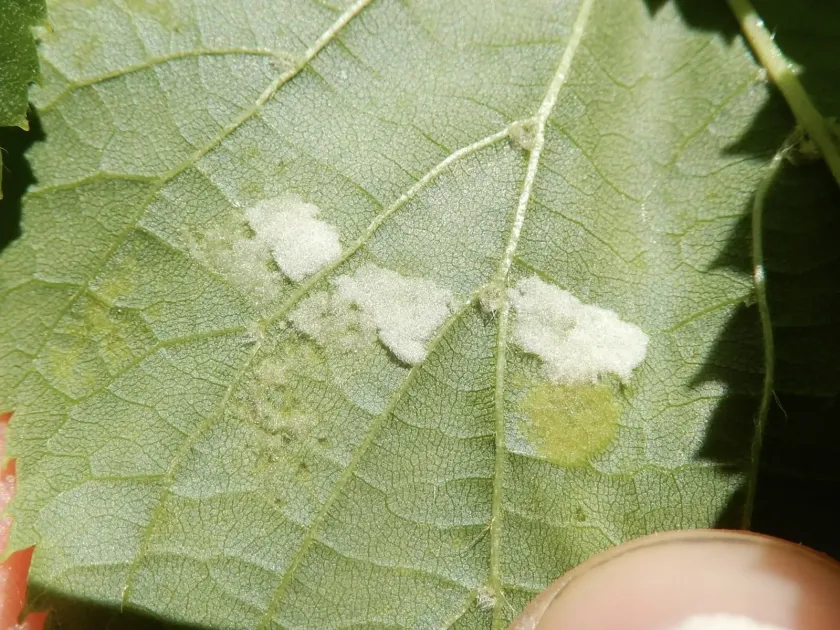
The primary symptom is the presence of felt-like patches (erinea) on the undersides of the leaves. These patches are initially whitish or yellowish, later turning brown or deep red.
On the upper surface of the leaf, corresponding bumps or swellings appear, causing the leaf to look puckered, wrinkled, or distorted.
- Felt-like patches on the leaf underside.
- Color transition from white to brown over time.
- Leaf distortion and curling of the blade.
- Premature yellowing and leaf shedding.
- Reduced vigor and stunted canopy development.
The "felt" is composed of abnormally elongated leaf epidermal hairs, which create a protected micro-environment for the mites to feed and lay eggs safely.
Control measures
Preventative control is best achieved by applying systemic acaricides just as the buds begin to open, targeting the mites as they migrate from their winter shelters.
Maintaining optimal tree health through regular irrigation and fertilization improves the tree's natural resilience against mite colonization and subsequent damage.
In cases of light infestation, physical removal of affected leaves can help reduce the localized population, although this is often impractical for large, mature specimens.
Integrated Pest Management (IPM) practices, including the preservation of natural predators like predatory mites, can help balance populations in urban environments without excessive chemical use.
Sanitation is important; while most mites hibernate on the bark, removing heavily infested leaf litter can still contribute to lowering the overall pest pressure in the surrounding environment.
Taxonomy
- Latin name
- Eriophyes leiosoma
- Order
- Mites
- Family
- Eriophyidae
- EPPO code
- ERPHLE
Discussion
No discussions yet — be the first.