
Alder gall mite
Eriophyes laevis
Description
How to identify
The Alder gall mite (Eriophyes laevis) is a microscopic member of the Eriophyidae family. These tiny organisms are worm-like in shape and barely visible even with a magnifying lens.
They overwinter as fertilized females, finding shelter in bark crevices or under the protective scales of leaf buds during the dormant winter period.
With the onset of spring and increasing temperatures, the mites emerge and colonize developing alder leaves, triggering the formation of characteristic galls.
They belong to the group of mites that do not possess wings, relying on wind currents and other animals for dispersal across the canopy or to neighboring trees.
Their biological cycle is strictly synchronized with the alder phenology, which ensures they have access to fresh, nutrient-rich tissues throughout their growth phase.
What it damages
This species is a specialized feeder on Alnus glutinosa (black alder) and related species, causing severe localized reactions in the host plant tissues.
By feeding on the sap, the mites cause the leaf cells to proliferate uncontrollably, resulting in the development of galls that house and protect the mite colonies.
While the overall survival of the tree is rarely at risk, the damage can lead to significant physiological stress, especially in younger, vulnerable saplings.
In ornamental plantations, the presence of these galls dramatically reduces the aesthetic quality of the trees, making them undesirable for landscaping purposes.
The reduction in effective photosynthetic area due to massive gall cover can stunt growth and weaken the tree's resilience against secondary pathogens.
Signs of infestation
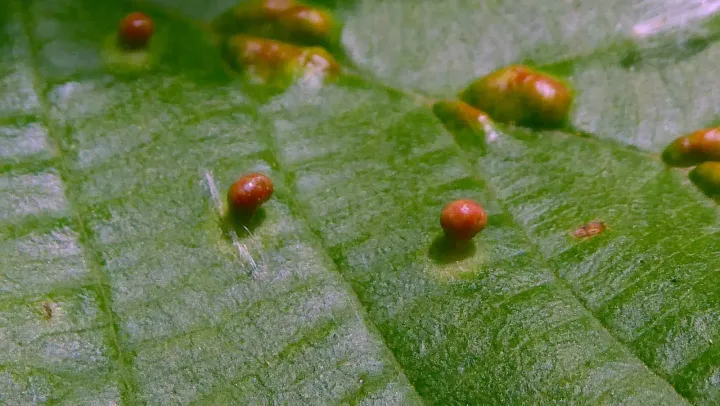
The primary symptom is the appearance of small, raised bumps on the upper surface of the leaves, which gradually develop into distinct, wart-like galls.
Initially, these galls are often green but can change color to red, purple, or brown as the season progresses and the mite population increases.
Deformed leaves are a common indicator; the mite activity disrupts normal leaf expansion, leading to twisted or curled foliage that looks unhealthy.
Small openings are often found on the underside of the leaf, acting as entrance points or ventilation for the mite colony residing within the gall.
Widespread infestations leave the entire crown looking speckled and rugged, serving as an unmistakable sign of Eriophyes laevis presence.
Control measures
The most effective cultural practice is pruning and destroying infested branches, which significantly reduces the mite population for the following season.
Chemical control involving acaricides should be timed carefully, typically during the bud-break stage when mites are most active and migrating.
Promoting general tree health through proper fertilization and irrigation helps the trees withstand mite attacks and improves their recovery speed.
Biological control, such as encouraging natural predatory mites, can be effective in maintaining an ecological balance within arboretums and parks.
- Apply sulfur-based acaricides during early spring.
- Prune and burn heavily infested shoots.
- Clear leaf litter in autumn to disrupt overwintering habitats.
- Monitor trees periodically during the spring flushing period.
Taxonomy
- Latin name
- Eriophyes laevis
- Order
- Mites
- Family
- Eriophyidae
- EPPO code
- ERPHLA
Discussion
No discussions yet — be the first.