
Grape leaf blister mite
Eriophyes insidiosus
Description
How to identify
The Grape leaf blister mite (Eriophyes vitis), belonging to the family Eriophyidae, is a microscopic pest that specifically targets grapevines. These mites are elongated, worm-like, and nearly translucent, making them impossible to see with the naked eye.
They overwinter as adults primarily under the bud scales of the grapevine, as well as in bark crevices. As soon as spring temperatures rise, the mites emerge to infest the developing buds and young leaves of the vines.
The life cycle is rapid and temperature-dependent, allowing for multiple generations within a single growing season. Under favorable conditions, the population can expand exponentially, spreading through vineyards via wind currents or human activity.
The mite is an obligate parasite, meaning it cannot survive long away from its host plant. Its feeding habit involves injecting enzymes into the leaf tissue, which induces a localized growth response from the plant.
Monitoring for this pest is critical, as early detection can prevent widespread infestation that could potentially compromise the health of the entire vineyard and reduce the overall quality of the vintage.
What it damages
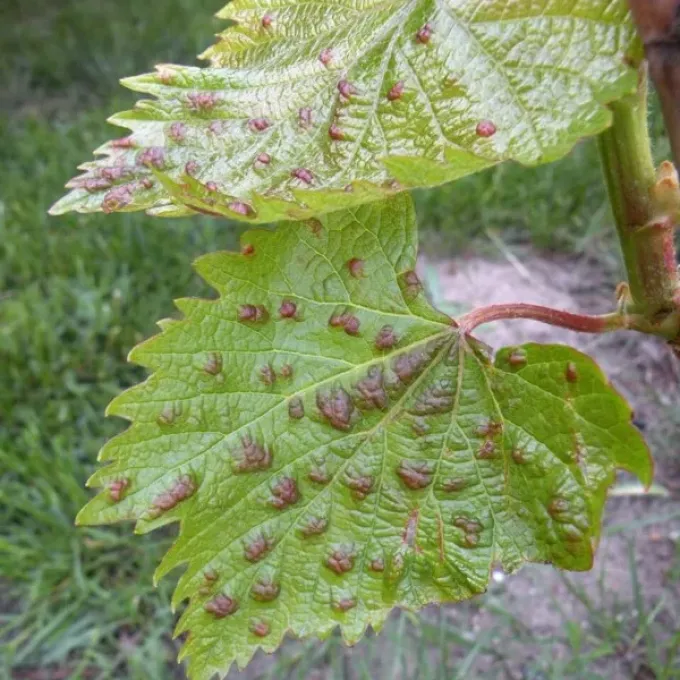
The primary damage is caused to the leaves, where the mites feed on the epidermal cells. This causes the formation of characteristic galls on the upper leaf surface, which restricts the leaf's photosynthetic capacity.
In cases of severe infestation, the mites may attack flower clusters and young berries. This can result in flower abortion, poor fruit set, and significant reductions in total crop yield, negatively impacting the economic output of the vineyard.
The weakened state of the infested leaves leads to poor vine vigor and delayed maturation of the woody shoots. This lack of maturity can result in decreased winter hardiness, putting the vines at risk of frost damage.
Furthermore, the persistent stress caused by mite feeding may predispose the vines to opportunistic infections. Fungal diseases such as downy and powdery mildew find it easier to establish themselves in the damaged, necrotic leaf tissues.
While the pest rarely kills a mature vine, its chronic presence reduces the photosynthetic efficiency of the canopy, leading to lower sugar accumulation and overall lower berry quality for winemaking or table consumption.
Signs of infestation
The most visible symptom of an infestation is the presence of blister-like swellings (galls) on the upper surface of the grape leaves. These blisters correspond to localized depressions on the underside of the leaf.
Inside these underside depressions, a dense, felt-like growth of abnormal plant hairs develops. Initially, this felt is white or pale, but it turns rusty or brown as the mite colony ages and the tissue begins to die.
Severely infested leaves often exhibit curling, distortion, and stunted growth. The overall appearance of the foliage becomes mottled and unhealthy, which is a clear indicator that the plant is struggling to maintain its physiological functions.
Flower clusters infested by the mites may fail to bloom or produce fruit, often becoming covered in a dry, crusty texture. If not addressed, this leads to thinning of the clusters and uneven berry development.
- Convex blisters (galls) on the upper leaf surface.
- Dense, woolly felt-like patches on the underside of leaves.
- Leaf distortion, curling, and stunted growth.
- Brown or rusty discoloration of the leaf tissue.
- Inhibition of fruit set and cluster development.
Control measures
Integrated pest management (IPM) is the best approach for controlling Eriophyes vitis. Sanitation is the first step, involving the removal and destruction of heavily infested leaves and the pruning of affected shoots.
Chemical control is most effective when timed with the mite's emergence. Acaricide applications should be made during the bud-break stage to target the overwintering adults before they colonize the new leaves.
Sulfur-based products are highly recommended as they serve a dual purpose, effectively suppressing both the mite population and the development of powdery mildew, which is a common concern in grape cultivation.
Regular vineyard scouting is essential to identify localized "hot spots" of infection. By treating only affected areas, growers can reduce the overall use of chemicals and minimize the impact on beneficial predator mite populations.
Maintaining vine health through balanced fertilization and proper canopy management ensures that vines are robust enough to withstand mild infestations. Avoid excessive nitrogen, which creates succulent tissue highly attractive to mites.
Taxonomy
- Latin name
- Eriophyes insidiosus
- Order
- Mites
- Family
- Eriophyidae
- EPPO code
- ERPHIN
Discussion
No discussions yet — be the first.