
Aspen gall mite
Eriophyes dispar
Description
How to identify
The aspen gall mite, scientifically known as Eriophyes dispar, belongs to the family Eriophyidae, commonly referred to as gall mites. These are microscopic arthropods with a characteristic worm-like body, reaching a length of approximately 0.2 mm.
Due to their microscopic size, these mites are impossible to detect with the naked eye on the leaves. Their presence is identified primarily by the specific physiological changes they induce in the plant host tissues.
The life cycle of this species is closely synchronized with the development of the host tree. Adult fertilized females hibernate in the buds or bark crevices of the aspen tree, exhibiting high resilience to cold winter temperatures.
In spring, as the buds break and leaves emerge, the mites become active and migrate to the young foliage. They feed on plant cells, injecting substances that trigger the abnormal growth of plant tissue, resulting in the formation of galls.
Throughout the growing season, the mite undergoes multiple generations, which allows the population density to increase significantly under favorable climatic conditions.
What it damages
The primary host for this mite is the aspen (Populus tremula). The damage is characterized by the formation of numerous galls, which significantly reduce the functional surface area of the leaves available for photosynthesis.
While aspen is the main host, the mite can also affect closely related poplar species if they are in close proximity, which is common in landscape planting or nurseries.
Severe infestations weaken the tree's overall physiological condition. In young saplings, the presence of galls can lead to stunted growth and reduced shoot development, which is critical during the establishment phase.
Heavy leaf damage causes early leaf drop, which disrupts the tree's ability to store sufficient nutrients for the dormant winter period, thereby reducing the plant's long-term vigor.
While mature trees in forest ecosystems usually survive, the aesthetic damage in urban environments makes these trees less desirable, and repeated infestations can lead to partial crown dieback.
Signs of infestation
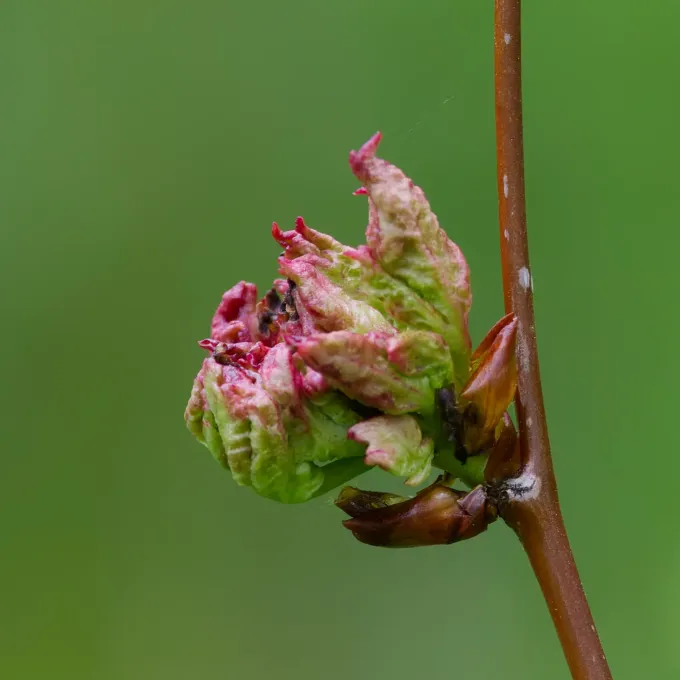
The most distinctive sign of infestation is the appearance of galls on the leaves. These often look like small, bumpy protrusions or sacs that can be found on either the upper or lower surfaces of the leaves.
The galls are often discolored, ranging from light green to reddish or brownish shades, which clearly contrast with the healthy parts of the leaf tissue.
As the galls develop, the leaf blade may become deformed, twisted, or curled. These galls provide a protected environment for the mite colonies to feed and reproduce safely.
The density of galls varies; in some cases, they are scattered, while in severe infestations, they may cover the entire leaf surface, causing it to lose its natural shape.
- Presence of characteristic gall growths on the leaves.
- Leaf distortion, curling, and abnormal shape.
- Color changes in the leaf tissue at the sites of infestation.
- Premature leaf senescence and early defoliation.
Control measures
Controlling gall mites is inherently difficult because the pests are sheltered inside the plant tissues where conventional contact pesticides have limited efficacy.
The most effective management strategy involves sanitary pruning. Removing and destroying infested branches and fallen leaves during autumn helps significantly reduce the population of overwintering females.
Chemical control is only effective during the brief window in spring when mites emerge from their wintering sites and migrate to new leaves, prior to the formation of galls.
Acaricides specifically labeled for use in forestry or ornamental plants should be applied carefully. Rotating active ingredients is recommended to prevent the development of resistance.
Improving general tree health through proper fertilization, adequate irrigation, and minimizing environmental stress helps trees recover from mite damage and increases their natural resilience.
Taxonomy
- Latin name
- Eriophyes dispar
- Order
- Mites
- Family
- Eriophyidae
- EPPO code
- ERPHDI
Discussion
No discussions yet — be the first.