
Eriophyes chibaensis mite
Eriophyes chibaensis
Description
How to identify
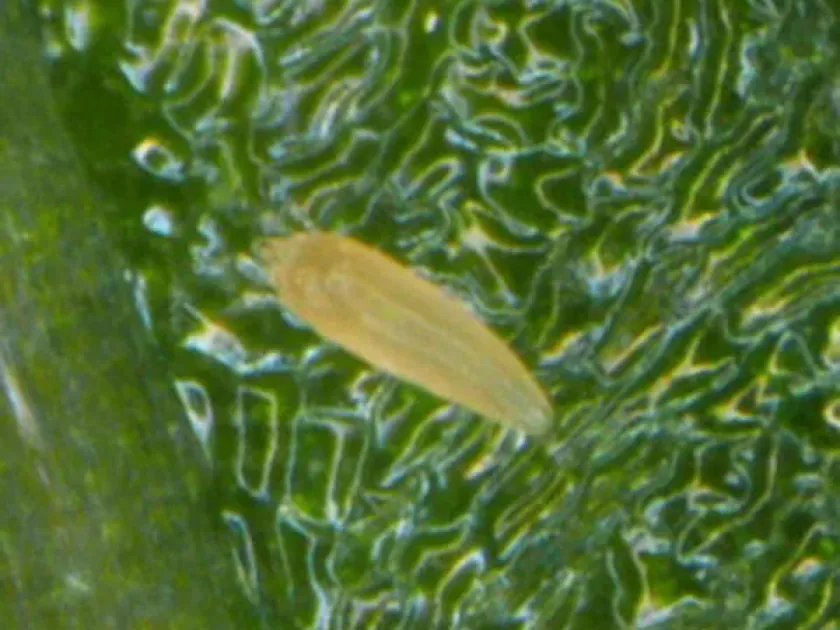
Eriophyes chibaensis belongs to the Eriophyidae family, commonly known as gall or four-legged mites, within the order Trombidiformes. These are microscopic arthropods that typically measure only 0.2 to 0.3 millimeters, making them invisible to the naked eye.
The body of the mite is worm-like, elongated, and tapers toward the rear. A distinctive feature of this family is the presence of only two pairs of legs located at the front of the body, which earns them the name "four-legged mites."
Their coloration ranges from nearly transparent to whitish-yellow or pinkish. They possess piercing-sucking mouthparts adapted for feeding on plant cell contents and injecting specific enzymes during the feeding process.
Females are highly fecund and can lay eggs directly into plant tissues or within crevices on leaf surfaces. They typically overwinter as fertilized females inside buds or under the bark scales of dormant plants.
Identifying the species in field conditions is challenging due to their microscopic size. Agronomists often rely on laboratory diagnostics, examining tissue sections under a microscope to confirm the specific morphological features of the mites.
What it damages
This mite species primarily affects ornamental woody plants and shrubs. Host plants that are susceptible to forming specific galls and deformations on their leaf surfaces are the most frequent targets of these pests.
Damage manifests as a disruption of plant physiology, leading to stunted shoot growth and a reduction in the overall ornamental value of the planting. Impaired photosynthesis due to epidermal damage negatively affects the accumulation of essential nutrients.
During mass outbreaks, premature leaf drop is observed, which weakens the plant's immunity before winter. In severe cases, the death of individual buds and the deformation of young growth can occur.
The damage is often localized; however, under favorable humidity and temperature conditions, the mite can spread rapidly throughout the plant via wind or insect vectors.
Economic losses are most significant in ornamental plant nurseries, where the aesthetic quality of the plants dictates their market value. Leaf damage can render entire batches of plants unsellable.
Signs of infestation
The primary sign of infestation is the formation of galls — pathological tissue outgrowths that can appear as bumps, "witch's brooms," or specific projections. Their shape and color depend on the specific host plant.
In the early stages, chlorotic spots or points appear on the leaves and gradually merge. Tissue at the mite's feeding sites loses chlorophyll, manifesting as mosaic patterns or discoloration of parts of the leaf blade.
Leaf blades may curl, wrinkle, or become distorted. The leaf surface becomes bumpy due to uneven tissue growth stimulated by the toxins injected by the mite while feeding.
The interior of galls or curled leaves is often covered in a characteristic felt-like coating (erineum), which consists of overgrown plant hairs. This creates a microclimate that protects the mite colonies from external environmental factors.
Sometimes, deformation of reproductive organs occurs; buds may fail to open or develop abnormally. These symptoms indicate deep-seated damage to the vascular system and hormonal disruption within the plant.
Control measures
Controlling Eriophyes chibaensis requires a systematic approach, as the microscopic size of the pest makes contact-based treatments difficult. The primary strategy involves the use of specialized acaricides.
Systemic acaricides that penetrate plant tissues are highly recommended. Mites feeding on the plant sap ingest the active ingredient, ensuring effective control even for those hidden inside galls.
Sanitary pruning and the disposal of heavily infested shoots are crucial elements of control. This helps reduce the initial inoculum and prevents the further spread of the mite across the plant canopy during the growing season.
Preventive treatments should be applied during the bud-burst stage, when mites emerge from their overwintering sites and are most vulnerable. It is optimal to carry out 2-3 applications with an interval of 10-14 days.
Rotation of acaricides from different chemical classes is necessary to prevent the development of resistance within the mite population. Additionally, maintaining overall plant health through balanced watering and proper fertilization is recommended.
Taxonomy
- Latin name
- Eriophyes chibaensis
- Order
- Mites
- Family
- Eriophyidae
- EPPO code
- ERPHCH
Discussion
No discussions yet — be the first.