
Boxwood mite
Eriophyes buxi
Description
How to identify
The boxwood mite (Eriophyes buxi) is a microscopic pest belonging to the family Eriophyidae. These mites are extremely small, typically measuring about 0.2 mm, making them invisible to the naked eye.
They possess an elongated, worm-like body and are usually pale white or yellowish in color. Unlike spider mites, they do not produce webs, which makes their presence less obvious to gardeners.
The life cycle of the boxwood mite is strictly tied to the host plant. They primarily overwinter inside the terminal and lateral buds of boxwood, protected by bud scales.
As spring temperatures rise, the mites emerge from their winter refuge to feed and reproduce, completing multiple generations throughout the growing season.
Their spread across a garden or nursery is mainly facilitated by wind, birds, or the transfer of infested plant material during seasonal maintenance or propagation.
What it damages
The primary host for Eriophyes buxi is the common boxwood (Buxus sempervirens). They feed specifically on the tender tissues of newly developing buds and young leaves.
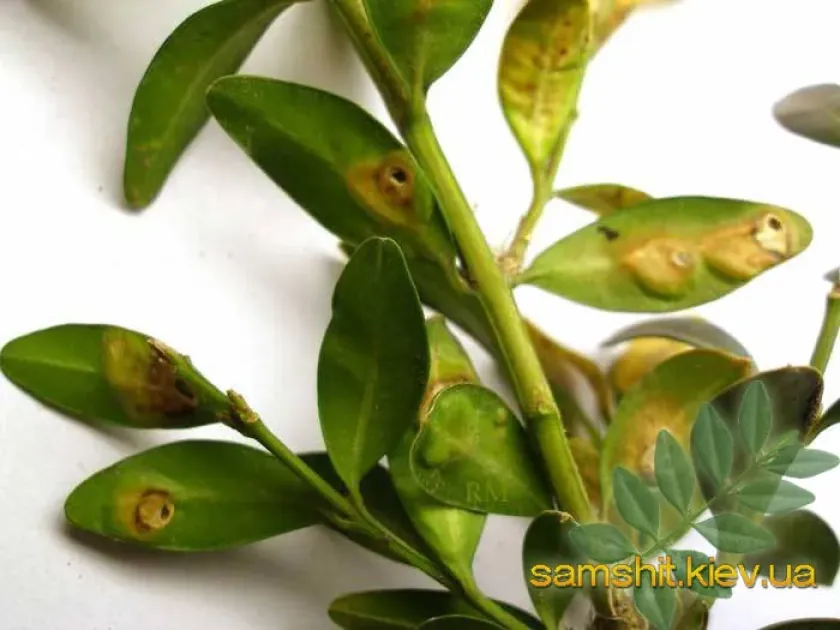
Feeding activities cause the plant to alter its growth pattern, leading to the formation of swollen, distorted buds that often fail to open properly or develop into stunted, chlorotic leaves.
The cumulative damage results in a loss of aesthetic value, as the plants develop thin foliage, irregular branching, and a generally sickly, stunted appearance.
By weakening the buds and young shoots, the mites can also create secondary entry points for fungal pathogens, which can exacerbate the decline of the plant.
In high-density plantings or topiary designs, the impact of these mites can lead to significant structural damage, requiring severe pruning or removal of affected sections.
Signs of infestation
The most reliable sign of an infestation is the presence of enlarged, swollen buds that appear malformed compared to healthy ones.
Affected leaves often show signs of curling, cupping, or yellowing, losing their characteristic dark green glossy sheen and uniform texture.
During the spring, one might notice restricted terminal growth, where the tips of branches fail to elongate and instead remain as dense, clustered, and distorted leaf masses.
Close inspection of the buds, often requiring a hand lens or a microscope, will reveal the presence of numerous minute, elongated mites within the scales.
Plants heavily infested for multiple seasons show an overall reduction in vigor, becoming sparse and failing to maintain the density required for hedges and shapes.
Control measures
Management of the boxwood mite is challenging because the pests spend most of their life cycle protected within the bud scales.
- Apply specialized acaricides during the early spring as the mites emerge from their overwintering sites.
- Ensure thorough coverage of the foliage and specifically target the areas where buds are located.
- Practice regular sanitation by pruning and removing heavily infested branches to reduce the pest reservoir.
- Use systemic insecticides that are labeled for mite control in ornamental plants to reach the pests feeding within tissues.
- Monitor the health of your plants regularly, as early detection significantly improves the success rate of control efforts.
Taxonomy
- Latin name
- Eriophyes buxi
- Order
- Mites
- Family
- Eriophyidae
- EPPO code
- ERPHBU
Discussion
No discussions yet — be the first.