
Wormwood gall mite
Eriophyes annui
Description
How to identify
The wormwood gall mite (lat. Eriophyes annui) is a microscopic pest belonging to the family Eriophyidae. Unlike typical mites, these organisms possess a worm-like body and only two pairs of legs, which are situated near the head.
Due to their size, which is often less than 0.2 mm, they cannot be identified with the naked eye. Agronomists rely on microscopic examination of the plant tissue to confirm the presence of this specific species.
The biological cycle of the mite is strictly linked to the phenology of the host plant. They typically hibernate as fertilized females in the protected areas of buds or stem crevices throughout the winter months.
Activity begins as soon as temperatures rise in spring. The mite undergoes several generations per season, allowing its population to expand rapidly if climatic conditions remain favorable and stable.
Dispersal is mainly passive; the mites are carried by the wind, insects visiting the flowers, or through the movement of infested plant material and agricultural equipment during cultivation practices.
What it damages
The primary host for Eriophyes annui is the genus Artemisia. The mites pierce plant cells to extract sap, which triggers a physiological response resulting in the formation of galls.
The damage is systemic: it affects the development of new leaves, terminal buds, and flowers. The disruption of regular plant growth leads to a significant decrease in the biomass production of the wormwood crops.
Infection significantly reduces the concentration of volatile oils and medicinal compounds, which directly impacts the commercial value of the wormwood as a high-quality herbal raw material.
Plants heavily infested with the gall mite show reduced vitality, stunted growth, and an inability to reproduce successfully. This can lead to a complete loss of the harvest in cases of severe outbreaks.
The cumulative effect of mite feeding weakens the host plant, making it more susceptible to secondary fungal or bacterial infections that enter through the damaged epidermis.
Signs of infestation
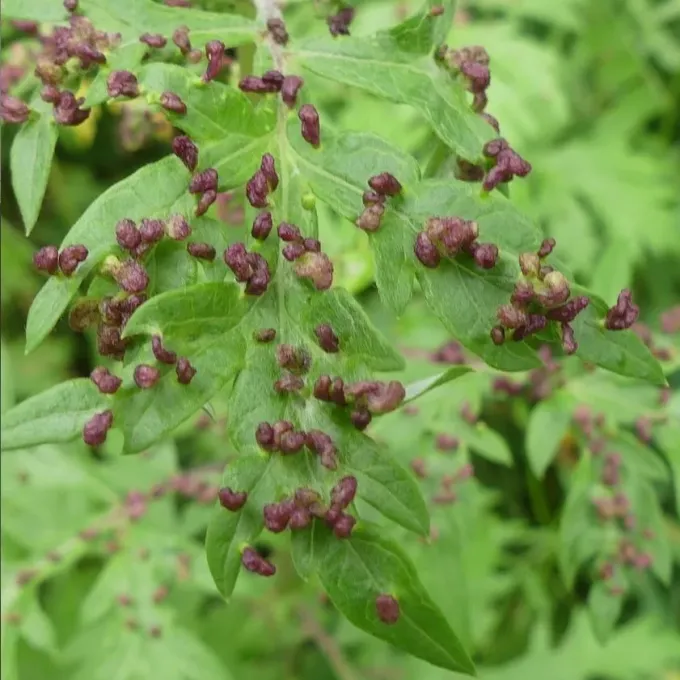
The most distinctive sign is the formation of galls, which are abnormal growths on leaves and stems. These can appear as swellings, distorted leaf edges, or dense masses of deformed plant tissue.
Leaves often exhibit curling, thickening, or a characteristic chlorosis. In many instances, the growth of new shoots is severely retarded, leading to a crowded or stunted appearance of the plant canopy.
A classic symptom is the «witches' broom» effect, where buds proliferate excessively and form deformed clusters, preventing the development of healthy stalks and typical floral structures.
The general visual appearance of an infested crop is uneven growth and patches of discolored, withered foliage that does not respond to regular irrigation or nutrient applications.
Upon closer inspection with a magnifying lens, one may observe the mites in their hiding spots, although the visible changes in plant morphology are usually the primary indicator for farmers.
Control measures
Managing the wormwood gall mite starts with rigorous selection of clean, certified planting material. It is essential to inspect any new stock before introducing it to the field.
Sanitation is key; pruning and destroying heavily infested plant parts is necessary to reduce the pest load. These residues should be removed and disposed of away from the planting area.
Chemical control involving specific acaricides must be applied at the correct timing, usually when the mites are transitioning from their overwintering sites to new growth, before they become protected by galls.
Biological control, such as promoting predatory mite populations or using entomopathogenic fungi, can be integrated into the management strategy to provide long-term population suppression.
- Conduct regular inspections during the early vegetative stage.
- Maintain proper distance between new and existing Artemisia crops.
- Improve plant vigor through balanced fertilization to withstand light infestations.
Taxonomy
- Latin name
- Eriophyes annui
- Order
- Mites
- Family
- Eriophyidae
- EPPO code
- ERPHAN
Discussion
No discussions yet — be the first.