
Aloe mite
Eriophyes aloinis
Description
How to identify
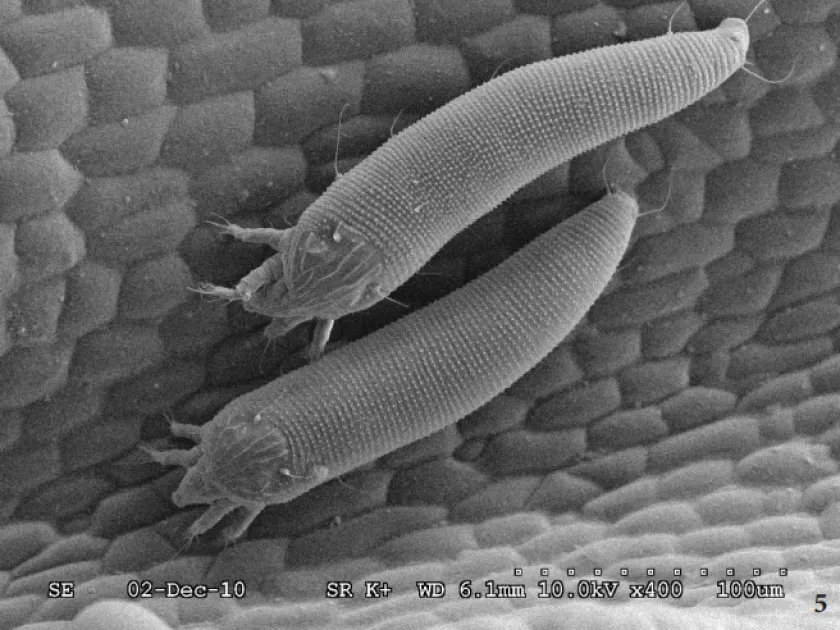
The Aloe mite (Eriophyes aloinis) is a microscopic pest belonging to the Eriophyidae family, commonly known as gall mites. These organisms are invisible to the naked eye, measuring only a fraction of a millimeter in length.
Their bodies are vermiform (worm-like), elongated, and semi-transparent, typically pale white or yellowish. Unlike other mites, they possess only two pairs of legs, which are situated near the head region.
These mites complete their life cycle inside the succulent tissues or in the tightly packed crevices of the Aloe plant, making them difficult to target with contact insecticides.
They are prolific breeders. In warm, dry environments, the population cycle can be completed in just over a week, leading to rapid infestations that can devastate a plant collection quickly.
Transmission occurs through contaminated tools, physical contact between plants, or wind-borne movement within greenhouse environments, making sanitation vital.
What it damages
Aloe mites primarily attack species within the genus Aloe. They feed on the meristematic tissues of the plant, including the apical bud and young developing leaves.
As they feed, they inject toxic saliva that alters the plant's hormonal balance, resulting in the abnormal proliferation of cells, which creates characteristic galls or warty growths.
The internal damage interrupts the vascular flow and physiological development of the plant, causing severe stunting and general decline in health.
Once a plant is severely infested, the internal damage to the growing points becomes irreversible, leading to structural deformity and the eventual collapse of the succulent.
Secondary infections, such as bacterial soft rot, are common following an Aloe mite infestation, as the damaged tissues are highly susceptible to opportunistic pathogens.
Signs of infestation
The most distinctive symptom of an Aloe mite infestation is the formation of warty, tumor-like growths (galls) on the leaves, stems, or flower spikes, often referred to as "Aloe cancer."
Affected growing points become highly congested, discolored, and stunted, preventing the plant from producing normal, healthy foliage.
Leaves may exhibit irregular thickening, twisting, or curling. The epidermis in infested areas often turns necrotic, appearing brown, tan, or greyish.
Flowering is usually inhibited. If a flower stalk does emerge from an infested plant, it is often twisted and fails to open properly, resulting in aborted or malformed blooms.
A closer inspection with a hand lens might reveal a whitish, powdery-looking substance in the crevices of the galls, which consists of masses of mites and their eggs.
Control measures
Immediate physical removal of all infested plant tissue is the primary defense. The affected areas should be cut away using sterilized tools until only healthy, green tissue remains.
Systemic acaricides are necessary for management, as contact sprays fail to reach the mites embedded within the plant's galls and internal tissues.
- Regular application of systemic miticides (e.g., abamectin-based products) is required to disrupt the life cycle.
- Consistent intervals of 7 to 10 days between treatments are crucial to target newly emerged nymphs.
Sanitation is paramount. Tools must be disinfected with alcohol or heat between every plant to prevent the spread of the microscopic mites across the collection.
Maintaining proper plant vigor and avoiding extreme environmental stress can help the plants build natural defenses, though chemical intervention is usually required for eradication.
Taxonomy
- Latin name
- Eriophyes aloinis
- Order
- Mites
- Family
- Eriophyidae
- EPPO code
- ERPHAL
Discussion
No discussions yet — be the first.