
Chinese wax scale
Ericerus pela
Description
How to identify
The Chinese wax scale (Ericerus pela) is a member of the Coccidae family. It is historically significant for its ability to produce large amounts of high-quality white wax.
Adult females are oval-shaped and stationary, protected by a hard, waxy, or chitinous cover that allows them to cling tightly to the stems and leaves of host plants.
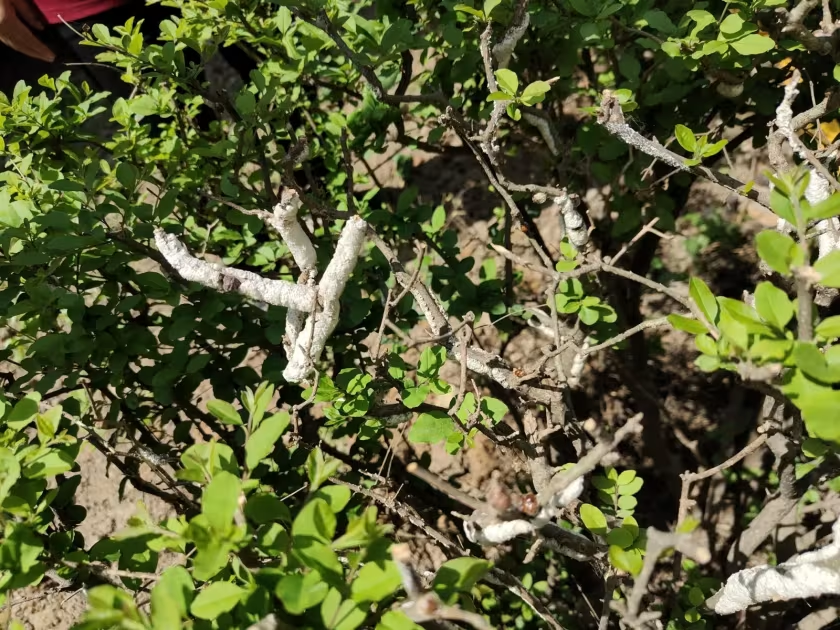
Males are distinct in their development, eventually becoming winged and leaving behind noticeable white waxy filaments on the bark during their active phase.
The crawlers (first-instar nymphs) are small, mobile, and yellowish. This is the only life stage during which the insect can easily move to new parts of the plant.
As the insect matures, it anchors itself to the plant, where it remains for the rest of its life cycle, consuming plant sap and growing under its protective covering.
What it damages
While the Chinese wax scale primarily affects the Chinese ash tree, it also colonizes other plants, including privet, lilac, and various other woody ornamental species.
The insects feed by inserting their mouthparts into the phloem to extract sap, which weakens the plant and stunts growth, particularly in young or stressed trees.
Severe infestations lead to significant leaf yellowing, curling, and premature defoliation, which hampers the plant's ability to store energy for the next growing season.
The honeydew excreted by these scales covers the plant surface, fostering the growth of sooty mold, which blocks light and impairs the tree's photosynthetic capability.
Heavy damage can result in branch dieback and, in extreme cases of young plant infestation, the total death of the specimen due to prolonged nutritional stress.
When it appears
The insect has one generation per year. Fertilized adult females overwinter on the bark of twigs, entering a state of dormancy until spring temperatures rise.
As the weather warms, females begin laying eggs underneath their waxy protective shells, which keep the eggs safe from predators and harsh environmental conditions.
Crawler emergence typically occurs in early summer, coinciding with the lush new growth of the host plants, which provides ample food for the young insects.
During the summer, the nymphs settle and develop into their adult forms. During this time, they extract sap aggressively to support their metabolic needs.
By autumn, as temperatures decline, the insects cease active feeding and prepare to overwinter, moving to more sheltered areas of the woody stems.
Signs of infestation
The most obvious sign of an infestation is the appearance of white, cotton-like waxy secretions on the twigs and branches, especially during the male developmental stage.
Sticky honeydew on foliage is a primary indicator of scale activity. This substance often attracts ants, which farm the scales and protect them from natural enemies.
Leaves on infested branches often show symptoms of chlorosis, curling, or the presence of a dark, powdery sooty mold growing on the sticky exudates.
Upon closer inspection of the bark, you can spot brown or reddish-brown, stationary bumps, which are the protective shells housing the adult female insects.
A sudden decline in tree vigor, branch dieback, and visible white wax deposits on stems are clear signals that immediate diagnostic attention is required.
Control measures
Mechanical removal of heavily infested branches during the dormant winter season is a highly effective way to reduce the overall population of the pest.
Horticultural oils can be applied during the early spring to smother overwintering females, providing an environmentally friendly way to curb the infestation.
Systemic insecticides should be applied during the crawler emergence window, as this is when the insects lack the protective waxy covering that makes them resistant to contact sprays.
Biological control involves maintaining a habitat that supports predatory beetles and parasitic wasps, which are known to naturally predate on scale insect populations.
- Pruning and destroying infested plant material
- Monitoring for crawler emergence
- Applying systemic pesticides during peak activity
- Encouraging natural predators in the landscape
Taxonomy
- Latin name
- Ericerus pela
- Order
- Hemiptera (bugs, aphids, leafhoppers)
- Family
- Coccidae
- EPPO code
- ERCEPE
Discussion
No discussions yet — be the first.