
Onager
Equus hemionus
Description
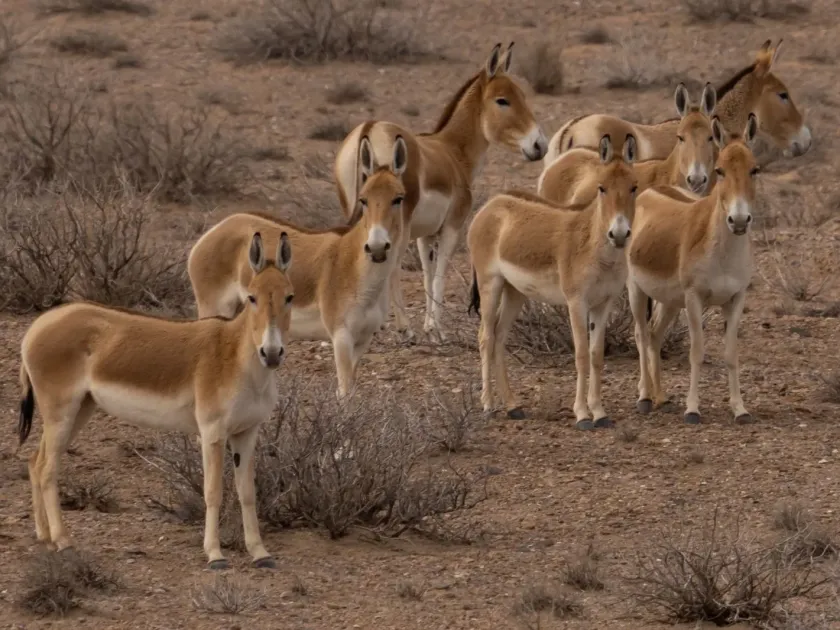
How to identify
The onager (lat. Equus hemionus) is a large equid species native to Central Asia, resembling a donkey in its general morphology but characterized by a slender body and a distinctive dark dorsal stripe.
These animals are highly social, typically moving in herds. Their presence near agricultural land is a significant concern for farmers due to the large amount of biomass consumed by a single herd.
Unlike conventional agricultural pests, the onager is a large herbivore. Its biological cycle is tied to arid environments, and it displays high adaptability in its movement patterns across landscapes.
Taxonomically, the onager belongs to the order Perissodactyla, family Equidae. Because of its conservation status, it is legally protected in most regions where it exists.
Onagers are powerful animals with great endurance, allowing them to traverse long distances between natural habitats and agricultural crops in search of high-quality forage.
What it damages
Onagers feed on a variety of crops, including cereals, legumes, and alfalfa. They often target fields during critical growth stages, which can lead to significant yield losses.
Feeding behavior involves both grazing and trampling, as the herd moves through the field, causing physical destruction to the crop canopy and reducing harvestable area.
Winter wheat fields are particularly vulnerable as they provide a green source of nutrition when wild forage is dry or scarce, leading to intensive grazing by onager herds.
Beyond crop loss, the constant trampling by heavy animals causes soil compaction, negatively affecting soil structure, drainage, and future nutrient uptake of the plants.
The economic impact can be severe in regions where onagers overlap with farming zones, often requiring localized protection strategies to mitigate losses.
When it appears
Activity is most pronounced during the summer months when heat leads to the desiccation of wild grasses, forcing herds to move closer to irrigated agricultural plots.
In autumn and winter, the emergence of winter crops draws herds toward farmland, as these plants provide essential nutrients required for the animals' seasonal maintenance.
Onagers are largely nocturnal or crepuscular, meaning they primarily raid fields at dawn, dusk, or during the night, making manual monitoring difficult for farm workers.
The influx of herds is often correlated with water availability. Areas near irrigation canals or stock ponds are at a higher risk of being targeted by nomadic groups of onagers.
Environmental fluctuations significantly influence their presence, with drought years showing higher incidences of crop damage compared to years with ample rainfall.
Signs of infestation
The presence of onagers is clearly marked by deep hoof prints on soft soil, which are easily distinguishable from smaller herbivores due to their size and shape.
Characteristic grazing patterns show crops bitten off close to the ground, with clean edges indicating the specialized dentition of an equid rather than the uneven tearing seen in other pests.
Wide, beaten paths through standing crops indicate the movement of the herd and provide a clear map of their activity within a field.
Accumulated dung deposits within or at the edges of the field are strong indicators that the animals have used the area as a feeding or resting site.
Unlike burrowing pests, onagers leave no excavated soil; their impact is restricted to the above-ground biomass and surface soil compaction, aiding in identification.
Control measures
Physical fencing is the most effective deterrent, though it must be robust enough to withstand the weight and behavior of a large equine animal.
Electric fencing, designed specifically for livestock, serves as a non-lethal method to keep herds away from protected crop areas during critical growth periods.
Visual and auditory repellents, such as strobe lights or automated noise-makers, can provide temporary relief but require periodic changes to prevent habituation.
Strategic planting, such as placing less palatable buffer crops around the perimeter of high-value fields, can help in managing the herd's interaction with the farm.
Given the onager's protected status, management must comply with wildlife regulations, prioritizing non-invasive and humane deterrence measures at all times.
Taxonomy
- Latin name
- Equus hemionus
- Family
- Equidae
- EPPO code
- EQUUHE
Discussion
No discussions yet — be the first.