
Pear leaf blister mite
Epitrimerus pyrimarginemtorquens
Description
How to identify
The pear leaf blister mite (Epitrimerus pyrimarginemtorquens) belongs to the Eriophyidae family, known as rust or gall mites. These are microscopic pests, measuring about 0.15-0.2 mm in length, making them invisible to the naked eye.
Physically, they possess a tapered, worm-like body and are typically creamy white or translucent in color. A defining characteristic of this family is the presence of only two pairs of legs, both attached to the front of the body.
These mites live primarily on the underside of leaves. They hibernate as adult females, seeking shelter under the scales of dormant buds during winter, which protects them from harsh weather and many chemical treatments.
Their life cycle is closely synchronized with the phenology of the pear tree. Several generations can occur throughout the growing season, leading to rapid population growth under favorable environmental conditions.
Dispersal is passive, mainly occurring via wind currents, movement of nursery stock, or accidental transport by tools and clothing. Their high reproductive rate poses a significant challenge in commercial orchard management.
What it damages
This mite is a specialized pest that exclusively attacks pear trees. By feeding on leaf tissue, the mites inject saliva containing enzymes that cause abnormal cell growth and necrosis in the leaves.
Damaged leaves suffer from reduced photosynthetic efficiency, leading to tree exhaustion. In young orchards or nurseries, this damage can severely stunt growth and compromise the development of the structural framework of the tree.
Affected trees often show signs of physiological stress, resulting in reduced cold tolerance and increased susceptibility to secondary infections. The disruption of nutrient storage in the wood negatively impacts fruit production for the following year.
Severe infestations can lead to premature leaf drop, which significantly weakens the tree. This loss of foliage reduces the tree's ability to store energy for the subsequent spring bloom.
In addition to physiological damage, the aesthetic impact on leaves can reduce the commercial value of nursery stock, often leading to total loss of affected plants in high-density production systems.
When it appears
The mites become active in early spring as temperatures rise and pear buds begin to swell. This is the period when females emerge from their wintering sites and move to the developing foliage.
Peak activity generally occurs in June and July. During this time, the weather is typically warm and humid, providing optimal conditions for the rapid multiplication of the mite population.
Summer heat can occasionally suppress their activity slightly, but they persist in protected areas like leaf folds and the margins along the central veins of the leaves.
As autumn approaches and temperatures drop, the mites migrate toward the buds to enter diapause. This migration continues until the leaves fall, marking the beginning of the overwintering phase.
Integrated pest management protocols require monitoring from the green-tip stage through mid-summer to prevent the population from reaching economic threshold levels.
Signs of infestation
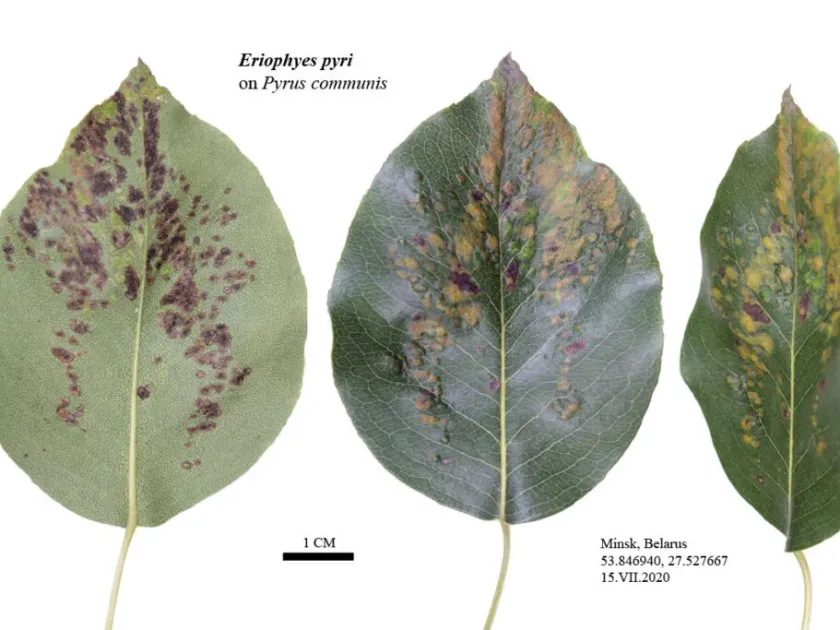
The most visible sign of infestation is the curling and distortion of the leaf margins. Leaves often fold upward or downward, forming irregular shapes rather than their typical flat, healthy structure.
A brownish or russet-colored discoloration often appears on the underside of the leaves. This is the result of damaged tissue and the mite's impact on the leaf's outer layer.
- Severe curling and deformation of leaf edges.
- Russeting or necrotic spots on the leaf surface.
- Stunted shoot growth in younger trees.
- Chlorotic patches that may resemble viral symptoms.
- Premature yellowing and leaf shedding.
Using a 10x magnification lens, one can spot the mites along the leaf veins. Unlike other spider mites, this species does not produce silk webbing, which is a key diagnostic feature.
Because the curling leaves provide shelter, the mites are often hidden from casual inspection. Secondary fungal infections may also establish in the damaged tissues, confusing the diagnosis.
Control measures
Successful management requires an integrated approach. The timing of chemical applications is critical, as the curling leaves effectively protect the mites from contact insecticides.
Cultural practices are essential; gathering and destroying fallen leaves reduces the overwintering population. Proper pruning also helps by removing heavily infested wood and improving spray penetration.
Specific acaricides are used to control the population. The most effective window for chemical treatment is just before flowering and immediately after petal fall, when the mites are most exposed.
Resistance management is vital. Growers should alternate between different chemical classes of pesticides to ensure long-term efficacy. Adding surfactants to spray mixtures helps improve coverage on the leaf surface.
For small-scale growers or highly infested nursery blocks, pruning out the most severely affected branches and disinfecting tools is a recommended method to curb the spread of the colony.
Taxonomy
- Latin name
- Epitrimerus pyrimarginemtorquens
- Order
- Mites
- Family
- Eriophyidae
- EPPO code
- EPITPY
Discussion
No discussions yet — be the first.