
Entylia carinata
Entylia carinata
Description
How to identify
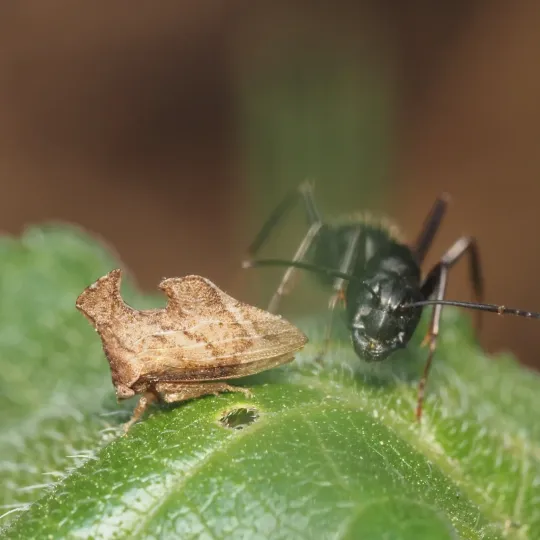
Entylia carinata, commonly known as a type of treehopper, belongs to the family Membracidae in the order Hemiptera. The adult is distinguished by a prominent, hump-like outgrowth on its pronotum, which gives the insect its characteristic appearance.
The coloration of the adults ranges from light brown to nearly black, providing effective camouflage against tree bark or stems. The body is sturdy and compact, equipped with well-developed wings.
Nymphs differ significantly from adults, possessing soft bodies often covered in small spines or projections and lacking wings. They are relatively sedentary and typically congregate on plant stems.
A notable feature of this species is its symbiotic relationship with ants. The treehoppers excrete honeydew, which attracts ants that, in turn, protect the colony from potential predators.
Adults typically measure between 5 and 7 mm in length. They can be identified by the sharp, keeled crest that extends along the entire dorsal side of the thorax.
What it damages
Entylia carinata is a polyphagous pest, primarily damaging members of the Asteraceae and Fabaceae families. It poses a significant threat to crops like sunflowers, thistles, and various ornamental plants.
The insect feeds exclusively on plant sap, using its piercing-sucking mouthparts to penetrate the soft tissues of stems, leaves, and petioles.
During mass outbreaks, these pests can severely drain the vitality of plants, leading to stunted growth, deformed shoots, and a measurable decrease in overall agricultural yield.
As they feed, treehoppers can act as vectors for phytopathogenic viruses, making their indirect damage to crops often more severe than the mechanical injury to the plant tissue itself.
The honeydew excreted by the insects settles on leaf surfaces, fostering the growth of sooty mold, which inhibits photosynthesis and further stresses the infested plant.
When it appears
The lifecycle of Entylia carinata is closely tied to local temperature conditions. In spring, as stable warm weather arrives, overwintering adults emerge to seek out suitable host plants.
Females lay their eggs directly into the plant tissue, usually inserting them into leaf veins or the tender stems of young shoots using their ovipositors.
Nymphs undergo several instars during the summer, feeding actively throughout the season. Depending on the geographical region, the species may produce one to two generations per year.
The highest population density is typically observed in mid-summer, when colonies consisting of nymphs of various ages and adult insects can be found on a single plant.
As autumn approaches, adults seek overwintering sites, often hiding in plant debris, fallen leaves, or the upper soil layer, where they can survive colder temperatures.
Signs of infestation
The first indicator of an infestation is often the presence of "ant trails" and ants actively traveling along the stem to visit the treehopper colony.
Sticky honeydew residue on leaves and stems is a key sign, which eventually turns black due to the growth of sooty mold, giving the plant a distressed appearance.
Affected plant areas often show chlorosis, premature yellowing, curling, and edge necrosis due to the persistent loss of vital plant fluids.
Small lesions or bumps may form at the sites where the insects have pierced the tissue, caused by a chemical reaction to the insect's saliva.
A visual inspection of the underside of leaves will reveal clusters of nymphs, which may attempt to move away or press tightly against the stem when disturbed.
Control measures
The primary control method is cultural management, specifically the removal of weed hosts, particularly thistles and other Asteraceae that serve as reservoirs for the pest.
Regular monitoring of crops from the early growth phase is highly recommended to identify the onset of colonization and allow for timely localized intervention.
Biological control methods, such as the use of natural predators like lady beetles and lacewings or entomopathogenic fungi, can be effective in gardens or organic farming settings.
In cases of severe infestation on large-scale crops, systemic insecticides can be applied; these travel through the plant's vascular system to kill sucking insects during their feeding process.
- Regular weeding and field sanitation
- Targeted application of insecticides when damage thresholds are met
- Conservation of natural enemies like ladybirds and lacewings
Taxonomy
- Latin name
- Entylia carinata
- Order
- Hemiptera (bugs, aphids, leafhoppers)
- Family
- Membracidae
- EPPO code
- ENTICA
Discussion
No discussions yet — be the first.