
Fungus beetle
Enicmus fungicola
Description
How to identify
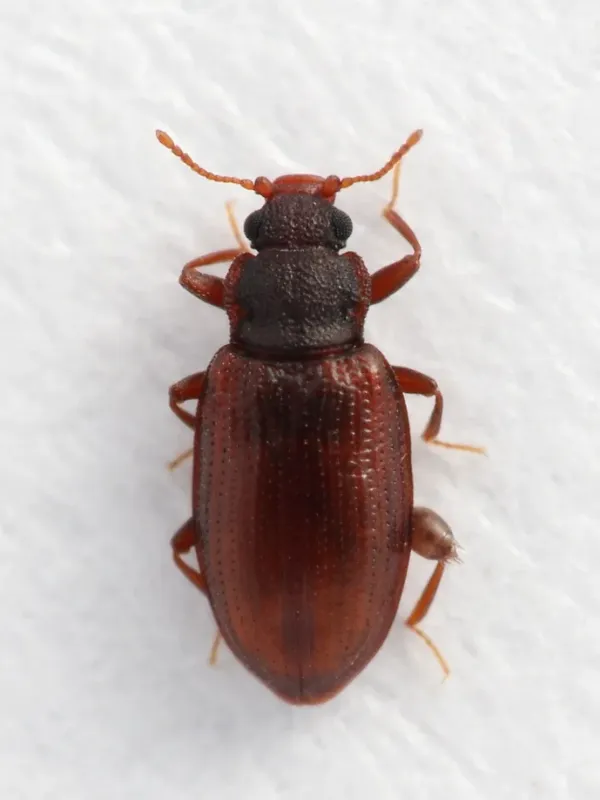
The fungus beetle (Enicmus fungicola) belongs to the Latridiidae family, order Coleoptera. These are very small insects, typically measuring between 1.5 and 2.5 mm in length.
Adult beetles are usually dark brown in color. Their bodies are elongated and oval, featuring distinct punctured striae on the elytra, which is a key diagnostic feature.
The larvae are pale and highly mobile. They possess mouthparts specifically adapted for grazing on mold spores and hyphae found on damp organic materials.
The life cycle of this beetle is highly dependent on environmental conditions, particularly the presence of moisture and fungal growth in storage facilities.
Identifying this species in a warehouse requires the use of magnification, as they are often hidden within cracks or deep inside the grain mass.
What it damages
The fungus beetle is not a primary grain pest, as it cannot feed on healthy, dry kernels. It exclusively infests products already affected by mold fungi.
It is commonly found in damp grain elevators, flour mills, and storage warehouses where humidity levels have risen above the safety thresholds.
By consuming fungal spores, these beetles can inadvertently spread mold throughout the stored product, accelerating the decay process of the entire batch.
Infested grain becomes spoiled, acquires a moldy smell, and loses its commercial value, making it unsuitable for food production or animal feed.
The indirect damage is significant because the presence of these beetles is a reliable indicator that the grain is heating up and undergoing microbial decomposition.
Signs of infestation
The primary sign of an infestation is the visual detection of adult beetles on the surface of stored grain or inside storage equipment.
Visible patches of mold on grain or processed food products act as a strong warning sign of potential colonization by this beetle species.
A persistent musty or sour odor in the storage facility is often an indication that the fungus beetle population has reached a critical density.
Finding larval exuviae (shed skins) and insect debris in grain samples confirms active breeding within the storage container.
The use of standard insect monitoring traps placed in corners or near storage bins can help detect the presence of the beetle at early stages.
Control measures
The most effective strategy is the rigorous control of grain moisture content. Keeping grain dry inhibits mold growth, effectively starving the beetle population.
Regular sanitation of warehouses, including the removal of dust, spillages, and crop residues, is essential to eliminate the habitats where these beetles breed.
If an infestation occurs, chemical control via fumigation with phosphine-based products is the standard procedure to eradicate all life stages of the insect.
Improving the ventilation and climate control within storage facilities prevents condensation and the formation of localized damp spots.
Prioritize cleaning grain to remove broken kernels and foreign material, as these components are the most susceptible to mold and, subsequently, to beetle attacks.
Taxonomy
- Latin name
- Enicmus fungicola
- Order
- Coleoptera (beetles)
- Family
- Latridiidae
- EPPO code
- ENIMFU
Discussion
No discussions yet — be the first.