
Enicmus brevicornis
Enicmus brevicornis
Description
How to identify
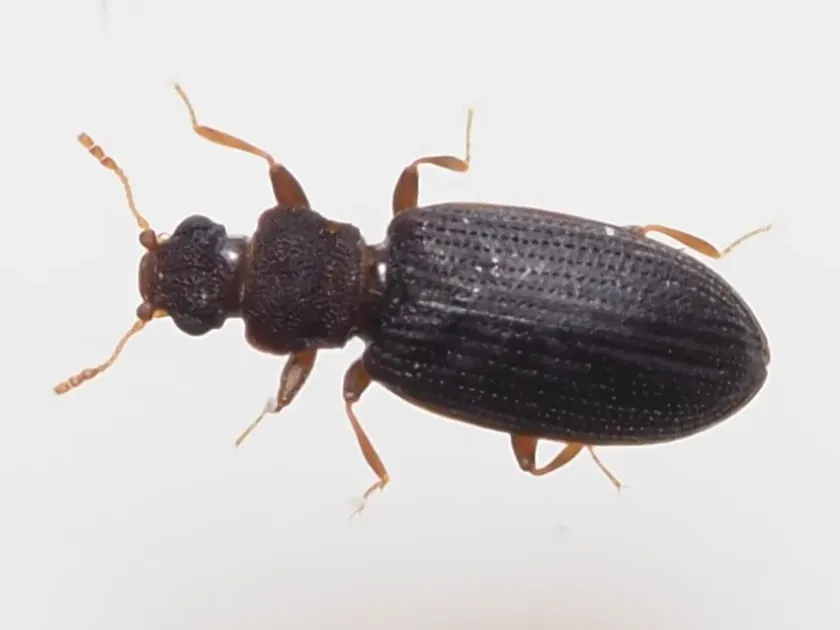
Enicmus brevicornis is a small beetle belonging to the family Latridiidae, commonly known as minute brown scavenger beetles. These insects are typically 1.5 to 2.5 mm in length.
Their body shape is oval, with a reddish-brown to dark brown coloration. A distinguishing feature is the puncturation pattern on the elytra, which requires magnification to observe accurately.
The common name reflects their short antennae, which end in a distinct club. As part of the Latridiidae family, they are ecologically linked to environments where fungal growth is prevalent.
The larvae of this species are tiny and worm-like, often overlooked during inspections. They are specialists in grazing on fungal mycelium and spores in humid storage environments.
These beetles are not typically found in perfectly dry, high-quality grain. Their presence is a biological indicator of moisture ingress and subsequent mold development within the storage facility.
What it damages
Enicmus brevicornis is classified as a secondary pest. They do not consume the grain kernels themselves, but thrive on the mold that develops on damp or damaged agricultural products.
Cereals, oilseeds, and processed feed are susceptible to infestation if moisture content exceeds safe levels. The damage is primarily caused by the contamination of the product with beetle remains and the spread of fungal spores.
The presence of these beetles indicates a failure in storage management, specifically regarding humidity control and ventilation. Infested stock often develops a distinct, unpleasant musty odor.
While the economic impact is usually less severe than primary pests, their activity promotes localized heating of the grain mass, which can further degrade the storage conditions.
Marketability of the grain is significantly reduced, as the infestation makes the product unsuitable for high-quality food or feed production without expensive cleaning and remediation.
When it appears
Within climate-controlled or well-insulated warehouses, this beetle can remain active throughout the entire year. They do not require a dormant season if conditions remain stable.
Population peaks are typically observed during the autumn and winter months, when temperature differences inside warehouses lead to condensation on the surface of stored bulk materials.
The life cycle is highly dependent on humidity. In dry conditions, the development of the population slows significantly, as the food source (mold) ceases to grow.
During the warmer seasons, beetles can migrate from external natural habitats, such as wood piles or decaying vegetation, into storage facilities through open doors or vents.
Depending on ambient conditions, a generation can complete its cycle in as little as a few weeks, allowing for rapid expansion in poorly managed storage areas.
Signs of infestation
The primary indicator of an infestation is a characteristic musty or moldy smell emanating from the grain piles or stored sacks.
Visual confirmation involves inspecting the warehouse structure, especially crevices, wooden pallets, and corners where moisture accumulates. The beetles are often found congregating near moldy patches.
Fine dust accumulation, consisting of frass and larval skins, on the surface of the products or packaging indicates active feeding sites.
Monitoring using grain probes and sieve analysis is necessary to detect low-level infestations before the population reaches critical numbers.
Stagnant or caked patches of grain within a bulk pile are prime locations for Enicmus brevicornis and should be sampled immediately for entomological assessment.
Control measures
The cornerstone of control is moisture management. Drying grain to a moisture content below 14% effectively removes the fungal food source, causing the beetle population to collapse.
Sanitation is vital; regular cleaning of the warehouse to remove dust, spilled grain, and debris prevents the establishment of long-term breeding reservoirs.
Applying residual insecticides to warehouse surfaces before loading new grain provides a protective barrier against invading beetles.
- Maintain low humidity levels using mechanical ventilation.
- Seal warehouse entrances to prevent the entry of migratory beetles.
- Perform routine temperature monitoring to identify hotspots.
If an infestation occurs, affected areas must be isolated, the product must be re-dried or cleaned, and professional fumigation may be required in severe cases to eliminate the population.
Taxonomy
- Latin name
- Enicmus brevicornis
- Order
- Coleoptera (beetles)
- Family
- Latridiidae
- EPPO code
- ENIMBR
Discussion
No discussions yet — be the first.