
Plaster beetles
Enicmus
Description
How to identify
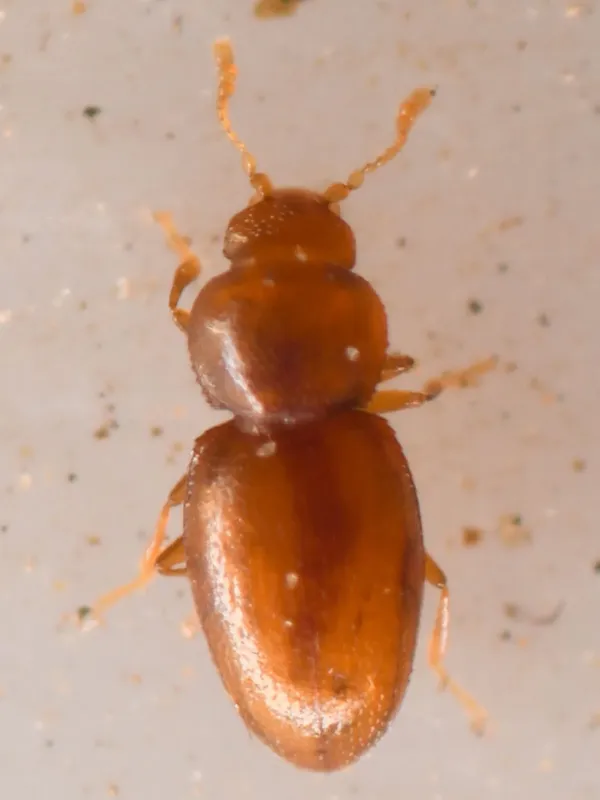
Plaster beetles, specifically members of the genus Enicmus, belong to the Latridiidae family, often referred to as mold beetles. Adult beetles are minute, typically measuring between 1.5 and 3 mm in length, with a distinctively sculpted pronotum.
Their coloration ranges from reddish-brown to almost black, providing effective camouflage in organic debris. The elytra often feature longitudinal striae, and their overall body structure is highly adapted to navigating narrow crevices in building materials.
The larvae are small, light-colored, and elongated with well-developed chewing mouthparts. They are rarely seen as they reside deep within the substrate, feeding on mold and fungal spores found on damp surfaces.
Adults possess functional wings, allowing them to disperse rapidly throughout storage facilities or warehouses. They are highly sensitive to environmental changes and are known to enter diapause under unfavorable conditions.
Systematically, they are classified under the order Coleoptera. Their presence is a critical diagnostic indicator of moisture problems in buildings and stored goods.
What it damages
The primary food source for Enicmus species is mold and fungal spores. Unlike primary pests, they do not typically feed on dry, healthy grain or intact agricultural products, but rather exploit the by-products of decay.
They infest stored products such as flour, dried fruit, and feeds that have been subjected to moisture or self-heating. Once mold growth begins, these beetles congregate in large numbers to consume the developing fungus.
Damage is primarily caused by contamination. Their fecal matter, larval skins, and adult remains impart a foul, musty odor to the product, rendering it unfit for consumption or processing according to health standards.
By grazing on mold, they may inadvertently spread fungal spores to non-infested parts of the storage area, effectively accelerating the spoilage process. This biological interaction can lead to significant economic losses for grain facilities.
In addition to food contamination, their presence can trigger allergic reactions in workers due to the inhalation of airborne mold spores and insect debris prevalent in infested environments.
When it appears
Activity levels are directly correlated with humidity and temperature. Plaster beetles thrive in warm, humid conditions where mold growth is abundant, with an optimal temperature range of 20–25°C.
In climate-controlled or poorly ventilated warehouses, they can breed year-round. If relative humidity exceeds 60%, the lifecycle can be completed rapidly, resulting in overlapping generations.
During cold seasons or periods of desiccation, their activity decreases significantly. However, the beetles remain alive in protected pockets of the storage structure, ready to emerge once conditions improve.
The development time from egg to adult is highly variable based on the moisture content of the substrate. Rapid colonization often follows water leaks, high-humidity weather events, or inadequate drying of harvested crops.
They often migrate from structural wall voids or damp building materials into the commodity storage area as soon as the moisture content of the product provides a suitable niche for their survival.
Signs of infestation
Identification often begins with the visual detection of tiny, dark beetles moving on walls, pallets, or the surface of stored grain. Due to their small size, a magnifying glass or sticky trap monitoring is required for early detection.
A musty or earthy odor is a classic indicator of a mold beetle infestation. This smell originates from the degradation of organic matter and the presence of fungal colonies that the beetles are currently consuming.
In infested flour or grain, one might find clumped or caked material. These clumps are often held together by dense fungal mycelium and the waste products produced by the beetle population.
Small dust-like particles around the base of bags or in storage corners are often signs of feeding activity. These particulates consist of chewed organic matter and insect waste fragments.
Regular inspection of damp areas, such as behind peeling paint, wall voids, or near roof leaks, is essential to pinpoint the source of an infestation before it spreads to the inventory.
Control measures
The most effective strategy for controlling plaster beetles is moisture management. Products must be dried to appropriate moisture levels and stored in facilities with good ventilation to inhibit mold growth.
Good warehouse hygiene is vital. This includes regular cleaning of spilled grain, dust, and debris. Any cracks, crevices, or water leaks must be sealed to remove potential breeding sites for the beetles.
If an infestation is already established, fumigation may be necessary for large-scale storage units to reach the beetles in deep crevices. Targeted insecticidal treatments may be used for surfaces and voids.
- Maintain structural integrity to prevent water leaks.
- Utilize high-capacity aeration systems to cool grain.
- Monitor humidity levels in all storage areas.
- Isolate infested lots to prevent the spread of mold and beetles.
Prevention involves consistent monitoring of the warehouse environment. Since plaster beetles are often introduced via packaging or incoming damp loads, inspecting supplies before they enter the main storage area is a critical preventative measure.
Taxonomy
- Latin name
- Enicmus
- Order
- Coleoptera (beetles)
- Family
- Latridiidae
- EPPO code
- ENIMSP
Discussion
No discussions yet — be the first.