
Two-marked treehopper
Enchenopa binotata
Description
How to identify
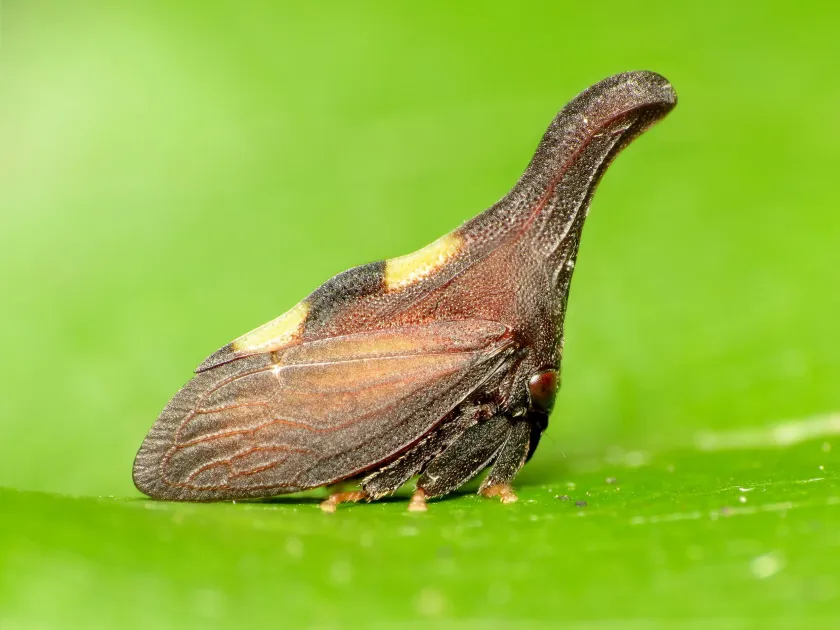
The Two-marked treehopper, scientifically known as Enchenopa binotata, belongs to the family Membracidae. It is a small insect characterized by a distinct horn-like projection on its pronotum.
Adults are typically black or dark brown in color. They are easily identified by two prominent yellowish or white stripes running along the sides of their dorsal structure.
Measuring between 5 and 7 mm in length, these insects possess powerful hind legs, allowing them to jump rapidly if they perceive a potential threat to their safety.
Nymphs of this species are often found covered in a white, waxy secretion. This substance acts as a protective shield against predators and desiccation during their development.
They are social insects that often congregate in colonies. These colonies frequently attract ants, which feed on the honeydew produced by the nymphs, providing additional security.
What it damages
Both nymphs and adults cause damage by using their piercing-sucking mouthparts to feed on the sap from young shoots, leaves, and stems of host plants.
They target a wide variety of deciduous trees and shrubs, including walnut, viburnum, maple, oak, and grapevines, often causing significant stress to young saplings.
Females inflict mechanical damage during oviposition by cutting deep slits into the bark of twigs. This disrupts the vascular system and slows down sap flow.
Persistent feeding leads to distorted, stunted, and curled foliage and shoots, significantly reducing the aesthetic value and fruit production of the infested plants.
The wounds created during egg-laying provide entry points for pathogens, potentially leading to fungal infections, necrotic tissues, or the death of individual branches.
When it appears
The Two-marked treehopper follows a univoltine lifecycle, meaning it completes only one generation per year, with eggs overwintering within the plant tissue.
In spring, as trees begin to break dormancy and buds swell, the nymphs emerge from the eggs and immediately begin feeding on the nutrient-rich sap of the new growth.
The nymphal stage lasts for several weeks, passing through multiple instars before transforming into adult insects by early to mid-summer.
Adults remain active throughout the summer months, mating and expanding their presence across the host plant and moving to nearby trees if necessary.
As autumn approaches, adult activity gradually decreases, and females focus on selecting suitable young branches to deposit their eggs for the following year.
Signs of infestation
One of the most reliable signs of infestation is the presence of small, characteristic scars or slits on the bark of one-year-old twigs.
White, fluffy waxy patches on the stems or leaf axils in late spring are clear indicators of colonial nymphal activity on the host plant.
The presence of honeydew—a sticky, sweet substance—on leaves often encourages the growth of sooty mold, which appears as a black, powdery coating.
Stunted growth or wilting of the terminals, despite adequate watering, suggests that the treehopper colony is extracting significant amounts of plant sap.
- Deformed or curled young shoots.
- Presence of ants patrolling branches.
- Black sooty mold on the foliage surface.
Control measures
Sanitation is a primary control measure; pruning and destroying heavily infested branches during the winter or early spring can significantly reduce the overwintering egg population.
Systemic insecticides are effective when applied during the nymphal stage, as they are absorbed by the plant and kill the insects as they feed on the sap.
Monitoring is crucial; checking the trees in early spring allows for targeted applications before the population spreads and causes widespread damage.
Supporting biological control agents, such as lady beetles, lacewings, and parasitic wasps, can help manage treehopper numbers in a balanced ecosystem.
Controlling ant populations on host plants is essential, as ants deter natural predators and parasites, effectively shielding the treehopper colonies from natural control.
Taxonomy
- Latin name
- Enchenopa binotata
- Order
- Hemiptera (bugs, aphids, leafhoppers)
- Family
- Membracidae
- EPPO code
- ENCHBI
Discussion
No discussions yet — be the first.