
Enchenopa treehopper
Enchenopa
Description
How to identify
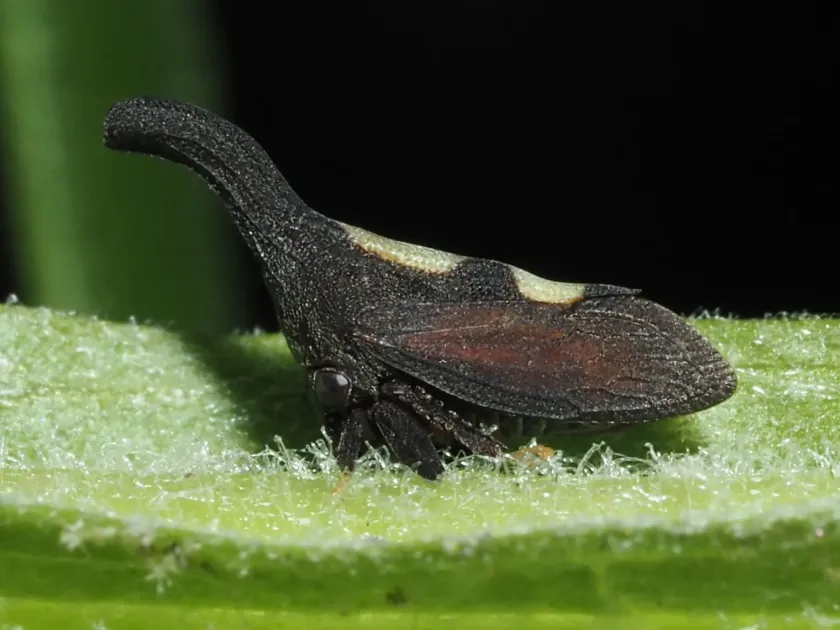
The Enchenopa treehopper belongs to the family Membracidae, an order of Hemiptera. They are easily identified by the unique shape of their pronotum, which often extends backward to form a horn-like protrusion, earning them the nickname 'thorn bugs'.
Adults typically measure between 5 and 10 millimeters in length. Their coloration is usually cryptic, ranging from dark brown to black, helping them blend seamlessly with the bark of their host trees.
Nymphs differ from adults by being wingless and having various spines or tubercles on their bodies. They are relatively sedentary, usually clustering on succulent stems where they feed on plant sap.
Females possess a specialized ovipositor, an organ used to cut deep slits into the bark of host plants, where they deposit their eggs. This behavior is a key diagnostic feature of their presence.
These insects often maintain a mutualistic relationship with ants, which protect the treehoppers from predators in exchange for honeydew, the sugary byproduct of their feeding process.
What it damages
Enchenopa species affect a wide variety of woody plants and shrubs. In agricultural settings, they are particularly troublesome in nurseries where they can weaken young saplings.
The primary damage occurs during egg-laying, as the female slices into the plant tissue, which creates an entry point for secondary infections, fungi, and bacterial pathogens.
Continuous sap-sucking by large colonies of nymphs and adults leads to nutrient depletion, resulting in stunted growth, yellowing leaves, and reduced vigor in host plants.
Heavy infestations can cause terminal shoot dieback and deformed branches, which significantly affects the commercial quality of ornamental trees and fruit-bearing saplings.
The physiological stress caused by these insects often makes trees more susceptible to environmental factors like drought and extreme temperature fluctuations.
When it appears
The life cycle of the Enchenopa treehopper is closely synchronized with the growth of its host plants. Eggs overwinter safely inside the plant bark until spring.
Nymphs emerge in early spring, coinciding with bud break. They spend several weeks feeding on the tender new growth, making this the most active period for damage development.
Adults typically emerge mid-summer. Unlike the nymphs, adults are mobile and highly capable of flying, which facilitates the spread of the population across larger orchard or nursery areas.
Late summer and autumn are dedicated to mating and egg-laying. Females are extremely active during this time, selecting optimal spots on healthy stems to ensure the survival of the next generation.
The cycle concludes with the onset of winter, during which the dormant eggs are protected within the thick, woody tissue of the plant host.
Signs of infestation
Characteristic scars on the bark, appearing as a series of slits or necrotic patches, are the most reliable sign that an Enchenopa colony has been active in the area.
Sticky honeydew secretions on leaves or branches near the base of the plant often indicate the presence of feeding nymphs, as these excretions attract other insects like ants.
Visible curling, wilting, or bending of young terminal shoots can be a direct result of feeding, as the disruption of vascular tissues impairs normal shoot development.
Excessive ant activity on specific branches or stems is a strong indicator of treehopper presence, as they are drawn to the colonies to harvest the sweet honeydew.
Premature leaf drop or localized chlorosis on young branches suggests that the plant's nutritional supply has been severely compromised by sap-feeding insects.
Control measures
Cultural control is the first line of defense; regular pruning of infested shoots during winter effectively reduces the overwintering population before eggs can hatch in spring.
In cases of severe infestation, systemic insecticides applied during the early nymphal stages provide the best results, as the insects are most vulnerable before reaching maturity.
Encouraging the presence of natural predators, such as ladybugs, lacewings, and parasitic wasps, can help keep treehopper populations in check without the need for chemical intervention.
Improving general plant health through proper fertilization and irrigation helps trees heal faster from the mechanical damage caused by oviposition and sap-feeding.
- Remove and destroy infested cuttings during the dormant season.
- Monitor for early signs of egg-laying scars in late summer.
- Apply horticultural oils if necessary to suppress early-season populations.
- Maintain proper plant spacing to prevent easy movement between hosts.
Taxonomy
- Latin name
- Enchenopa
- Order
- Hemiptera (bugs, aphids, leafhoppers)
- Family
- Membracidae
- EPPO code
- ENCHSP
Discussion
No discussions yet — be the first.