
Encarsia fasciata
Encarsia fasciata
Description
How to identify
Encarsia fasciata belongs to the order Hymenoptera, family Aphelinidae. This tiny insect is often confused with beneficial entomophages due to its classification within the genus Encarsia.
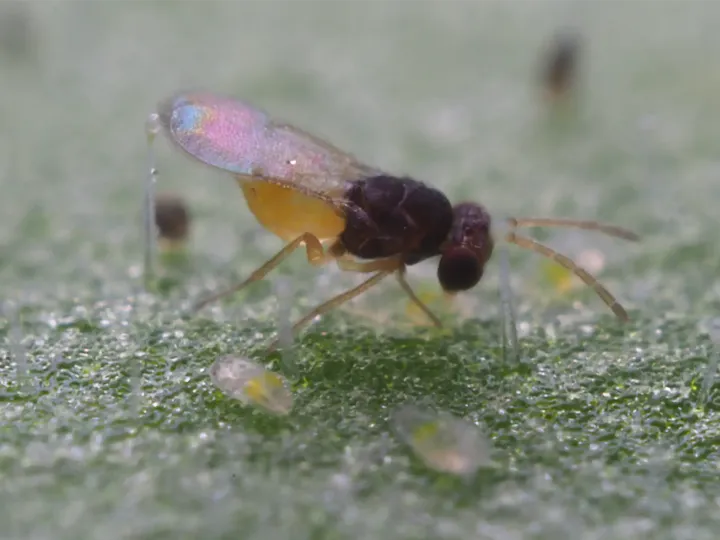
Physically, the adult specimen is a minute parasitic wasp with characteristic dark stripes on its abdomen, which is reflected in the specific epithet fasciata. The body length of the adult is less than one millimeter.
The life cycle of this insect is closely linked to whiteflies. Unlike some specialized species, this organism demonstrates high adaptability to various microclimatic conditions in protected ground.
For accurate identification in laboratory conditions, microscopy is required, as the morphological features of the species are similar to other members of the genus used in biological control programs.
Studying this species is essential for agronomists, as when the population balance in agroecosystems is disrupted, this species may show unwanted activity towards beneficial insects.
What it damages
The primary food source for Encarsia larvae are whitefly nymphs. However, under certain conditions, the activity of this species can reduce the efficiency of biological control programs.
The pest affects a wide range of protected ground crops, including tomatoes, cucumbers, eggplants, and certain types of ornamental flowers. Damage occurs during the larval development stage.
The harm manifests in the displacement of other, more effective whitefly parasites, which leads to uncontrolled growth of the pest population and subsequent loss of commercial product quality.
Plants damaged by whiteflies when parasite control is weakened suffer from colonization by sooty molds, which develop on the insects' secretions.
The result of the complex pest activity is a significant reduction in the photosynthetic activity of leaves and, consequently, a decrease in crop yield.
Signs of infestation
The first sign of infestation is the presence of modified whitefly puparia on the underside of leaf blades. They acquire an atypical shade, indicating that the parasite has completed its development cycle inside the host.
There is an appearance of sticky residue (honeydew) on the leaf surface, which subsequently turns black due to fungal infections accompanying the whitefly infestation.
Upon visual inspection of the plants, increased activity of small flying insects can be observed, even when preventive measures against the main pest are in place.
A decrease in the efficacy of commercial strains of beneficial entomophages is often an indirect signal that a local parasite species is dominating the greenhouse.
Stunted growth of shoots and yellowing of the lower leaf tiers also indicate a critical level of pest infestation that requires immediate intervention.
Control measures
The foundation of protection is population monitoring using yellow sticky traps, which allow for the assessment of insect species composition in the greenhouse complex.
Strict isolation of production facilities and disinfection of equipment are recommended to prevent the migration of insects between sectors.
The application of chemical protection agents must be highly selective to avoid destroying the beneficial entomofauna if it is being used for whitefly control.
Biological control may include the use of specific pheromone traps to disrupt mating and reduce the reproduction rates of the pest.
- Regular removal of weeds around the perimeter of greenhouses.
- Control of humidity and temperature levels to create unfavorable conditions for pest development.
- Engagement of specialist entomologists for accurate species identification.
Taxonomy
- Latin name
- Encarsia fasciata
- Order
- Hymenoptera
- Family
- Aphelinidae
- EPPO code
- ENCAFA
Discussion
No discussions yet — be the first.