
Aphelinus abdominalis
Aphelinus abdominalis
Description
How to identify
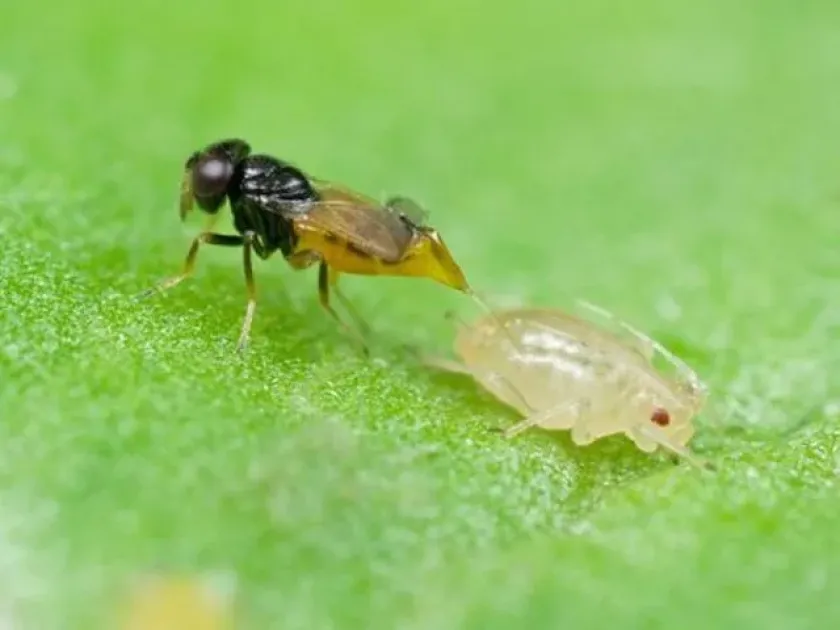
Aphelinus abdominalis is a small parasitic wasp belonging to the Aphelinidae family. Adult individuals measure approximately 2–3 mm in length and are easily recognized by their distinct yellow abdomen, which sets them apart from other similar wasp species.
The females of this species act as highly specialized parasitoids that actively hunt for aphid colonies to lay their eggs. They possess excellent searching capabilities, allowing them to locate even sparse populations of pests on leaves.
The insect's life cycle occurs entirely within the host body. The larva develops internally, feeding on the aphid’s tissues without damaging vital organs until the final stage, ensuring the host remains alive for as long as possible.
In the final stage of development, the parasite transforms the dead aphid into a hard, dark brown or black «mummy». This mummification process is the most reliable diagnostic sign of the beneficial insect's presence.
Observing these mummies is essential for assessing the success of a biological control program, and growers should avoid disturbing them to allow for the next generation of beneficial wasps to emerge.
What it damages
Technically, this species is not a pest; it is a beneficial entomophagous insect. It serves as a specialized biological agent that targets various aphid species (Aphididae) which cause significant damage to agricultural crops.
Among the primary hosts for this wasp are major greenhouse pests, including the potato aphid, the glasshouse aphid, and the melon aphid. By parasitizing these insects, the wasp naturally reduces their population density.
The act of parasitism not only kills the aphid but also prevents further feeding damage and the spread of plant viruses often transmitted by aphids. This dual action makes it a critical tool for plant health.
The wasp is highly effective in greenhouses growing tomatoes, cucumbers, peppers, and various ornamental plants. It provides a sustainable alternative to chemical pesticides, contributing to overall crop vigor.
By integrating Aphelinus abdominalis into a pest management strategy, growers can significantly reduce the risk of infestation while maintaining the ecological balance of the greenhouse environment.
When it appears
The biological activity of Aphelinus abdominalis is heavily dependent on temperature and light duration. It performs best under stable greenhouse conditions with temperatures typically ranging between 20–25 degrees Celsius.
Under optimal conditions, the wasp's life cycle lasts approximately two to three weeks, enabling a rapid increase in the population whenever there is a sufficient supply of aphid hosts available.
The application season generally begins as soon as the first aphids are detected in early spring. Early releases are crucial to prevent the exponential growth of aphid colonies during the initial growth stages of the crop.
In summer, when temperatures can soar, the efficiency of the wasp might temporarily decrease, requiring attention to humidity levels. A consistent microclimate is essential for maintaining high reproductive rates.
When planning release schedules, growers must account for potential temperature fluctuations, as they can significantly impact the emergence rates of adults and the overall developmental speed of the larvae.
Signs of infestation
The primary sign of successful infestation by Aphelinus abdominalis is the presence of black or dark brown aphid mummies on the foliage. These mummies are immobile and remain firmly attached to the plant surface.
With the use of a hand lens, one can observe small, perfectly round exit holes on the dorsal side of the mummies. These holes indicate that an adult wasp has successfully emerged to continue its hunting cycle.
A noticeable decline in the number of live aphids within a colony, coupled with an increasing number of black mummies, confirms that the beneficial wasps are effectively controlling the pest population.
Adult wasps can often be observed flying slowly among the leaves as they search for new hosts. They are generally timid and will move to adjacent plants when disturbed by human activity in the greenhouse.
- Presence of black, inflated aphid mummies on leaves.
- Visible round exit holes on the surface of the mummies.
- A significant reduction in live aphid numbers without chemical intervention.
- Observation of small, dark, winged wasps flying near the crop.
Control measures
To preserve and maximize the population of Aphelinus abdominalis, it is imperative to avoid the use of broad-spectrum insecticides. Even a single application can wipe out the beneficial insect population.
If intervention is necessary for other pests or diseases, growers should select highly selective, biological-friendly products that do not harm parasitic Hymenoptera.
Optimizing the greenhouse microclimate is vital for success. Maintaining a temperature range of 20–25 degrees Celsius and humidity levels around 60–70% ensures maximum fertility and survival rates for the females.
In cases of high aphid density, frequent releases of the parasitoid over several weeks are recommended to sustain the parasitism rate and quickly regain control over the pest outbreak.
Monitoring using yellow sticky traps is a standard practice to keep track of wasp activity and ensure that the biological control program remains effective throughout the entire production cycle.
Taxonomy
- Latin name
- Aphelinus abdominalis
- Order
- Hymenoptera
- Family
- Aphelinidae
- EPPO code
- APHEAB
Discussion
No discussions yet — be the first.